
Entry
Reader's guide
Entries A-Z
Subject index
Apis
In Ancient Egypt, the Apis bull was the calf of a cow that was never able to have another calf. It was a calf with distinctive features that made it remarkable and unique. For example, the apis bull was black with a white diamond on its forehead, an image of an eagle on its back, two white hairs on its tail, and a scarab beetle mark under its tongue. Such a bull had to be special in the eyes of the ancient Egyptians. They thought that a flash of lightning had to strike the cow in such a way that the cow conceived a calf with the distinctive marks. This was enough for them to see this calf as a mark of something uniquely sacred. It had been sent from heaven by the deity to interact on Earth with humans.
Nothing persuaded the Egyptians that this was a coincidence; everything suggested to them that this was a divine plan, and they articulated the nature of the bull as a part of their theology. Like the Mnevis and the Buchis bulls, the Apis bull was an Earthly appearance of god. Throughout Kemet's history, there had been animals that had interceded between humans and the deities; there had even been animal representations in stone, wood, and metal of deities, but this was different. Here in the living flesh was an animal that was the incarnate of a god, living and acting like a bull among humans, but being himself divine. This idea would not be seen again until it was seen in human form with Jesus, who was considered flesh that became god. This entry looks at the origins of Apis worship, the major festival, and the priestly process of finding new bulls to take the place of Apis.
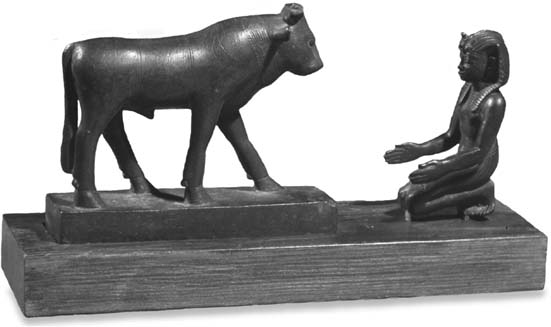
Figure. Bronze statuette group of the king before the Apis bull. From Egypt. Late Period, after 600 BC. The Apis bull was sacred to the god Ptah of Memphis. Only one Apis bull existed at a time, unlike other sacred animals.
Origin of the Idea
The Apis bull concept may have originated in Nubia. We know that it was worshipped in the Nile Valley long before it became associated with a particular deity. However, in Egypt, the Apis bull was Ausar on the Earth in full manifestation. Ausar was worshipped as the god of the Dead and resurrection at the end of the Old Kingdom. By then, Apis had been worshipped in Nubia and Egypt since at least the first dynasty. Some authors think that the Apis bull might be predynastic, a position that seems quite probable given the data regarding its presence at the first dynasty. Later, as Mnevis was Ra-Atum, so Buchis was Ra, and Apis the resurrected Ausar. These three bulls selected for their special markings and physical characteristics were gods on the Earth.
When the Apis died, he was mourned, ritualized, mummified, and buried with the same pomp and pageantry that one associated with the death and burial of a per-aa. Plutarch claims that the Apis bull was worshipped because the people believed him to be Ausar. This black bull, the mighty bull, the Great Black One, was Apis-Ausar, the soul of Ausar. Sacrifices to the Apis bull had to be made with oxen that were of uniform brown or white color; they could have no blemish on their hides. The Great Black One had to have clean, unblemished animals for the sacrifice to be acceptable.
...
- Ancestral Figures
- Communalism and Family
- Concepts and Ideas
- Deities and Divinities
- Abasi
- Agwe
- Aida Wedo
- Aiwel
- Akamba
- Amen
- Anubis
- Anukis
- Apep
- Apis
- Asase Yaa
- Aten
- Atum
- Ausar
- Auset
- Azaka, the Loa
- Bes
- Bondye
- Chi
- Danbala Wedo
- Divinities
- Eleda
- Eniyan
- Ennead
- Esu, Elegba
- Ezili Dantò
- Ezili Freda
- Faro
- God
- Goddesses
- Hapi
- Hathor
- Heru, Horus
- Ibis, Symbol of Tehuti
- Jok (Acholi)
- Khnum
- Khonsu
- Mami Wata
- Mawu-Lisa
- Min
- Montu
- Nana Buluku
- Ngai
- Ngewo
- Nkulunkulu
- Nyame
- Nzambi
- Obatala
- Oduduwa
- Ogdoad
- Ogun
- Olodumare
- Olokun
- Olorun
- Orisha Nla
- Orunmila
- Oshun
- Oya
- Ptah
- Ra
- Ruhanga
- Sekhmet
- Serapis
- Seshat
- Set
- Shango
- Shu
- Songo
- Sopdu
- Tefnut
- Thoth
- Tibonanj
- Wepwawet
- Woyengi
- Yao
- Yemonja
- Zin
- Eternality
- Nature
- Personalities and Characters
- Possessors of Divine Energy
- Rituals and Ceremonies
- Adae
- Agricultural Rites
- Ceremonies
- Circumcision
- Clitorectomy
- Dance and Song
- Desounen
- Harvest
- Incense
- Initiation
- Invocations
- Lele
- Medicine
- Medicine Men and Women
- Mediums
- Mummification
- Music
- Naming
- Offering
- Ohum Festival
- Opening of the Mouth Ceremony
- Puberty
- Purification
- Rain Dance
- Rites of Passage
- Rites of Reclamation
- Rituals
- Seclusion
- Shawabti
- Shrines
- Societies of Secrets
- Yam
- Yanvalou
- Sacred Spaces and Objects
- Akhenaten
- Altars
- Amulet
- Asamando
- Bata Drums
- Boats
- Bois Caiman
- Cowrie Shells
- Crossroads
- Drum, The
- Flag and Flag Planting
- Govi
- Groves, Sacred
- Ikin
- Ilé-Ifè
- Incense
- Kisalian Graves
- Lakes
- Maroon Communities
- Mount Cameroon
- Mount Kenya
- Mountains and Hills
- Oumfò
- Potomitan
- Pyramids
- Rivers and Streams
- Rocks and Stones
- Sarcophagus
- Sphinx
- Totem
- Vilokan
- Waset
- Societies
- Symbols, Signs, and Sounds
- Taboo and Ethics
- Texts
- Traditions
- Akan
- Asante
- Azande
- Baga
- Baganda
- Bakongo
- Bakota
- Balanta
- Balengue
- Baluba
- Bamana
- Bamileke
- Bamun
- Banyankore
- Banyarwanda
- Bariba
- Barotse
- Bassa
- Basuto
- Batonga
- Bete
- Bobo
- Candomblé
- Chagga
- Chewa
- Chokwe
- Convince
- Dagu
- Dinka
- Diola
- Dioula
- Dogon
- Duala
- Efik
- Ekoi
- Ewe
- Fang
- Fon
- Fula (Fulbe)
- Ga
- Gamo Religion
- Gola
- Gurunsi
- Haya
- Hoodoo
- Hutu
- Ibibio
- Idoma
- Igbo
- Jola
- Kabre of Togo
- KalÛnga
- Kirdi
- Kumina
- Lobi
- Lomwe
- Lovedu
- Lugbara
- Luo
- Maasai
- Mende
- Mossi
- N'domo
- North America, African Religion in
- Nuer
- Obeah
- Okande
- Ovambo
- Palo
- Pedi
- Petwo
- Peul
- Rada
- Santeria
- Sara
- Saramacca
- Senufo
- Serer
- Shilluk
- Shona
- Songo
- Sotho
- Susu
- Swazi
- Tallensi
- Teke
- Tellem
- Temne
- Tiv
- Tsonga
- Tswana
- Tutsi
- Umbanda
- Vai
- Vodou and the Haitian Revolution
- Vodou in Benin
- Vodou in Haiti
- Vodunsi
- Wamala
- West African Religion
- Winti
- Wolof
- Xhosa
- Yao
- Yoruba
- Zarma
- Zulu
- Values
- Loading...
Get a 30 day FREE TRIAL
-
 Watch videos from a variety of sources bringing classroom topics to life
 -
Read modern, diverse business cases
-
Explore hundreds of books and reference titles

Read next

More like this
Sage Recommends
We found other relevant content for you on other Sage platforms.
Have you created a personal profile? Login or create a profile so that you can save clips, playlists and searches