
Entry
Reader's guide
Entries A-Z
Subject index
Anubis
Anubis is the Greek translation for the Kemetic/Egyptian Anpu. He is the Jackal-headed Kemetic god of the dead. Although fearsome in appearance, Anubis is recognized as being a caring and nurturing god. He holds power over the spirits of the dead on their journeys after death. He is the personification of the Summer Solstice because he is associated with opening the way to the after-world. Anubis was integral in the conveyance of the dead seeking entrance into the Afterlife.
There is a quality of creation to his activities. He is credited with creating the process of embalming and mummification, and in Kemet/Egypt, he held domain over the cemeteries and protected them against Earthly perils. Anubis was instrumental in the judgment of the Dead and their fate. Satisfactory completion of the judgment trials of Maat permitted the Dead to enter into the Hall of Ausar/Osiris for an eternal joyous afterlife. However, should the Dead fail judgment, they were ushered into Amenti to be ravaged by Ammut. Anubis is an ancient Kemetic God of noble lineage; his origins are traced to the first family of Gods. His mother Nebt-bet/Nepbtbys is twin sister to Auset/Isis. Some say that his sect of worship was older than and rivaled that of Ausar. This entry looks at his functions, characteristics, and lineage.
The God's Role
Anubis holds dominion over the embalming aspects of mummification and holds sovereignty over decay caused by time and the resistance to decay. He appears numerous times in the Kemetic Book of the Coming Forth/Going by Day or the Egyptian Book of the Dead, as well as in funeral text and tomb and coffin texts. Anubis was the original god of the dead before Ausar's reign. During the reign of Ausar, he serves as an aid and a helper. The scope and importance of his influence is evidenced by his role in the resurrection of Ausar. It was Anubis who judged Ausar's worthiness at death. He is depicted in some texts professing to be the protector of Ausar. Anubis used his influence against time and decay when wrapping Ausar's body in his characteristic linens, which were made by Auset and her twin sister, Nebt-het. In this way, Ausar's body would never decay.
Figure, Egyptian statue, Anubis. Anubis was the guardian of the dead, who greeted the souis in the Underworld and protected them on their journey. Ancient art photographed in Carisberg Giyptotek, Copenhagen, Denmark.
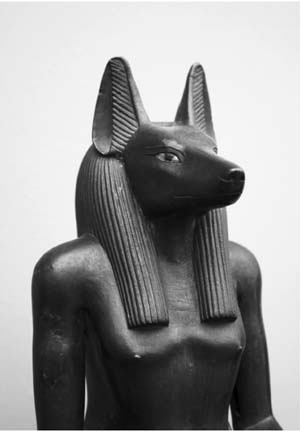
As aid to Ausar in the underworld, Anubis is often depicted in funerary text assisting with the balancing of the heart of the dead against the feather of Maat. He presides over the questioning of the dead in the affirmations of Maat by a tribunal of 42 Gods in the Hall of Maati or the Hall of Double Truths. Anubis balances the Tongue of Great Balance, depicted as a scale, and received the heart of the Dead. He relays the worthiness of the Dead to Ausar, receives and presents the symbols of the dead's worthiness, and acts as an intermediary between the Dead and the gods. However, he also protects, prepares, and cares for the Dead on their journey in the afterlife. Anubis is instrumental in the preparation of the body of the dead and preparing the dead for the trial of Maat.
...
- Ancestral Figures
- Communalism and Family
- Concepts and Ideas
- Deities and Divinities
- Abasi
- Agwe
- Aida Wedo
- Aiwel
- Akamba
- Amen
- Anubis
- Anukis
- Apep
- Apis
- Asase Yaa
- Aten
- Atum
- Ausar
- Auset
- Azaka, the Loa
- Bes
- Bondye
- Chi
- Danbala Wedo
- Divinities
- Eleda
- Eniyan
- Ennead
- Esu, Elegba
- Ezili Dantò
- Ezili Freda
- Faro
- God
- Goddesses
- Hapi
- Hathor
- Heru, Horus
- Ibis, Symbol of Tehuti
- Jok (Acholi)
- Khnum
- Khonsu
- Mami Wata
- Mawu-Lisa
- Min
- Montu
- Nana Buluku
- Ngai
- Ngewo
- Nkulunkulu
- Nyame
- Nzambi
- Obatala
- Oduduwa
- Ogdoad
- Ogun
- Olodumare
- Olokun
- Olorun
- Orisha Nla
- Orunmila
- Oshun
- Oya
- Ptah
- Ra
- Ruhanga
- Sekhmet
- Serapis
- Seshat
- Set
- Shango
- Shu
- Songo
- Sopdu
- Tefnut
- Thoth
- Tibonanj
- Wepwawet
- Woyengi
- Yao
- Yemonja
- Zin
- Eternality
- Nature
- Personalities and Characters
- Possessors of Divine Energy
- Rituals and Ceremonies
- Adae
- Agricultural Rites
- Ceremonies
- Circumcision
- Clitorectomy
- Dance and Song
- Desounen
- Harvest
- Incense
- Initiation
- Invocations
- Lele
- Medicine
- Medicine Men and Women
- Mediums
- Mummification
- Music
- Naming
- Offering
- Ohum Festival
- Opening of the Mouth Ceremony
- Puberty
- Purification
- Rain Dance
- Rites of Passage
- Rites of Reclamation
- Rituals
- Seclusion
- Shawabti
- Shrines
- Societies of Secrets
- Yam
- Yanvalou
- Sacred Spaces and Objects
- Akhenaten
- Altars
- Amulet
- Asamando
- Bata Drums
- Boats
- Bois Caiman
- Cowrie Shells
- Crossroads
- Drum, The
- Flag and Flag Planting
- Govi
- Groves, Sacred
- Ikin
- Ilé-Ifè
- Incense
- Kisalian Graves
- Lakes
- Maroon Communities
- Mount Cameroon
- Mount Kenya
- Mountains and Hills
- Oumfò
- Potomitan
- Pyramids
- Rivers and Streams
- Rocks and Stones
- Sarcophagus
- Sphinx
- Totem
- Vilokan
- Waset
- Societies
- Symbols, Signs, and Sounds
- Taboo and Ethics
- Texts
- Traditions
- Akan
- Asante
- Azande
- Baga
- Baganda
- Bakongo
- Bakota
- Balanta
- Balengue
- Baluba
- Bamana
- Bamileke
- Bamun
- Banyankore
- Banyarwanda
- Bariba
- Barotse
- Bassa
- Basuto
- Batonga
- Bete
- Bobo
- Candomblé
- Chagga
- Chewa
- Chokwe
- Convince
- Dagu
- Dinka
- Diola
- Dioula
- Dogon
- Duala
- Efik
- Ekoi
- Ewe
- Fang
- Fon
- Fula (Fulbe)
- Ga
- Gamo Religion
- Gola
- Gurunsi
- Haya
- Hoodoo
- Hutu
- Ibibio
- Idoma
- Igbo
- Jola
- Kabre of Togo
- KalÛnga
- Kirdi
- Kumina
- Lobi
- Lomwe
- Lovedu
- Lugbara
- Luo
- Maasai
- Mende
- Mossi
- N'domo
- North America, African Religion in
- Nuer
- Obeah
- Okande
- Ovambo
- Palo
- Pedi
- Petwo
- Peul
- Rada
- Santeria
- Sara
- Saramacca
- Senufo
- Serer
- Shilluk
- Shona
- Songo
- Sotho
- Susu
- Swazi
- Tallensi
- Teke
- Tellem
- Temne
- Tiv
- Tsonga
- Tswana
- Tutsi
- Umbanda
- Vai
- Vodou and the Haitian Revolution
- Vodou in Benin
- Vodou in Haiti
- Vodunsi
- Wamala
- West African Religion
- Winti
- Wolof
- Xhosa
- Yao
- Yoruba
- Zarma
- Zulu
- Values
- Loading...
Get a 30 day FREE TRIAL
-
 Watch videos from a variety of sources bringing classroom topics to life
 -
Read modern, diverse business cases
-
Explore hundreds of books and reference titles

Read next

More like this
Sage Recommends
We found other relevant content for you on other Sage platforms.
Have you created a personal profile? Login or create a profile so that you can save clips, playlists and searches