
Entry
Reader's guide
Entries A-Z
Subject index
Adinkra Symbols
Associated most often with a multitude of symbols, the term “adinkra” is more accurately used to denote a symbolic funerary message given to transitioning and/or departed souls. The term “di” means “to make use of” or “to employ,” and the term “nkra” means “message.” Literally, then, adinkra means “to make use of a message,” but when spoken together, the term is understood to mean “to leave one another” or “to say goodbye.” Moreover, because the term “nkra” has “kra” (life force; soul) at its root, adinkra is further understood as a message that a transitioning and/or departed soul takes with it on its return to Nyame. Thus, adinkra is a type of language.
Although it is clear that the Akan have used adinkra for many centuries, there has been much academic debate over the exact origins of the symbols. The most commonly accepted legend comes from the stampers (those who create/produce adinkra). Legend has it that the symbols gained their name from Nana Kofi Adinkra, the famous 19th-century king of Gyaman, located in neighboring Cote d'lvoire. King Adinkra was said to have challenged the authority of the then Asantehene Nana Osei Bonsu Panyin by making a replica of the Sika Dwa (golden stool).
The result of this spiritual violation of the Asante nation was the Asante-Gyamn War in which the Gyamans were defeated. The Asantehene was said to have admired the craftsmanship of the replica Sika Dwa, which was adorned with various symbols, so much so that he forced the defeated Gyaman craftsmen to duplicate the symbols and also teach Asante craftsmen how to produce them themselves. So begins the Akan legacy of adinkra symbols.
The Akan believe that the entire world is composed of two realms—the physical (living) and nonphysical (spirit). In their cosmology, there is no clear distinction between the physical and spiritual worlds—the two complement each other and often overlap. The physical is directed by the power of the spiritual—Nyame, the Abosom (deities/divinities), and the Nsamanfo (ancestors). Each individual transitions through these two realms by way of the Akan life cycle: birth, puberty, marriage, physical death, and rebirth.
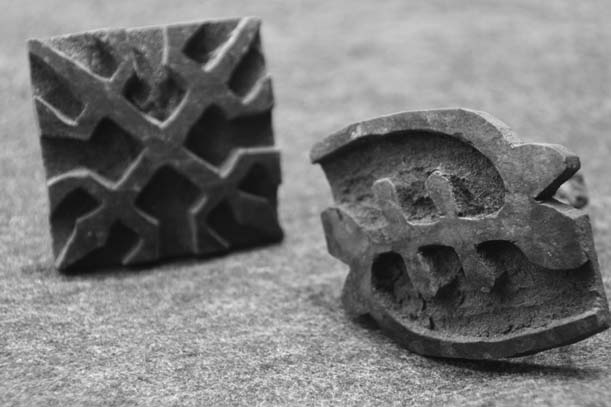
Close-up shot of two adinkra stamps carved out of calabash gourds, from Ghana. Used mainly when someone dies, the adinkra symbols are stamped on fabric worn on funeral occasions.
Source: Karen Low Phillips/iStockphoto.
Thus, the Akan do not regard physical death as the end of life, but as the transition from Earthly life to spiritual life. It is a transition that each individual must make to reach the spiritual world and continue to live as Nsamanfo. Physical death instead renders family relationships eternal, and the rituals performed by the living Abusua (family) emphasize the unbroken bonds between those living on Earth, the departed sunsum (spirit), and Nsamanfo. It is the responsibility of those living on Earth to perform the Ayie so that the sunsum can properly transition to the Asamando (ancestral world); if not, the sunsum will transform into an unsettled and malevolent spirit and may come back to harm the family.
Thus, great satisfaction is derived from the performance of the Ayie, and the community looks down on those who do not properly bury their kin. Unlike in Western society, where the dead are generally mourned by friends and family, in Akan societies, the entire community mourns the loss of one of its members. Communal performance of appropriate rites helps to strengthen the bond between the living and the Nsamanfo. The Ayie is performed in four stages: (a) Adware (preparation of the corpse), (b) Adeda (lying in state) and Siripe (wake-keeping), (c) Asie (burial), and (d) Ndaase (thanksgiving). In contemporary times, the Ayie usually takes place over the course of a weekend.
...
- Ancestral Figures
- Communalism and Family
- Concepts and Ideas
- Deities and Divinities
- Abasi
- Agwe
- Aida Wedo
- Aiwel
- Akamba
- Amen
- Anubis
- Anukis
- Apep
- Apis
- Asase Yaa
- Aten
- Atum
- Ausar
- Auset
- Azaka, the Loa
- Bes
- Bondye
- Chi
- Danbala Wedo
- Divinities
- Eleda
- Eniyan
- Ennead
- Esu, Elegba
- Ezili Dantò
- Ezili Freda
- Faro
- God
- Goddesses
- Hapi
- Hathor
- Heru, Horus
- Ibis, Symbol of Tehuti
- Jok (Acholi)
- Khnum
- Khonsu
- Mami Wata
- Mawu-Lisa
- Min
- Montu
- Nana Buluku
- Ngai
- Ngewo
- Nkulunkulu
- Nyame
- Nzambi
- Obatala
- Oduduwa
- Ogdoad
- Ogun
- Olodumare
- Olokun
- Olorun
- Orisha Nla
- Orunmila
- Oshun
- Oya
- Ptah
- Ra
- Ruhanga
- Sekhmet
- Serapis
- Seshat
- Set
- Shango
- Shu
- Songo
- Sopdu
- Tefnut
- Thoth
- Tibonanj
- Wepwawet
- Woyengi
- Yao
- Yemonja
- Zin
- Eternality
- Nature
- Personalities and Characters
- Possessors of Divine Energy
- Rituals and Ceremonies
- Adae
- Agricultural Rites
- Ceremonies
- Circumcision
- Clitorectomy
- Dance and Song
- Desounen
- Harvest
- Incense
- Initiation
- Invocations
- Lele
- Medicine
- Medicine Men and Women
- Mediums
- Mummification
- Music
- Naming
- Offering
- Ohum Festival
- Opening of the Mouth Ceremony
- Puberty
- Purification
- Rain Dance
- Rites of Passage
- Rites of Reclamation
- Rituals
- Seclusion
- Shawabti
- Shrines
- Societies of Secrets
- Yam
- Yanvalou
- Sacred Spaces and Objects
- Akhenaten
- Altars
- Amulet
- Asamando
- Bata Drums
- Boats
- Bois Caiman
- Cowrie Shells
- Crossroads
- Drum, The
- Flag and Flag Planting
- Govi
- Groves, Sacred
- Ikin
- Ilé-Ifè
- Incense
- Kisalian Graves
- Lakes
- Maroon Communities
- Mount Cameroon
- Mount Kenya
- Mountains and Hills
- Oumfò
- Potomitan
- Pyramids
- Rivers and Streams
- Rocks and Stones
- Sarcophagus
- Sphinx
- Totem
- Vilokan
- Waset
- Societies
- Symbols, Signs, and Sounds
- Taboo and Ethics
- Texts
- Traditions
- Akan
- Asante
- Azande
- Baga
- Baganda
- Bakongo
- Bakota
- Balanta
- Balengue
- Baluba
- Bamana
- Bamileke
- Bamun
- Banyankore
- Banyarwanda
- Bariba
- Barotse
- Bassa
- Basuto
- Batonga
- Bete
- Bobo
- Candomblé
- Chagga
- Chewa
- Chokwe
- Convince
- Dagu
- Dinka
- Diola
- Dioula
- Dogon
- Duala
- Efik
- Ekoi
- Ewe
- Fang
- Fon
- Fula (Fulbe)
- Ga
- Gamo Religion
- Gola
- Gurunsi
- Haya
- Hoodoo
- Hutu
- Ibibio
- Idoma
- Igbo
- Jola
- Kabre of Togo
- KalÛnga
- Kirdi
- Kumina
- Lobi
- Lomwe
- Lovedu
- Lugbara
- Luo
- Maasai
- Mende
- Mossi
- N'domo
- North America, African Religion in
- Nuer
- Obeah
- Okande
- Ovambo
- Palo
- Pedi
- Petwo
- Peul
- Rada
- Santeria
- Sara
- Saramacca
- Senufo
- Serer
- Shilluk
- Shona
- Songo
- Sotho
- Susu
- Swazi
- Tallensi
- Teke
- Tellem
- Temne
- Tiv
- Tsonga
- Tswana
- Tutsi
- Umbanda
- Vai
- Vodou and the Haitian Revolution
- Vodou in Benin
- Vodou in Haiti
- Vodunsi
- Wamala
- West African Religion
- Winti
- Wolof
- Xhosa
- Yao
- Yoruba
- Zarma
- Zulu
- Values
- Loading...
Get a 30 day FREE TRIAL
-
 Watch videos from a variety of sources bringing classroom topics to life
 -
Read modern, diverse business cases
-
Explore hundreds of books and reference titles

Read next

More like this
Sage Recommends
We found other relevant content for you on other Sage platforms.
Have you created a personal profile? Login or create a profile so that you can save clips, playlists and searches