
Entry
Entries A-Z
Subject index
World War II
War that restored African Americans' right to fight for their country and began the process of giving them other basic civil rights.
After World War I, African American veterans came back from the battlefields of Europe to face discrimination and violence at home.
The United States remained deeply racist and segregated. Moreover, the years between the two world wars saw a marked decrease in the size of the nation's military, further reducing the access to the armed services that blacks needed if they were to establish their military presence and their claim to the rights for which they had willingly died.
Preparing for War
The Army Air Corps opened its ranks to blacks only in 1939. Even then, it trained no pilots. The army required that its divisions be segregated, and it had no black flying unit available. So, although authorized, there were initially no African American pilot trainees. The army also had no black infantry units.
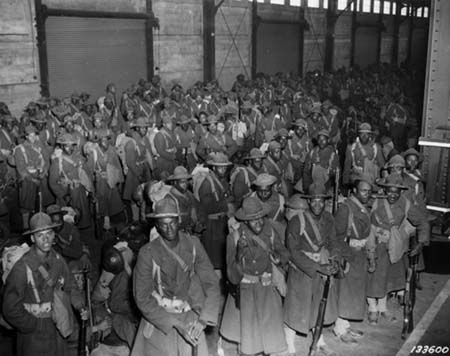
Black army troops waiting to board a military transport in 1942, bound for the fighting in Europe during World War II. At the beginning of World War II, the U.S. military recruited aggressively among blacks in order to expand the armed forces. Nevertheless, military life during the war remained highly segregated. Although they received equal pay, equipment, and housing, they were still usually treated as less than equal. The majority of blacks in the armed forces never saw combat, serving instead as support personnel—handling maintenance, laundry, food supply, and other such tasks. Those who did fight, however, proved their worth, and their contributions and sacrifices for the nation contributed to progress toward greater justice and equality in the post-war years.
Black leaders and newspapers pressed for a more equitable system. Their pressure helped gain passage of the Selective Service Act of 1940, which provided that race and color were irrelevant to induction or training of men in the army and navy. African Americans now had a legal right to fight for and serve the nation.
The administration of President Franklin D. Roosevelt established a number of policies under this law—African Americans could serve in numbers equivalent to their percentage of the population (about 10 percent), they could attend Officer's Candidate School, increased training of pilots and mechanics would begin, and army posts and arsenals would establish and enforce equal employment policies. However, white and black troops would continue to be segregated. While less than what some African American leaders wanted, these policies opened all branches of the service to African Americans.
The new policies meant the armed services had to recruit aggressively. The navy restricted African Americans to duty as mess men and stewards, and the Marines did not open enlistment to blacks until 1942. The Air Corps had no black units. As a result, the majority of enlistees joined the army. Numbers of enlistees grew from 3,600 in August 1939 to nearly half a million in December 1942. More than a million African American men and women served in the military during the war.
Military Life
Military life was totally segregated, except when white officers led black units and in Officer's Candidate School, where officers in training could be trained together in a ratio of 3 percent black and 97 percent white. Career advancement was limited for black officers because they could command only blacks, not whites.
...
- Loading...
Get a 30 day FREE TRIAL
-
 Watch videos from a variety of sources bringing classroom topics to life
 -
Read modern, diverse business cases
-
Explore hundreds of books and reference titles

Read next

More like this
Sage Recommends
We found other relevant content for you on other Sage platforms.
Have you created a personal profile? Login or create a profile so that you can save clips, playlists and searches