
Entry
Entries A-Z
Subject index
Segregation, School
The physical separation of schoolchildren in distinct and separate facilities, creating primarily white-only or black-only schools. The 1896 Supreme Court decision in Plessy v. Ferguson upheld state laws that sanctioned segregation in public transportation. Although that court decision did not pertain to schools, the Supreme Court's ruling in the case, which favored a system of “separate but equal” facilities, gave local and state authorities the legal right to create a system of separate public schools for the races. Consequently, a segregated system of elementary and secondary schools, as well as many colleges and graduate schools, developed. School segregation, as well as the great disparity between the quality of education offered to blacks and whites to which it contributed, became a national issue in the mid-1900s and invigorated the civil rights movement in its challenge to inequality in American society as a whole.
The Development of the “Separate but Equal” Doctrine
After the Plessy decision, many states, especially in the South, created a system of racial separatism called Jim Crow. Public education became a center piece of that system. Although the Supreme Court had approved such separation, it had also required that the separate facilities be equal. However, the practice of most states belied a very different system. The Jim Crow school system was inherently unfair to African American children because the educational opportunities remained second-rate and substandard compared to the opportunities and facilities available to whites.
Most local school boards were composed of white members who consistently underfunded black-only schools. Often, black schools had inadequate facilities, outdated or no textbooks and instructional mate-rials, and poorly paid teachers and administrators. For example, in 1949, the Clarendon County School District in South Carolina spent an average of $179 on each enrolled white student but only $43 on each black student. The all-black R. R. Moton High School in Farmville, Virginia, was held in a building without heat and had crowded classrooms made of tarpaper and plywood.
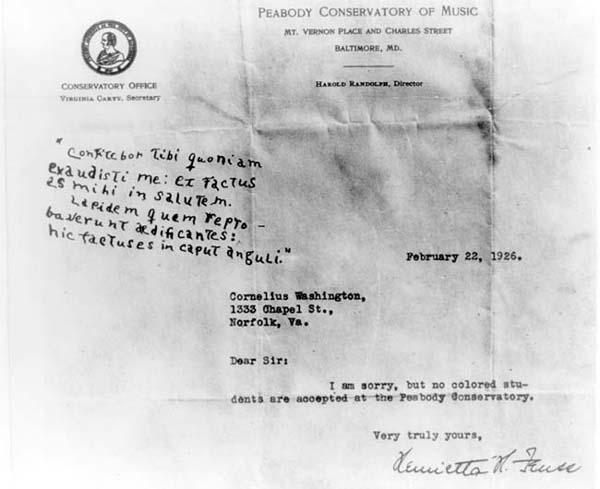
Letter from the Peabody Conservatory of Music in Baltimore, Maryland, rejecting a student on the basis of race. Until the mid-1950s, African American students could be legally segregated from whites in educational institutions in the United States. Before the Civil War, very few blacks even had the opportunity to attend school, particularly in the South. A system of segregated education developed in the late 1800s after the Supreme Court decision in Plessy v. Ferguson sanctioned a policy of "separate but equal." As a result, black students, even the most gifted and talented, could be denied admission to schools attended by whites, such as the Peabody Conservatory of Music. The handwritten note in Latin, presumably written by Washington, quotes Jerome's Vulgate translation of Psalm 118, verses 21 and 22: “I thank you that you have answered me and become my salvation. The stone that the builders rejected has become the chief cornerstone.”
Although illegal under the “separate but equal” doctrine of Plessy, many school districts refused to provide equal funds to the black schools. The education of black children in those schools remained deficient, inadequate, and illegal. The Jim Crow system became an established custom that was legally sanctioned and widely supported by public opinion.
...
- Loading...
Get a 30 day FREE TRIAL
-
 Watch videos from a variety of sources bringing classroom topics to life
 -
Read modern, diverse business cases
-
Explore hundreds of books and reference titles

Read next

More like this
Sage Recommends
We found other relevant content for you on other Sage platforms.
Have you created a personal profile? Login or create a profile so that you can save clips, playlists and searches