
Entry
Entries A-Z
Subject index
Jim Crow
A term thought to have originated in the 1830s with a white minstrel performer who created a blackface character of that name. By the 1850s, the “Jim Crow” character was a standard part of the minstrel show scene. The name was later given to a system of racial separation, established mainly in the South, that began in the late 1890s. For the first several decades of the twentieth century, public facilities, accommodations, means of transportation, and public schools in the South were maintained separately for blacks and whites. Generally, the black-only facilities were poorly or inadequately maintained, and the black-only public schools received much less public funding than their white-only counterparts. The civil rights movement dismantled the system of Jim Crow through legal decisions, of federal equal rights laws with the help of federal troops to enforce the laws.
The Origins of Jim Crow
During the Reconstruction era that followed the end of the Civil War, Republican political leaders from the North sought to establish full citizenship rights for the newly freed slave population. Passage of the Thirteenth, Fourteenth, and Fifteenth Amendments to the Constitution gave a legal status to blacks that seemed to signify the realization of that dream. However, considerable white resistance to those ideas grew as blacks asserted themselves, into the political and social life of the South, with the help of federal troops to enforce the laws.
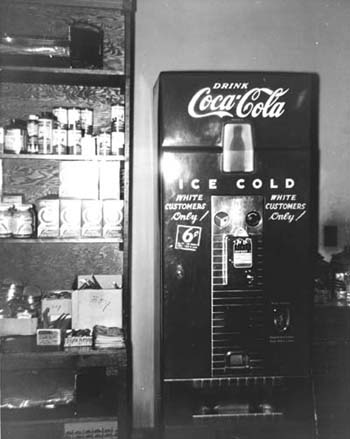
A segregated soda machine, a typical example of the racial discrimination that existed during the Jim Crow era. Jim Crow refers to the system of racial separation that segregated whites and blacks from the late 1890s until the mid-1900s. Under Jim Crow, African Americans were denied access to the same facilities used by whites. They had to use separate facilities for everything from water fountains, bathrooms, and seating areas, to schools, beaches, and any other public facilities.
By 1877, the will of the North to impose continued military rule on the Southern states to ensure the new freedoms for blacks had waned. The contested presidential election of 1876 led to a political compromise between Republicans and Democrats in which each controlled one house of the U.S. Congress. In the Compromise of 1877, Democrats and Republicans agreed to approve the electoral votes of Republican candidate Benjamin Harrison in return for an end to the most radical form of Reconstruction. As a result, all military forces were withdrawn from the South, and blacks had to fend for themselves in asserting their newly granted freedoms.
Almost immediately, the political gains made by blacks were reversed. The Ku Klux Klan organized to terrorize blacks who sought to vote in elections or run for office. Southern states also reenacted constitutions that deprived blacks of freedom and passed new laws that restricted the rights of blacks to enjoy the freedoms they had had under Reconstruction.
Blacks challenged those new laws, relying on the recently enacted Civil War amendments (the Thirteenth, Fourteenth, and Fifteenth Amendments) to provide legal support for their position that the laws deprived them of their equal rights. However, the Supreme Court proved to be an ally of Southern leaders, redefining in several essential decisions the meaning of citizenship and the scope and breadth of the Civil War amendments. Blacks fared poorly in these decisions, and the power of the states in relation to the federal government grew in the areas that affected the status of black citizens.
...
- Loading...
Get a 30 day FREE TRIAL
-
 Watch videos from a variety of sources bringing classroom topics to life
 -
Read modern, diverse business cases
-
Explore hundreds of books and reference titles

Read next

More like this
Sage Recommends
We found other relevant content for you on other Sage platforms.
Have you created a personal profile? Login or create a profile so that you can save clips, playlists and searches