
Entry
Entries A-Z
Subject index
Hill-Thomas Hearings
A series of Senate hearings held in October 1991 on the subject of the nomination of black jurist Clarence Thomas as a Supreme Court justice, which included allegations of sexual harassment by University of Oklahoma law professor Anita Hill.
When Thurgood Marshall, America's first African American Supreme Court justice, retired in 1991, President George H. W. Bush used the opportunity to replace Marshall, a defender of civil rights and women's rights, with Clarence Thomas, a conservative black jurist. At that time, Thomas was serving as assistant secretary of education and had previously been chair of the Equal Employment Opportunity Commission (EEOC).
Choosing the forty-three-year-old Thomas as Marshall's replacement created a firestorm of criticism, as many African Americans argued that “descriptive representation” would only lead to the end of “substantive representation” of their interests. That is, many African Americans feared that because Thomas's views were much more conservative than those of most African Americans, he would not actually represent black interests while on the bench.
Fearing that the conservative Thomas would reverse progress made during the civil rights movement, many African Americans perceived his nomination as a tool by which America could once again fail to live up to its promise of racial equality. A number of women's organizations, including the National Organization for Women (NOW), also opposed the Thomas nomination because they feared he might join other conservative justices in reversing Roe v. Wade, the 1973 Supreme Court decision that legalized abortion. Thomas was also criticized for his lack of professional judicial experience, having served only two years as a federal judge before being nominated to the nation's highest court.
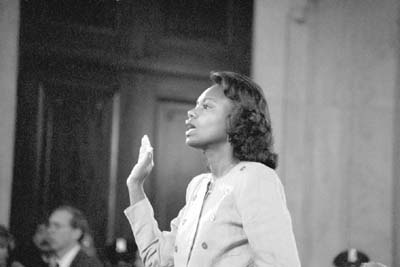
Anita Hill testifying before the Senate Judiciary Committee during the confirmation hearings of Supreme Court nominee Clarence Thomas in October 1991. A black conservative, Thomas was nominated by President George H. W. Bush to fill a vacancy left on the Court by noted black jurist Thurgood Marshall. The congressional hearings on the nomination were quite confrontational, in part because many blacks feared that Thomas would reverse civil rights gains. The hearings became especially heated after Thomas was accused of sexual harassment by Anita Hill, a former colleague at the Equal Employment Opportunity Commission. The HillThomas hearings delved into personal matters in explicit detail. Thomas was later confirmed, but the hearings had long-term consequences by drawing attention to the problem of sexual harassment in the workplace.
Despite objections from the National Association for the Advancement of Colored People (NAACP), the National Bar Association, the Urban League, and a number of other organizations, the Thomas nomination proceeded to the Senate Judiciary Committee, which split its vote on the nomination seven to seven. Debate on the nomination then went to the floor of the full Senate in October 1991. It was at that point that accusations of sexual harassment alleged by Anita Hill, an African American law professor at the University of Oklahoma, were revealed.
During the nationally televised hearings in mid-October, Hill charged that Thomas, while serving as chair of the EEOC and her boss, engaged in inappropriate behavior toward her after she refused to date him. Hill said that Thomas had made frequent sexual comments and talked about pornographic material in front of her.
...
- Loading...
Get a 30 day FREE TRIAL
-
 Watch videos from a variety of sources bringing classroom topics to life
 -
Read modern, diverse business cases
-
Explore hundreds of books and reference titles

Read next

More like this
Sage Recommends
We found other relevant content for you on other Sage platforms.
Have you created a personal profile? Login or create a profile so that you can save clips, playlists and searches