
Entry
Entries A-Z
Subject index
Chicago's South Side
The largest African American neighborhood in Chicago, which has spawned great accomplishments but also has experienced deep poverty and violence. Since the late 1900s, the city of Chicago as a whole has been slowly desegregating as African American residents move in greater numbers to the surrounding suburbs. At the same time, however, Chicago's South Side has remained largely black.
The South Side emerged as the black ghetto in Chicago between 1890 and 1950, but African Americans have been a part of Chicago life since the city's inception in the late 1700s. In his introduction to the landmark study of Chicago, Black Metropolis (1962), sociologist Everett C. Hughes wrote, “The story of labor force of Chicago and the role of the Negro in it is a version of the story of all industrial cities…. It is the story of a large part of the human race.”
In about 1779, Afro-French explorer and pioneer Jean Baptiste Pointe du Sable, an immigrant from Haiti, built a permanent settlement at the mouth of a river on the southwestern shore of an enormous lake that was later named Lake Michigan. This settlement eventually grew into the city of Chicago. In the early 1800s, some free northern blacks moved to Chicago, creating a sizable and politically active African American community.
Even in the years before the Civil War, black Chicagoans fought against discriminatory laws and defended fugitive slaves. African American business leaders formed valuable partnerships with politically powerful whites in the growing city. After the Civil War, black men in Chicago won the right to vote, and “public accommodations” were desegregated. The alliances between blacks and whites proved fruitful, and in 1871, Chicago elected its first black public official—John Jones, who was elected Cook County commissioner.
Relations between the black and white communities in Chicago began to deteriorate in the late 1800s and early 1900s, when large numbers of poor and working-class blacks migrated to Chicago. Between 1890 and 1915, southern migrants tripled the city's black population, taking jobs in the service industry or being employed as strikebreakers. These migrants were concentrated on the South Side and in a smaller ghetto on the West Side. Housing was rigidly segregated, and blacks were often forced to pay higher rents, despite the fact that they made less than white workers.
The phenomenal growth of Chicago's black population touched off racial tensions in the early 1900s. Many white neighborhoods organized to “protect” themselves from the “invasion” of blacks. Tensions were especially fierce among members of the white working class, whose unionizing efforts were sometimes thwarted by black strikebreakers.
Tension between the whites and blacks erupted into widespread violence in the 1919 Chicago riots. The riot began after a young African American swimmer drifted to a section of beach reserved for whites and was prevented from coming ashore by an angry crowd of whites. The young man drowned, but the police refused to make any arrests. The violence lasted a week, costing 23 blacks and 15 whites their lives. More than 500 people were injured.
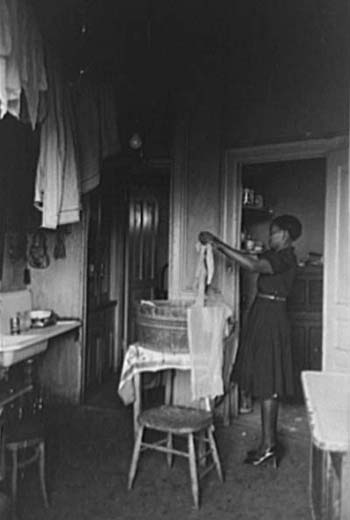
Woman doing laundry in an apartment on Chicago's South Side, which emerged as a predominantly African American neighborhood between 1890 and 1950. The growing black presence in the area created racial tensions with the city's white neighborhoods, however, and the heavily black South Side remains a segregated ghetto plagued by poverty and violence.
...
- Loading...
Get a 30 day FREE TRIAL
-
 Watch videos from a variety of sources bringing classroom topics to life
 -
Read modern, diverse business cases
-
Explore hundreds of books and reference titles

Read next

More like this
Sage Recommends
We found other relevant content for you on other Sage platforms.
Have you created a personal profile? Login or create a profile so that you can save clips, playlists and searches