
Entry
Entries A-Z
Subject index
Actors and Actresses
African American performers in film and television often have struggled to gain parity with white performers since the start of those two forms of entertainment.
The first African American theater group in the United States was the African Grove Theatre, founded in New York City in 1821. The company's repertoire included plays by English playwright William Shakespeare as well as lighter drama. Among the theater's leading actors were James Hewlett and Ira Aldridge. Disruptive behavior by whites in the audiences led to the closing of the theater in 1823. Hewlett and Aldridge both went on to long-running theater tours in Europe.
Minstrelsy and Early Musicals
A distinct tradition of African American performance developed in the antebellum period on Southern plantations, where enslaved African Americans performed for themselves and for their owners. Minstrel shows may have originated as an attempt by white performers and entrepreneurs to imitate these plantation performances, and stereotyped caricatures of African Americans, invariably played by white actors in blackface, were developed. Black minstrel troupes became established after the Civil War. Among the most recognized black minstrels were Billy Kersands, Ernest Hogan, and Bert Williams.
From the 1890s through the 1920s, African American performers outside the minstrel tradition won increasing acceptance. Successful early all-black musicals outside the minstrel tradition were Sam Jack's The Creole Show (1891), John W. Ishaw's The Octoroon (1895), and Bob Cole's A Trip to Coontown (1897). Nonminstrel singing and dancing stars such as Florence Mills and Bill “Bojangles” Robinson emerged during the 1920s.
Drama and Film
In straight drama, black actor Charles Gilpin scored a triumph in 1920, starring in The Emperor Jones by American playwright Eugene O'Neill. Actor and singer Paul Robeson's performance in O'Neill's All God's Chillun' Got Wings in 1924 made him a major star. The African American actress Rose McClendon was recognized as a significant talent with her performances in the play In Abraham's Bosom (1926), by Paul Green, and in other plays. Meanwhile, American-born Josephine Baker achieved her greatest recognition as an expatriate living in Paris in the 1920s.
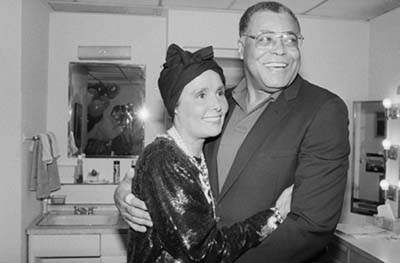
Lena Horne and James Earl Jones after a 1987 performance of Fences, a play by black playwright August Wilson. African American actors and actresses have been delighting audiences in the United States since the early 1800s, although most early performers worked in all-black theater troupes. In addition to appearing in dramatic works, black performers have also appeared in minstrel shows, in musicals, in film, and on televison. While opportunities were quite limited up to the recent decades, in recent years black actresses have found much greater success and acceptance in all forms of theatrical and popular entertainment.
In Hollywood films, African Americans were almost invariably relegated to roles as servants and menial workers. Within these limitations, several actors established recognizable individual specialties and became popular. Among these performers were Louise Beavers, Stepin Fetchit, Hattie McDaniel (who became the first African American to win an Academy Award for her performance in the 1939 movie Gone With the Wind), and Mantan Moreland. Usually, these and other black actors and actresses were called on to provide comic support. Among the rare exceptions were Rex Ingram, who established himself in dignified roles, and singer Lena Horne, who became a star attraction in a number of MGM musicals in the 1940s.
...
- Loading...
Get a 30 day FREE TRIAL
-
 Watch videos from a variety of sources bringing classroom topics to life
 -
Read modern, diverse business cases
-
Explore hundreds of books and reference titles

Read next

More like this
Sage Recommends
We found other relevant content for you on other Sage platforms.
Have you created a personal profile? Login or create a profile so that you can save clips, playlists and searches