
Entry
Reader's guide
Entries A-Z
Subject index
Indian Mascot Protests
Native American imagery has been used as mascots and symbols for public schools, universities, and professional organizations since the latter part of the 19th century. This practice has sparked controversy since its inception regarding the consequences these symbols have on Native American people, as well as society as a whole. Locally, individuals sought to alter Native American stereotypes, but a large organized effort did not commence until the latter part of the 1960s. As media attention grew, so did the momentum to eliminate all negative stereotypes of Native Americans.
Supporters for the ban of Indian mascots believe that they foster painful memories, trivialize and stereotype Native Americans, and also distort historical reality. The images chosen by many schools include a person who is overtly aggressive and violent. Names utilized include the Chiefs, Braves, and Redskins. These portrayals do not allow for the diversity among Native American cultures to be seen when all individuals are put under an umbrella label. This is viewed as very offensive in that historically Native Americans were conquered people so that they are seen through this image only after they were conquered. Other problems arise from the imitation or misuse of symbols that have religious significance to Native American people. These are typically taken out of context and used by many non–Native American people during a sporting event and not during a religious ceremony.
Those in opposition to this change maintain that these mascots honor or pay tribute to Native Americans and that many of these mascots are steeped in tradition. These arguments center on power and perspective. In the end, who gets to determine what is offensive? Some organizations maintain that they are working with Native American groups to honor and protect them. Another key argument used is that of the best of intentions. Organizations, especially those in the field of education, must use best practices. Inaction in the face of racism is racism. The best examples seen today are Florida State University Seminoles and the University of Illinois Chief Illiniwek mascots. The attempt to remove Chief Illiniwek has been chronicled in the 1997 PBS documentary In Whose Honor. While some colleges, including Dartmouth, Stanford, and St. John's, have changed their team nicknames, and universities, high schools, and middle schools have dropped their Indian mascots and logos during the 1980s and 1990s, no professional sports teams have done so.
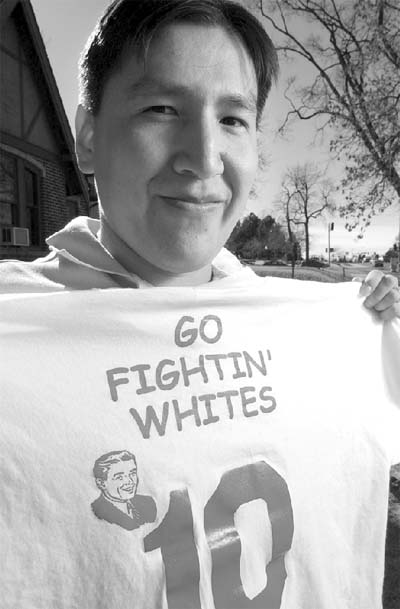
Solomon Little Owl, University of Northern Colorado intramural basketball team member and director of Native American Services at UNC in Eaton, Colorado, holds up the team T-shirt on March 11, 2002, he had printed for his intramural basketball team. Some American Indian students at the UNC were upset with the use of the caricature and name for the Eaton High School mascot and countered by naming their intramural basketball team the “Fightin'Whites,” using a 1950s-style caricature of a middle-aged white man as the mascot.
The 21st century also saw many professional associations passing resolutions in support of abolishing Native American mascots by sports teams and schools. Among those are the Organization of the National Congress of American Indians, the National Conference for Community and Justice, the Maryland Commission on Indian Affairs, the American Psychological Association (APA), the National Education Association, and the American Counseling Association. In 2005, the National Collegiate Athletics Association announced that it would prohibit schools that used Indian mascots and nicknames to play during the postseason tournament but did stop short of banning schools from using them all together.
...
- Activism and Social Justice
- Activism, Social and Political
- Advocacy
- Alternative Movements
- Boycotts and Divestment
- Civil Disobedience
- Coalition Building
- Community Organizing
- Cooperatives
- Direct Action
- Dissent
- Lobbying
- Nonviolence and Activism
- Philanthropy for Social Action
- Play, Creativity, and Social Movements
- Social Movements, Sociology of
- Strategies and Tactics in Social Movements
- Third-Party Politics
- Urban Uprisings, United States
- Utopian Communities
- The Arts
- Literature
- Testimonio
- Achebe, Chinua
- Arenas, Reinaldo
- Baldwin, James
- Baraka, Amiri
- Beat Poets
- Brutus, Dennis
- Camus, Albert
- Dalton, Roque
- de la Cruz, Sor Juana Inés
- Dickens, Charles
- Dorfman, Ariel
- García Márquez, Gabriel
- Ginsberg, Allen
- Hansberry, Lorraine
- Hikmet, Nazim
- Hughes, Langston
- Lewis, Sinclair
- Literature and Activism
- Miller, Arthur
- Morrison, Toni
- Neruda, Pablo
- Orwell, George
- Owen, Wilfred
- Piercy, Marge
- Political Humor
- Political Satire
- Rand, Ayn
- Rich, Adrienne
- Rushdie, Salman
- Sinclair, Upton
- Slam Poetry
- Social Science Fiction
- Thoreau, Henry David
- Twain, Mark
- Vidal, Gore
- Walker, Alice
- Whitman, Walt
- Zola, Émile
- Music
- Baez, Joan
- Belafonte, Harry
- Benefit Concerts
- Bono
- Dylan, Bob
- Guthrie, Woody
- Hip-Hop
- Jara, Víctor
- Kuti, Fela
- La Nueva Canción
- Lennon, John
- Marley, Bob
- Parra, Violeta
- Protest Music
- Punk
- Rage Against the Machine
- Reagon, Bernice Johnson
- Robeson, Paul
- Rock ‘n’ Roll
- Rock Bands and Activism
- Seeger, Pete
- Sosa, Mercedes
- Sweet Honey in the Rock
- Theodorakis, Mikis
- Union Songs
- Performing Arts
- Salt of the Earth
- Boal, Augusto
- Bread and Puppet Theater
- Brecht, Bertolt
- Dance and Activism
- Davis, Ossie
- Film
- Fonda, Jane
- Gómez-Peña, Guillermo
- Guerrilla Theater
- Hollywood Blacklists
- Lee, Spike
- Moore, Michael
- Performance Art, Political
- Performativity
- Play, Creativity, and Social Movements
- Political Humor
- Political Satire
- Radical Cheerleaders
- Raging Grannies
- Reverend Billy
- Robeson, Paul
- Sarandon, Susan
- Smith, Anne Deavere
- Theatre of the Oppressed
- Third World Cinema
- Working-Class Cinema
- Plastic Arts
- Literature
- Criticism/Critical Theory
- Cultural Studies, Popular Culture
- Bruce, Lenny
- Centre for Contemporary Cultural Studies
- Craftivism
- Culture Jammers
- de Certeau, Michel
- Difference
- Dunayevskaya, Raya
- Dussel, Enrique
- Ellacuría, Ignacio
- Foucault, Michel
- Frankfurt School of Critical Theory
- Hip-Hop
- Identity Politics
- Moral Panic
- Multiculturalism
- Other, The
- Performativity
- Postcolonial Theory
- Postmodernism
- Power, Theories of
- Punk
- Radical Cheerleaders
- Raging Grannies
- Resistance
- Reverend Billy
- Semiotic Warfare
- Situationist International
- Straight Edge Youth
- Subaltern
- White Privilege
- Willis, Paul
- Zines
- Consumer Movements
- Education
- Brown v. Board of Education
- Lau Decision
- Algebra Project
- Anti-Racist Teaching
- Bilingual Education
- Citizen School, The
- Counter-Recruitment
- Counts, George
- Critical Literacy
- Critical Pedagogy
- Cuban Literacy Campaign
- Dewey, John
- Disability Rights Movement
- Disability Studies
- Freire, Paulo
- Gender Equity Movement in Schools
- Genocide Studies
- Highlander Center
- Home Schooling
- Kozol, Jonathan
- Media Literacy
- Meier, Deborah
- Mississippi Freedom Schools
- Moses, Robert
- Multicultural Education
- Multiculturalism
- Ocean Hill–Brownsville Teachers' Strike
- Participatory Action Research
- Peace Education
- Postman, Neil
- Progressive Movement, Education
- Rousseau, Jean-Jacques
- Sadker, Myra and David
- Student Activism, K-12
- Student Activism, Latin American
- Student Nonviolent Coordinating Committee (SNCC)
- Teacher Unions
- Think Tanks
- Woodson, Carter
- Youth Organizing and Activism
- Environmentalism
- Alternative Health
- Animal Rights
- Berry, Wendell
- Caldicott, Helen
- Carson, Rachel
- Clamshell Alliance
- Climate Change and Global Justice
- Community Gardens
- Community-Based Ecological Resistance Movements
- Critical Mass Bicycle Movement
- Deep Ecology Movement
- Douglas, Marjory Stoneman
- Earth Charter
- Earth Day
- Earth First!
- Earth Summit
- Ecofeminism
- Ecopaganism
- Environmental Movement
- Environmental Racism
- Green Party
- Greenpeace
- Hill, Julia Butterfly
- Homeopathy Movement
- Indigenous People and Environmentalism
- Maathai, Wangari
- Mendes, Chico
- Organic Farming and Agribusiness
- Rainforest Action Network
- Rifkin, Jeremy
- Sierra Club
- Silkwood, Karen
- Slow Food Movement
- Solar Energy Movement
- Sustainable Living
- Thoreau, Henry David
- Urban Space, Politics of
- Vegetarianism
- Voluntary Simplicity
- Wilderness Preservation Act
- Globalization/Anti-Globalization
- Amnesty International
- Anti-Globalization Movement
- Anti-Immigrant Politics
- Anti-Imperialism
- Anti-Nuclear Movement
- Anti-Sweatshop Movement
- Battle of Seattle
- Benjamin, Medea
- Bové, José
- Child Advocacy
- Citizenship and Patriotism
- Civil Society
- Corrie, Rachel
- Debt Relief Movement
- Doctors Without Borders
- Fair Trade
- Free Movement Activism
- Genocide Studies
- Genocide Watch
- Global Exchange
- Glocalization
- Klein, Naomi
- Multiculturalism
- Multitude
- Non-Governmental Organizations (NGOs)
- Organization of the Petroleum Exporting Countries (OPEC)
- Pan-Africanism
- Rifkin, Jeremy
- Roy, Arundhati
- Stiglitz, Joseph
- War Tax Resistance
- Witness for Peace
- Women in Black
- World Social Forum
- Labor/Socialism/Communism/Social Class
- Communist Manifesto
- Agrarian Socialist Movement
- American Federation of Labor (AFL-CIO)
- Anarchism
- Anarcho-Syndicalism
- Berlin Wall destruction
- Bolsheviks
- Castro, Fidel
- Committee for Cleaners' Rights
- Communism
- Cooperatives
- Davis, Angela
- Day, Dorothy
- Debs, Eugene V.
- Democratic Socialism
- Eight-Hour-Day Movement
- Engels, Friedrich
- Eurocommunism
- Fabian Socialism
- False Consciousness
- Farmworkers' Movement
- Flynn, Elizabeth Gurley
- Goldman, Emma
- Gompers, Samuel
- Gramsci, Antonio
- Guevara, Che
- Harrington, Michael
- Hayden, Tom
- Hill, Joe
- Hormel Strikes
- Income Inequality
- Industrial Workers of the World (IWW)
- Jones, Mother (Mary)
- Justice for Janitors
- Keller, Helen
- Labor Culture
- Labor Law
- Lenin, V. I.
- Lewis, John L.
- Ludlow Massacre
- Lukács, Georg
- Luxemburg, Rosa
- Marx, Karl
- Marxist Theory
- May Day
- Muste, A. J.
- Non-Partisan League
- Ocean Hill–Brownsville Teachers' Strike
- Old Left
- Owen, Robert
- Palmer Raids
- PATCO Strike
- Pittsburgh Rail Strike of 1877
- Private Property
- Recuperated Factories in Argentina
- Reed, John
- Robeson, Paul
- Rosenberg, Julius and Ethel
- Sacco and Vanzetti
- Socialist Feminism
- Taxation and Activism
- Teacher Unions
- Teamsters for a Democratic Union
- Thomas, Norman
- Thompson, E. P.
- Trotsky, Leon
- Union Movements
- Union Songs
- UPS Strike
- Wellman, Saul
- West, Cornel
- Wildcat Strikes
- Working-Class Cinema
- Legal and Judicial System/Human Rights/Civil Rights
- Brown v. Board of Education
- Gideon v. Wainright
- Lau Decision
- Miranda v. Arizona
- Roe v. Wade
- Activism in Postconflict and Reconstruction
- Affirmative Action
- American Civil Liberties Union (ACLU)
- Amnesty International
- Anti-Ballistic Missile Treaty
- Anti–Death Penalty Movement
- Bill of Rights
- Campaign to End the Death Penalty
- Child Labor Laws
- Civil Disobedience
- Civil Rights Acts
- Clark, Ramsey
- Conscientious Objectors to War
- Cyber Rights
- Darrow, Clarence
- Dees, Morris
- Disability Rights Movement
- Doctors Without Borders
- Draft Resistance
- Drug Laws, Resistance to
- Ethical Culture Movement
- Free Speech Activism
- Homeless Activism
- Human Rights Watch
- International Campaign to Ban Landmines
- International Criminal Court
- Judicial Activism
- Kunstler, William
- Kurdish Human Rights
- Kyoto Accords
- Law and Social Movements
- League of Nations
- Myrdal, Gunnar
- Nhat Hanh, Thich
- Nobel Peace Prize
- Noncitizen Rights
- Ochoa, Digna
- Oxfam
- Physicians for Social Responsibility
- Red Cross
- Refugee Resettlement
- Save the Children
- Sex Workers' Rights
- Southern Poverty Law Center
- Taxation and Activism
- Treaty Rights Struggle
- United Nations Children's Fund (UNICEF)
- United Nations Educational, Scientific and Cultural Organization (UNESCO)
- Universal Declaration of Human Rights
- Voices in the Wilderness
- War Resisters' International
- War Tax Resistance
- Warren, Earl
- Welfare Rights Movement
- Whistleblowers
- Williams, Jody
- Witness for Peace
- Women in Black
- World Court
- Media and Communications
- http://MoveOn.org
- Adbusters
- Dissent Magazine
- Action for Children's Television
- Air America Radio
- Alternative Press
- Appropriate Technology Movement
- Blogging
- Community Radio and Television
- Culture Jammers
- Cyber Rights
- Digital Activism
- Digital Equity
- Electronic Democracy
- Electronic Privacy Movement
- Fairness & Accuracy in Reporting (FAIR)
- Fisk, Robert
- Free Software Movement
- Goodman, Amy
- Guerrilla Television
- Indymedia
- McLuhan, Marshall
- Media Activism
- Media Literacy
- Media Reform Movement
- Political Humor
- Political Satire
- Political Spectacle
- Polling
- Postman, Neil
- Reed, John
- Situationist International
- Terkel, Studs
- Think Tanks
- Timerman, Jacobo
- Virtual Sit-Ins
- Webb, Gary
- Zines
- ZNet
- Political and Social Movements (Africa)
- Achebe, Chinua
- African National Congress
- African Women and Social Justice
- Anti-Apartheid Movement
- Anti-Colonial Movements, Middle East and North Africa
- Anti-Colonial Movements, Sub-Saharan Africa
- Biko, Stephen
- Brutus, Dennis
- Dow, Unity
- First, Ruth
- Islamic Feminism
- Maathai, Wangari
- Machel, Graça
- Mandela, Nelson
- Mandela, Winnie
- Mau Mau Movement
- Meer, Fatima
- Mohammed, Bibi Titi
- Mongela, Gertrude
- Mtintso, Thenjiwe
- Ngugi wa Thiong'o
- Nkrumah, Kwame
- Pan-Africanism
- Ransome-Kuti, Funmilayo
- Sankara, Thomas
- Saro-Wiwa, Ken
- Tutu, Desmond
- Political and Social Movements (Asia/South Asia/Australia/New Zealand)
- Activism in Australia and New Zealand
- Anti-Colonial Movements, Asia
- Anti-Colonial Movements, South Pacific
- Aquino, Corazon
- Aung San
- Burmese Resistance Movement
- Confucius
- Dalai Lama
- East Timor Action Network
- East Timor, Resistance to Indonesian Occupation
- Gandhi, Mohandas K.
- Ho Chi Minh
- Khmer Rouge
- Kwangju Uprising
- Mao Tse-tung
- Mother Teresa
- Nehru, Jawaharlal
- Nhat Hanh, Thich
- Philippine People Power Revolution
- Roy, Arundhati
- Rushdie, Salman
- Save Narmada Movement
- Sun Yat-sen
- Suu Kyi, Aung San
- Tiananmen Square
- Political and Social Movements (Europe)
- Anarchism
- Benn, Tony
- Bové, José
- Darwin, Charles
- Djilas, Milovan
- Dubcček, Alexander
- Elizabethan Poor Law
- ETA
- Eurocommunism
- Fabian Socialism
- French Revolution
- Havel, Václav
- Holocaust, Resistance
- Immigrant Activism in France
- Irish Republican Army (IRA)
- Joan of Arc
- May Revolution, France
- Mondragón Cooperatives
- Nazism and Civilian Resistance
- Nobel Peace Prize
- Northern Ireland
- Northern Ireland Peace Process
- Popular Front
- Prague Spring
- Resistance
- Robinson, Mary
- Sands, Bobby
- Serbian Civil Unrest
- Solidarity, Poland
- Theodorakis, Mikis
- Trocmé, André
- Wałęsa, Lech
- Warsaw Ghetto Uprising
- Political and Social Movements (Former Soviet Union)
- Political and Social Movements (Latin America and Caribbean)
- Testimonio
- Abuelas de Plaza de Mayo
- Albizu Campos, Pedro
- Allende, Salvador
- Amaru, Túpac, II
- Anti-Colonial Movements, Latin America
- Arbenz, Jacobo
- Arenas, Reinaldo
- Arias, Oscar
- Aristide, Jean-Bertrand
- Bachelet, Michelle
- Cárdenas, Lázaro
- Castro, Fidel
- Chávez, Hugo
- Cuban Literacy Campaign
- Dalton, Roque
- de la Cruz, Sor Juana Inés
- Dorfman, Ariel
- Dussel, Enrique
- Ejército Zapatista de Liberación Nacional
- Flores Magón, Ricardo
- FMLN
- Freire, Paulo
- García Márquez, Gabriel
- Guevara, Che
- Gunder Frank, Andre
- Gutiérrez, Gustavo
- HIJOS, Children of the Disappeared
- López Obrador, Andrés Manuel
- La Nueva Canción
- Laclau, Ernesto
- Landless Movement
- Lebrón, Lolita
- Letelier, Orlando
- Lula da Silva, Luiz Inácio
- Madres de Plaza de Mayo
- Marcos, Subcomandante
- Marley, Bob
- Martí, José
- Martín-Baró, Ignacio
- Menchú Tum, Rigoberta
- Mendes, Chico
- Mexican Muralists
- Mexican Revolution
- Mexican Student Movement
- MIR (Movement of the Revolutionary Left)
- Morales, Evo
- Neruda, Pablo
- Ochoa, Digna
- Parra, Violeta
- Partido dos Trabalhadores
- Piqueteros
- Popular Unity Government
- Rastifarians
- Recuperated Factories in Argentina
- Romero, Oscar
- Sandinismo
- School of the Americas
- School of the Americas Watch
- Shining Path Movement
- Sosa, Mercedes
- Student Activism, Latin American
- Timerman, Jacobo
- Torres Restrepo, Camilo
- Toussaint L'Ouverture
- Urban Guerrilla Movements
- Villa, Pancho
- Ya Basta!
- Zapata, Emiliano
- Political and Social Movements (Middle East)
- al-Banna, Hasan
- Anti-Colonial Movements, Middle East and North Africa
- Arafat, Yasser
- Armenian Genocide
- Ashrawi, Hanan
- Awad, Mubarak
- Corrie, Rachel
- Ebadi, Shirin
- Golan Heights Druze Resistance
- Hezbollah
- Hikmet, Nazim
- Intifada (1987–1992, 2000–2003)
- Iranian Revolution (1963–1979)
- Iraq Women's Movement
- Islamic Feminism
- Israeli Peace Movement
- Jihad
- Muslim Brotherhood
- Nasrallah, Hassan
- New Profile
- Organization of the Petroleum Exporting Countries (OPEC)
- Palestine Liberation Organization (PLO)
- Palestine National Council
- Rabin, Yitzhak
- Saadawi, Nawal El
- Said, Edward
- Women in Black
- Zionism
- Political and Social Movements (North America)
- http://MoveOn.org
- Abolitionist Movements
- Abraham Lincoln Brigade
- ACORN
- African American
- Brown v. Board of Education
- Abernathy, Ralph
- Abolitionist Movements
- Abu-Jamal, Mumia
- Afrocentricity
- Ali, Muhammad
- Anti-Lynching Movement
- Baker, Ella
- Baldwin, James
- Baraka, Amiri
- Basquait, Jean-Michel
- Belafonte, Harry
- Bell, Derrick
- Black Panther Party
- Black Power
- Brown, H. Rap
- Brown, John
- Carmichael, Stokely
- Chisolm, Shirley
- Civil Rights Movement
- Congress of Racial Equality
- Conyers, John, Jr.
- Critical Race Theory
- Davis, Angela
- Davis, Ossie
- Dellums, Ronald
- Douglass, Frederick
- Du Bois, W. E. B.
- Edelman, Marion Wright
- Emancipation Proclamation
- Evers, Medgar
- Farrakhan, Louis
- Freedom Rides, 1961
- Garvey, Marcus
- Gregory, Dick
- Hamer, Fannie Lou
- Hampton, Fred
- Hansberry, Lorraine
- hooks, bell
- Hughes, Langston
- Jackson, George
- Jackson, Jesse
- Jordan, Barbara
- King, Coretta Scott
- King, Martin Luther, Jr.
- Kwanzaa
- Lee, Barbara
- Locke, Alain
- Malcolm X
- Marshall, Thurgood
- Million Man March
- Mississippi Freedom Schools
- Montgomery Bus Boycott
- Morrison, Toni
- Moses, Robert
- Muhammad, Elijah
- Nation of Islam
- National Association for the Advancement of Colored People (NAACP)
- National Urban League
- Newton, Huey P.
- Pan-Africanism
- Parks, Rosa
- Poor People's Campaign
- Randolph, A. Philip
- Rastifarians
- Reparations Movement
- Robeson, Paul
- Robinson, Jackie
- Rustin, Bayard
- Seale, Bobby
- Sharpton, Al
- Southern Christian Leadership Conference
- Student Nonviolent Coordinating Committee (SNCC)
- Truth, Sojourner
- Tubman, Harriet
- Turner, Nat
- Underground Railroad
- Walker, Alice
- West, Cornel
- White Privilege
- Wilkins, Roy
- Woodson, Carter
- Agrarian Socialist Movement
- Alinsky, Saul
- Alternative Bookstores
- American Gold Star Mothers
- American Indian/First Nation/Indigenous
- American Indian Movement
- Crazy Horse
- Deloria, Vine, Jr.
- Geronimo
- Hawai'ian Sovereignty Movement
- Indian Mascot Protests
- Indigenous People and Environmentalism
- Indigenous People and Social Justice
- Menchú Tum, Rigoberta
- Oglala, Incident at
- Peltier, Leonard
- Pueblo Revolt
- Reparations Movement
- Sitting Bull
- Wounded Knee
- American Revolution
- Anti-Busing Movement
- Anti-Immigrant Politics
- Anti-Nuclear Movement
- Anti-Prison Movement
- Anti–Death Penalty Movement
- Antigonish Movement
- Arab American Activism
- Asian American
- Attica Uprising
- Ballot Initiatives
- Benjamin, Medea
- Bill of Rights
- Billionaires for Bush
- Black Lung Movement
- Braden, Anne and Carl
- Brown, John
- Campus Antiwar Network
- Carter, James Earl
- Chautauqua
- Chicago Democratic Convention Demonstrations, 1968
- Chicago Seven
- Children's Defense Fund
- CIA Repression of Social Movements
- Clamshell Alliance
- Clark, Ramsey
- Code Pink
- Communist Party USA
- Communitarianism
- Community Action Program
- Community Organizing
- Cotton, Samuel
- Counter-Recruitment
- Coxey, Jacob S.
- Darrow, Clarence
- Dees, Morris
- Dellinger, David
- Douglas, Marjory Stoneman
- Draft Resistance
- Drug Laws, Resistance to
- Ellsberg, Daniel
- Eugenics Movement
- Federal Housing Administration (FHA)
- Feminism/Gender
- Roe v. Wade
- Abortion
- Anthony, Susan B.
- Anti-Pornography Activism
- Butler, Judith
- de Beauvoir, Simone
- Dworkin, Andrea
- Ecofeminism
- Ehrenreich, Barbara
- Equal Rights Amendment
- Feminism
- Feminist Majority Foundation
- Feminist Research
- Flynn, Elizabeth Gurley
- Friedan, Betty
- Gage, Matilda Joslyn
- Gender Equity Movement in Schools
- Genital Integrity Activists
- Goldman, Emma
- Islamic Feminism
- Men's Movement
- National Organization for Women (NOW)
- Ovington, Mary White
- Roy, Arundhati
- Sadker, Myra and David
- Sanger, Margaret
- Schlafly, Phyllis
- Seaman, Barbara
- Sex Workers' Rights
- Socialist Feminism
- Steinem, Gloria
- Take Back the Night
- Wells-Barnett, Ida B.
- Woman's Christian Temperance Union
- Women's Collective Acts of Resistance
- Women's Health Activism
- Women's International League for Peace and Freedom
- Women's Suffrage Movement
- Woolf, Virginia
- Fonda, Jane
- Franklin, Benjamin
- Gangs and Activism
- George, Henry
- GI Bill
- GI Movement
- Government Suppression of Social Activism
- Grange Movement
- Gray Panthers
- Great Society
- Greenback Movement
- Gun Politics
- Habitat for Humanity
- Hayden, Tom
- Highlander Center
- Hoffman, Abbie
- Hollywood Blacklists
- Homestead Riot
- Horton, Myles
- Hull-House
- Industrial Areas Foundation (IAF)
- Jefferson, Thomas
- Johnson, Lyndon B.
- Jones, Mother (Mary)
- Kennedy, John F.
- Kennedy, Robert F.
- LaFollette, Robert
- Latino/a
- Albizu Campos, Pedro
- Anzaldúa, Gloria
- Baez, Joan
- Bilingual Education
- Chávez, César
- Chicano Movement
- Farmworkers' Movement
- Grape Boycotts
- League of United Latin American Citizens (LULAC)
- Lebrón, Lolita
- Martínez, Betita
- Mexican American Legal Defense and Education Fund (MALDEF)
- Sánchez, George I.
- Tijerina, Reies López
- Treaty of Guadalupe Hidalgo
- Lesbian, Gay, Bisexual, and Transgendered
- ACT UP
- AIDS Memorial Quilt
- Butler, Judith
- Gay Liberation Front
- Gay-Straight Alliance Network
- Lesbian, Gay, Bisexual, and Transgender (LGBT) Movement
- Milk, Harvey
- National Gay and Lesbian Task Force
- Parents, Families and Friends of Lesbians and Gays (PFLAG)
- Queer Theory
- Shepard, Matthew
- Stonewall Rebellion
- Transgender Movement
- Lincoln, Abraham
- Lippmann, Walter
- Living Wage Movement
- Long, Huey P.
- McGovern, George
- Mencken, H. L.
- Military-Industrial Complex
- Militia Movements
- Minutemen Project
- Moore, Michael
- Multiculturalism
- National Rifle Association (NRA)
- New Deal
- Non-Partisan League
- Operation Rescue
- Operation Solidarity
- Paine, Thomas
- Peace Corps
- Philanthropy for Social Action
- Police Brutality
- Poor People's Campaign
- Prison-Industrial Complex
- Professional Activist Organizations
- Public Citizen
- Roosevelt, Eleanor
- Roosevelt, Franklin D.
- Rosenberg, Julius and Ethel
- Sacco and Vanzetti
- Sanctuary Movement
- Savio, Mario
- School of the Americas
- School of the Americas Watch
- Shays' Rebellion
- Sheehan, Cindy
- Smith, Samantha
- Southern Student Organizing Committee
- Spock, Benjamin
- Student Nonviolent Coordinating Committee (SNCC)
- Students for a Democratic Society
- Tennessee Valley Authority
- Third-Party Politics
- Thomas, Norman
- Thoreau, Henry David
- United for a Fair Economy
- United for Peace and Justice
- Urban Uprisings, United States
- Veterans for Peace
- Voices in the Wilderness
- Volunteers in Service to America (VISTA)
- Weather Underground
- Welfare Rights Movement
- Wellstone, Paul
- Whiskey Rebellion
- Young Americans for Freedom
- Young Patriots Organization
- Zinn, Howard
- Political Philosophy/Ethics
- Arendt, Hannah
- Atheism
- Bourdieu, Pierre
- Butler, Judith
- Camus, Albert
- Chomsky, Noam
- Citizenship and Patriotism
- Civil Disobedience
- Civil Society
- Commodification
- Communitarianism
- Confucius
- Critical Race Theory
- Darwin, Charles
- de Certeau, Michel
- Democracy
- Democratic Socialism
- Engels, Friedrich
- False Consciousness
- Fascism
- Foucault, Michel
- Frankfurt School of Critical Theory
- Gitlin, Todd
- Gramsci, Antonio
- Habermas, Jürgen
- Ideology
- Income Inequality
- Jesus Christ
- Just War Theory
- Keynes, John Maynard
- Laclau, Ernesto
- Leadership, Participatory Democratic
- Liberalism
- Libertarians
- Locke, Alain
- Locke, John
- Lukács, Georg
- Machiavelli, Niccolò
- Marcuse, Herbert
- Marx, Karl
- Marxist Theory
- Mill, John Stuart
- Mills, C. Wright
- Mouffe, Chantal
- Multitude
- Neoconservatism
- Neoliberalism
- Nietzsche, Friedrich
- Nonviolence and Activism
- Old Left
- Participatory Economics
- Plato
- Populism
- Power, Theories of
- Praxis
- Private Property
- Rand, Ayn
- Rawls, John
- Reich, Wilhelm
- Rousseau, Jean-Jacques
- Said, Edward
- Sartre, Jean-Paul
- Smith, Adam
- Social Democracy
- Social Movements, Sociology of
- Socialism
- Socrates
- Thompson, E. P.
- Thoreau, Henry David
- Touraine, Alain
- Utopian Communities
- Violence, Theories of
- Religious/Spiritual Movements
- Bahá'í Faith and Social Action
- Berrigan Brothers
- Boff, Leonardo
- Bonhoeffer, Dietrich
- Boyle, Father
- Catholic Worker Movement
- Christian Base Communities
- Christian Right
- Coffin, William Sloane
- Cone, James H.
- Conscientious Objectors to War
- Dalai Lama
- Day, Dorothy
- Ecopaganism
- Gutiérrez, Gustavo
- Intelligent Design Movement
- Islamic Feminism
- Jesus Christ
- Just War Theory
- Liberation Theology
- Luther, Martin
- Martín-Baró, Ignacio
- Merton, Thomas
- Millennial and Apocalyptic Movements
- Muhammad
- Muhammad, Elijah
- Muslim Brotherhood
- Option for the Poor
- Pacifism
- Prejean, Sister Helen
- Protestantism
- Public Theology
- Quakers
- Rastafarians
- Religious Activism
- Reverend Billy
- Romero, Oscar
- Sanctuary Movement
- Sobrino, Jon
- Social Gospel Movement
- Sojourners Movement
- Southern Christian Leadership Conference
- Spirituality and Peacemaking
- Torres Restrepo, Camilo
- Tutu, Desmond
- Wallis, Jim
- West, Cornel
- Woman's Christian Temperance Union
- Zionism
- Social, Health, and Welfare Rights
- Action Medic Groups
- Addams, Jane
- Advocacy
- Alternative Health
- Arts-in-Medicine Movement
- Black Lung Movement
- Breastfeeding Movement
- Child Advocacy
- Children's Defense Fund
- Cloward, Richard A., and Piven, Frances Fox
- Community Action Programs
- Doctors without Boarders
- Edelman, Marion Wright
- Ehrenreich, Barbara
- Federal Housing Administration (FHA)
- Homeless Activism
- Homeopathy Movement
- Hospice Movement
- Housing Movements
- Hull-House
- Koop, C. Everett
- Low-Income Housing
- Natural Childbirth Movement
- Physicians for Social Responsibility
- Poor People's Campaign
- Professional Activist Organizations
- Save the Children
- Slow Food Movement
- Spock, Benjamin
- Wald, Lillian
- Loading...
Get a 30 day FREE TRIAL
-
 Watch videos from a variety of sources bringing classroom topics to life
 -
Read modern, diverse business cases
-
Explore hundreds of books and reference titles

Read next

More like this
Sage Recommends
We found other relevant content for you on other Sage platforms.
Have you created a personal profile? Login or create a profile so that you can save clips, playlists and searches