
Summary
Contents
Subject index
Analyzing the relationship between globalization and cultures is the core objective of this volume. In it leading experts track cultural trends in all regions of the world, covering issues ranging from the role of cultural difference in politics and governance to heritage conservation, artistic expression, and the cultural industries. The book also includes a data section that consolidates the recently commenced but still inchoate work of cultural indicators.
3B. Professions
3B. Professions
Cultural Professions
– eu cultural professions: % change in employment in selected occupations, european union 1995–1999 – ilo charts: % of total employment in selected professions by selected countries 2005 – employment statistics for cultural workers versus all workers, european union 2002 – us employment: annual % of total employment in select professions, united states 2005 – uk cultural occupations: key statistics on cultural occupations in the united kingdom – eu cultural employment & education: % of university graduates in general employment versus cultural employment, european union 2002 – % of students graduating from tertiary education by field of study and region 2002–2003 – % of female graduates in tertiary education by field of study and region 2002–2003
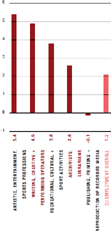
1.% CHANGE IN EMPLOYMENT IN SELECTED OCCUPATIONS EU 1995 – 1999
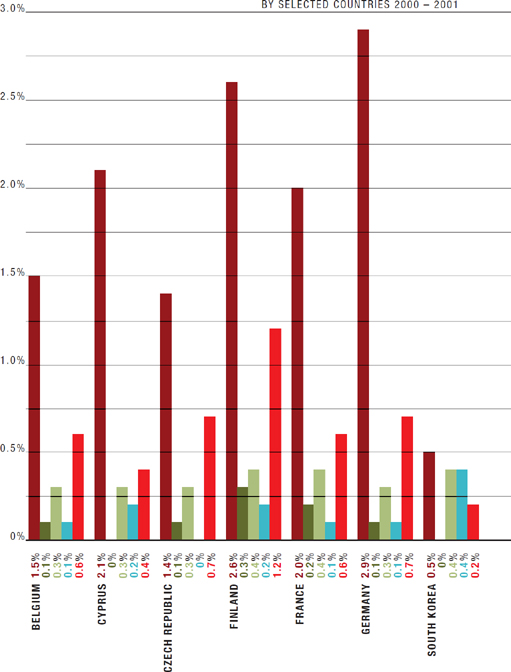
2.% OF TOTAL EMPLOYMENT IN SELECTED PROFESSIONS
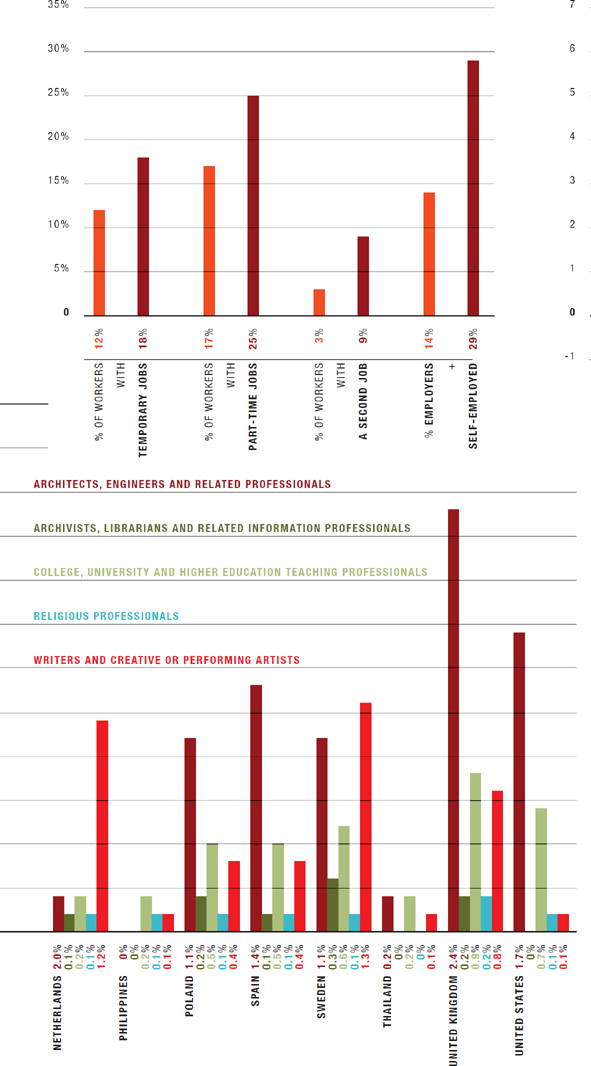
3. EMPLOYMENT STATISTICS FOR ALL WORKERS VERSUS CULTURAL WORKERS EU 2002
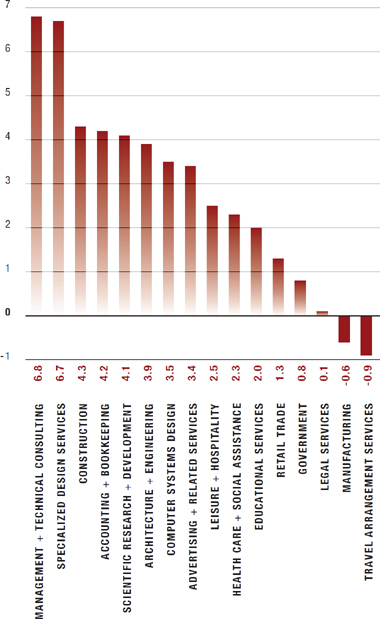
4. ANNUAL % GROWTH IN EMPLOYMENT IN SELECTED PROFESSIONS US 2005
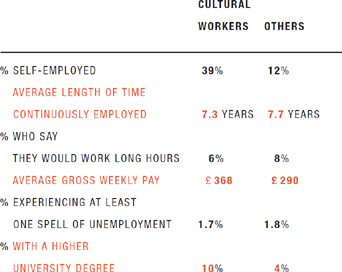
5. KEY STATISTICS ON CULTURAL OCCUPATIONS IN THE UK
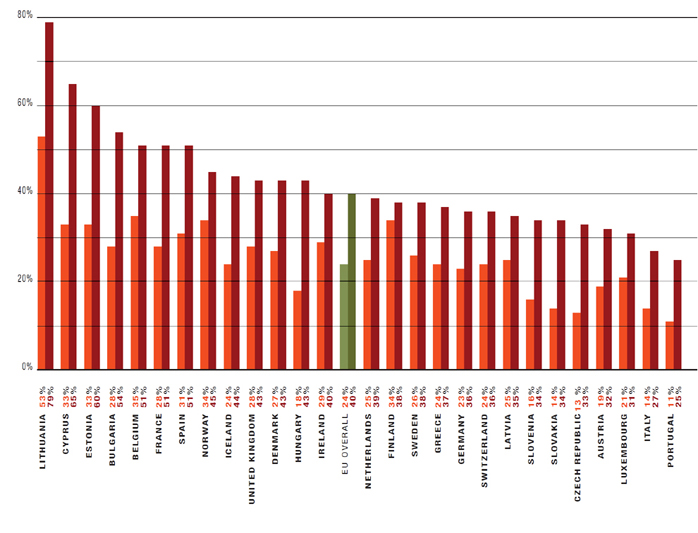
6. % OF UNIVERSITY GRADUATES IN GENERAL EMPLOYMENT VERSUS CULTURAL EMPLOYMENT EU 2002
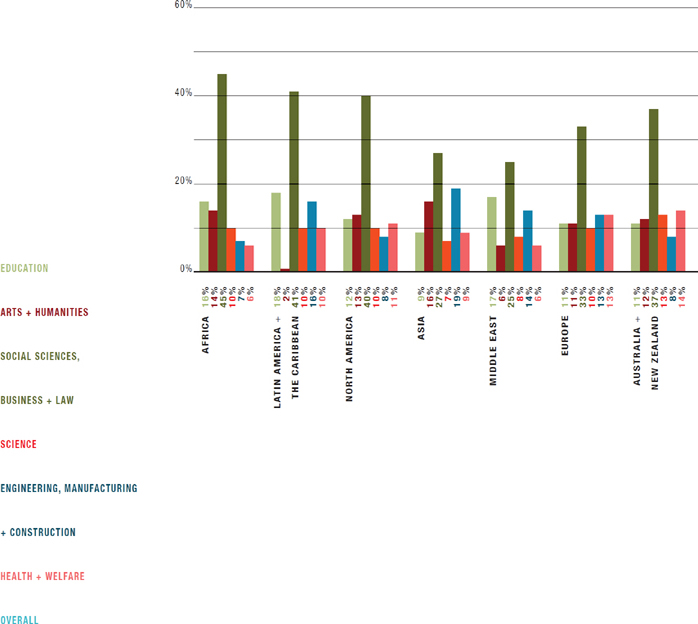
7. % STUDENTS GRADUATING FROM TERTIARY EDUCATION BY FIELD OF STUDY AND REGION 2002 – 03
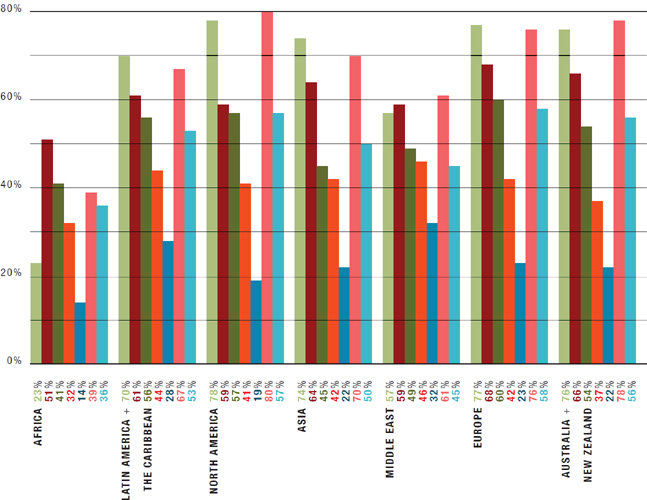
8. % FEMALE GRADUATES IN TERTIARY EDUCATION BY FIELD OF STUDY AND REGION 2002 – 03
CULTURAL PROFESSIONS The growth of the cultural industries and increasing commodification of cultural products has spawned a simultaneous growth in employment in cultural occupations. This growth is changing both the types of jobs available and the nature of the work itself. Growth in cultural occupations is not evenly distributed around the world, however, as it is growing most quickly in the more developed economies, particularly in Europe. Employment in cultural professions generally requires higher education, specialized skills, and considerable risk-taking as cultural employment often takes place on a temporary or part-time basis, or within the context of self-employment. The indicator suite shows that:
- In the EU, from 1995–1999, employment in the cultural professions grew faster than overall growth in employment. Particularly, in the entertainment and sports professions, as well as writing and creative or performing arts. Growth did not occur in pub-lishing, printing, and reproduction of recorded media, which may be due to the rapid consolidation of those industries (e.g. see suite on Books).
- The growth of cultural professions in the EU is reflected in greater percentages of university graduates in cultural employment then general employment in 2002, for all countries with available data. This trend is especially noticeable in economies in transition such as Estonia, Hungary, Slovenia, Slovakia, and the Czech Republic
- In EU countries, a higher percentage of the European population is employed in cultural professions particularly in architecture and engineering.
- In the US, employment in cultural professions is also on the rise. Fields such as specialized design services, architecture, and advertising are growing quickly, while fields such as retail and law are growing at a slower rate, and manufacturing is declining
- Conversely, cultural workers in Europe are more likely to hold temporarily or part-time jobs, to have a second job, and be self-employed than other workers overall. This suggests that cultural employment is more transitory and insecure than employment in other fields.
- Looking at the percentage of students graduating from university in select fields of study across the globe, we find that in every region the highest percentage of students graduated in social sciences, business and law. Females are highly represented in tertiary education, and particularly in fields of study likely leading to cultural employment. In every region, females make up more than half of all graduates in arts and humanities, except for Africa, as well as in education and science.
WHAT ARE CULTURAL PROFESSIONS?
...
- Loading...
Get a 30 day FREE TRIAL
-
 Watch videos from a variety of sources bringing classroom topics to life
 -
Read modern, diverse business cases
-
Explore hundreds of books and reference titles

Read next

More like this
Sage Recommends
We found other relevant content for you on other Sage platforms.
Have you created a personal profile? Login or create a profile so that you can save clips, playlists and searches