

Waste Not, Want Not: Eliminating Patagonia’s Pre- and Post-Consumer Textile Waste
Case
Teaching Notes
Supplementary Resources
Abstract
Patagonia has set a goal of eliminating all textile waste by 2025. As a leader in the sustainable apparel industry, this includes not only the cut-and-sew scraps and the liability fabrics, but also the end of life for all of its garments. In order to achieve this goal, innovation must occur throughout the entire lifecycle of Patagonia’s products: from the design and the manufacturing, to the consumer behavior side. The company has sought to change the way customers think about clothing – encouraging them to buy fewer, more durable products based on real needs. Patagonia has also worked to create alternatives to landfill for garments at the end-of-life – like repair, recycling, and upcycling. With the mission of: “We are in business to save our home planet,” Patagonia must achieve this in such a way that other companies can replicate. The case explores aspects of this goal through the eyes of a number of Patagonia employees who work on different teams within the apparel and gear business.
This case was prepared for inclusion in Sage Business Cases primarily as a basis for classroom discussion or self-study, and is not meant to illustrate either effective or ineffective management styles. Nothing herein shall be deemed to be an endorsement of any kind. This case is for scholarly, educational, or personal use only within your university, and cannot be forwarded outside the university or used for other commercial purposes.
2026 Sage Publications, Inc. All Rights Reserved
Resources
Exhibit 1. Five Main Phases of the Apparel Industry Lifecycle
Four hand-drawn boxes labeled as follows from top to bottom, design product, extract raw materials, manufacture, and distribute, are seen in a vertical column on the left, with a circle labeled user, below them. A fifth box labeled landfill is seen below the circle. Arrow heads point from the bottom of each box to the box below it, from the fourth box to the circle, and from the user circle to the fifth box below. Circular arrows are seen to the right of this flow to the right of the user circle that point from the user circle to each of the boxes above. The smallest circular arrow at the user box is labeled repair, and points to the start of the same arrow. The second circular arrow is labeled reuse, and points from the start of the user circle to the distribute box above. The third circular arrow is labeled remanufacture, and points from the start of the user circle, to the manufacture box above. The fourth circular arrow is labeled recycle, and points from the start of the user circle, to the extract raw materials box above.
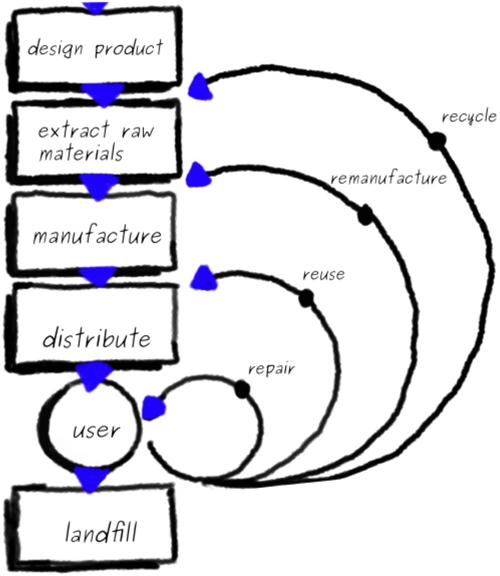
Source: Rachel Dzombak (UC Berkeley) & Heather Dillon (University of Portland).1
Exhibit 2. Model for New Circular Apparel Industry
The flow is titled creating a new textile economy. The four steps are superimposed on a rounded square outline in a bright color. The first step shows a man near a tree holding both his hands up, and a semicircular pond with fishes, in front of him. This is on the left side of the outline. The text at this step reads, phase out substances of concern and microfibre release. The second step is on the top outline of the square and has an infinity symbol above the outline, with both halves in two different colors. The icon of a tee shirt in the other color is seen superimposed on each half of the infinity symbol. The text at this step reads, increase clothing utilization. The third step has a dark-colored box with a receptacle on the right and an icon of a tee shirt going into it, symbolized by an arrow pointing from the tee shirt to the receptacle. A ball of yarn is seen coming out of the spout on the left side of this box. Two arrows that peel away from the outline point away from the base of the box. The first arrow from the dark box points to text that reads, anaerobic digestion & composting. The second arrow from the dark box points to text that reads, other material streams. The fourth step is on the bottom outline of the square and shows a windmill and two solar panels, with text below that reads, make effective use of resources and move to renewable inputs. A line peels away from the outline at the fourth step that points to text below that reads, renewably sourced feedstock. Logos at the bottom left reads Circular Fibres Initiative and Ellen MacArthur Foundation, and text at the bottom right reads tiny.cc/fibres
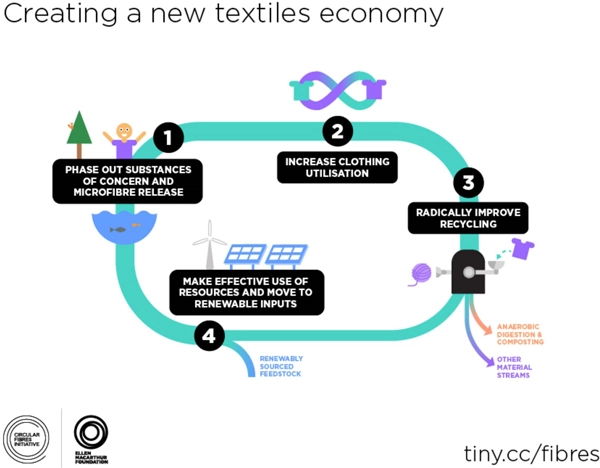
Exhibit 3. Clothing Purchases Grow as Utilization Falls
The x axis of this line graph shows the years between 2000 and 2015, in intervals of 5 years. The y axis of this graph show values ranging from 100 to 200, in intervals of 10. The three trend lines seen in this graph are labeled: world GDP, clothing sales, and clothing utilisation. The title of the first two trend lines reads, index 100 in 2000, and that of the third reads, number of times an item is worn [superscript 1] [Note below: superscript 1: Average number of times a garment is worn before it ceases to be used]. The world GDP trend line and the clothing sales trend line both start at about 100 around 2000. Both lines increase until 2015 with the clothing sales line growing at a much greater rate than the world GDP. The clothing sales lines ends at about 195 around 2015, and the world GDP ends at about 155 around 2015. The clothing utilisation trend line starts at 200 around 2000 and declines until 2015 to about 160. This line intersects the clothing sales line at about 170 around the year 2010. Two dark circles are seen superimposed on this graph. One just above the world GDP and clothing sales lines that reads, −50bn units (2000). An arrow labeled 2× points from this circle to the other dark-colored circle above the top of the clothing sales line on the right that reads, >100bn units (2015). The source below reads, Euromonitor International Apparel & Footwear 2016 edition (volume sales trends 2005–2015), World Bank, World development indicators – GD (2017).
Logos at the top right reads Circular Fibres Initiative and and Ellen MacArthur Foundation, and text at the bottom right reads tiny.cc/fibres.
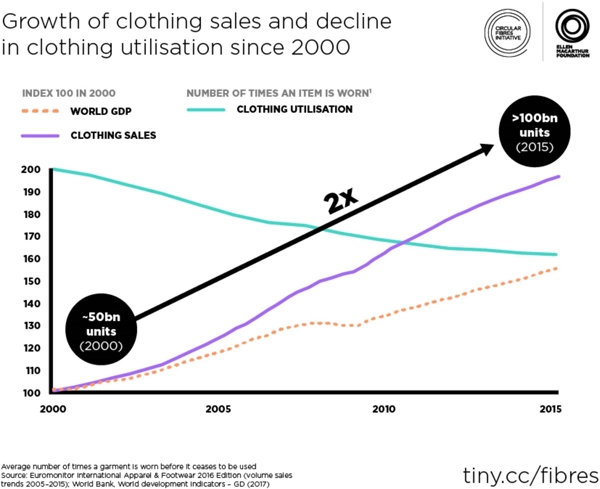
Exhibit 4. Worn Wear Infographic
This poster has five rows of boxes with illustrations and text in each box. The first row reads, keeping gear in use across the left side of the row, with the word use in very large text on the right side of the row. The second row has a drawing on a striped jacket on the left, a speech box in the middle box that points to the right that reads, “The best jacket for our planet is one that already exists.” The text in the third box on this row is an excerpt from a founder’s speech. The third row has two boxes. The box on the left reads, we get back items through [all in small text], returns; trade-ins; repairs [all in very large text]. The next box has a pile of clothes with text on the right that reads, this is what we do with all [in small text] the gear you send us [in very large text]. Four elbow arrows from this pile of clothes point to the each of the four boxes of the row below. The first box on the fourth row has the drawing of a Patagonia store front with the word, if it’s functional [in small text] above, and resell [in very large text] below. The second box has the drawing of a sewing machine with the text above that reads, if it’s damaged [in small text], and repair [in very large text], below. The third box has the drawing of open scissors with a banner on it that reads recrafted. The text above this reads, if it’s beyond repair [in small text], and recraft [in large text], below. The fourth box has the recycle symbol with text above that reads, if it’s reached the end [in small text], and recycle [in large text], below. The last row has close up of a cuff on the left, an RV in the middle, and the logo of Patagonia on the right. The poster has a sentence along each edge. The text along the top edge reads, if it’s broke, fix it. The text along the right edge reads, 15,000 repairs on the road around the world at over 150 repair events. The text along the bottom edge reads, 9 repair vehicles worldwide. The text along the left edge reads, US, Europe, Latin America, Japan, Korea – 25 countries had tour stops. These sentences are all joined by a dashed line.
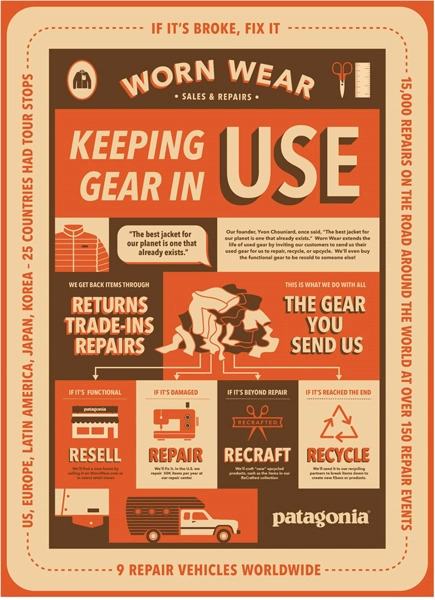
Exhibit 5. Delia – The Original Worn Wear Vehicle Travels Around North America Advocating for Reuse and Repair
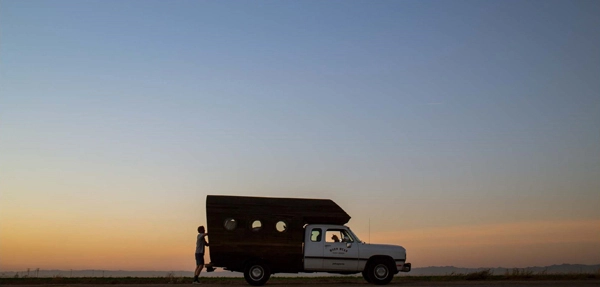
Exhibit 6. Worn Wear – Boulder, Colorado Pop-Up Store in Winter 2019
A poster on the left wall reads, the stories we wear and has four rows with three images on each row. The text on the top of the poster on the right wall reads, trade it in. A work table with a semicircular cover over it is also seen on the right below this poster.
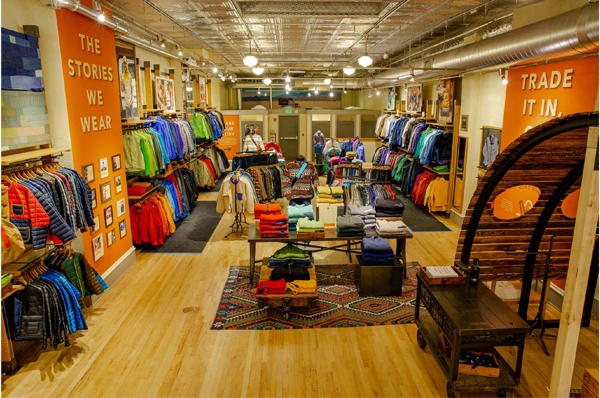
Exhibit 7. ReCrafted Collection Within the Worn Wear Boulder, Colorado Pop-Up Store
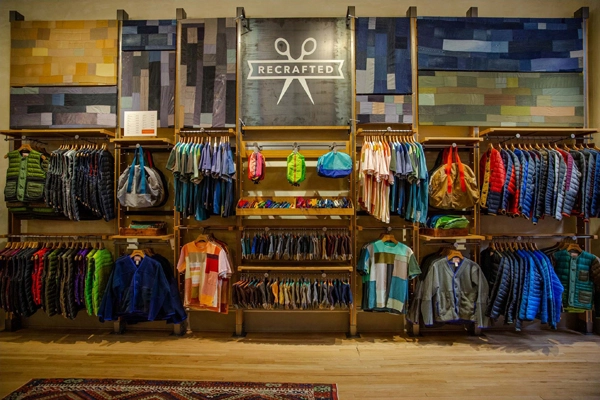
Exhibit 8. Goodwill Students for Zero Waste Graphic
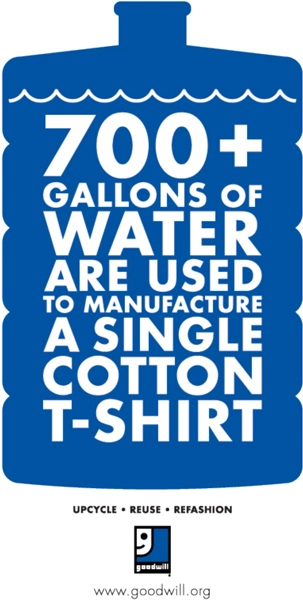
Exhibit 9. Apparel Industry Waste Sources and Current Solution Options
Pre-Consumer Waste | Who controls waste? | Source | Current solution options |
Liability Fabric | Factory and Patagonia | Excess fabric at finished goods and raw material factory |
|
Factory Scraps | Factory | Scraps leftover from production of final products |
|
Factory Seconds | Patagonia | Products made with some sort of defect at the finished goods factory that arrives at Patagonia’s warehouse |
|
Post Consumer Waste | Who controls waste? | Source | Current solution options |
Trade-Ins | Patagonia | Bought back from consumers at retail stores and via mail for merchandise credit |
|
Patagonia Returns | Patagonia | Items returned from customers for various reasons | |
Patagonia Repairs | Patagonia | Items sent in for repair by customers using Patagonia’s IronClad Guarantee | |
Patagonia Recycling | Patagonia | Items sent in by customers that have no or little useful life left | |
Customer @ Home | Customer | Items in customer closets that go unused |
|
This case was prepared for inclusion in Sage Business Cases primarily as a basis for classroom discussion or self-study, and is not meant to illustrate either effective or ineffective management styles. Nothing herein shall be deemed to be an endorsement of any kind. This case is for scholarly, educational, or personal use only within your university, and cannot be forwarded outside the university or used for other commercial purposes.
2026 Sage Publications, Inc. All Rights Reserved
Get a 30 day FREE TRIAL
-
 Watch videos from a variety of sources bringing classroom topics to life
 -
Read modern, diverse business cases
-
Explore hundreds of books and reference titles

Read next

More like this
Sage Recommends
We found other relevant content for you on other Sage platforms.
Have you created a personal profile? Login or create a profile so that you can save clips, playlists and searches