
Summary
Contents
Subject index
Increasing disruption, diminishing returns, and demanding Customers require business leaders to create more Value, remain relevant, and stay ahead of competition. CEOs have to evolve a “Value Creation” culture for the company so as to properly balance the interests of Customers, Employees, Investors, and the Marketplace.
Preface
The world is changing. Today management gurus are espousing Customer Value and Value Creation. Are you?
Satya Nadella, CEO of Microsoft, has crafted a new vision for his company to change for the future through Value Creation by empowering every person and every organization on the planet to achieve more! You need this kind of thinking to win in the future.
This book is to inspire CEOs and executives aiming to reach the top, and those on the top to remain there for a longer time. Even small business leaders and entrepreneurs will find the ideas in this book easy to implement and mostly inexpensive, because it means mostly adapting the right mind-set. The book focuses on why you should Create Value and how Creating Value can give you and your company longevity, sustained success and higher profits than other businesses, innovating and grasping opportunities before others do. Growing the Customer asset effectively requires a culture of Creating Value for the Customer before you can extract Value. This book changes managerial thinking to focus on Value Creation for other stakeholders (read employees, Customers, partners, unions, and society) to improve shareholder wealth significantly. This book makes Value Creation a distinct management practice1 as opposed to the old profit and company-focused ideas taught by many B schools. Do remember, as you do all this, that Customers Create Value for your companies.
Keep in mind, companies turn toward the Customer, just as sunflowers face toward the sun. They do so to get sustenance and absorb what the Customer has to give. The connection does not often go beyond this. Are companies really like sunflowers, or is there more to the relationships between the Customer and companies?
Unfortunately, the crucial role of the company toward the Customer remains static. It has not moved far in the last 100 years, except to track the Customer more closely (CRM2), understand his transactional ratings better (CSat3), know whether he likes companies (NPS4), improve multichannel contact (call centers and multimedia), and install better systems and processes. I suspect that much of this expenditure is justified from the cost-cutting or efficiency perspective, rather than true Value Creation for Customers.
The Customer is central to the company's needs and should be treated as such, and not as a taken for granted asset5 that does not need to be maintained unlike other capital assets, such as machinery, buildings, furniture, etc.
CEOs understand that their manufacturing managers must have a plan for maintaining their machinery, both routine and emergency. Maintenance of Customers is relegated to CRM and loyalty programs. Maintenance is not handled well, nor seen as a core task.
This book is for CEOs and managers to help them create more Value for the Customer and other stakeholders and thereby for the company. It advocates using the Customer asset effectively. The focus of Value Creation is not just on innovation but implementation. The book also indicates what factors prevent true Value Creation and what destroy it. The book will help CEOs get out of the present mind-set as Customers become stronger and companies, more fragile. How attractive your company is to Customers can make or break a company when measured through a Customer Value Index, and shared with marketplace and Customers. Such a public Customer Value Index will make companies work harder to Create Value.
This is a main effect and strategic book, and does not go into contextual or moderating variances between companies depending on external factors, the environment, the economic state of the company, and so on.
This book is for CEOs who have been Creating Value, partly consciously and sometimes unconsciously, probably much more instinctively. And somewhere they have destroyed Value unwittingly or unknowingly. This book is a wake-up call, because the deliberate creation of Value and the mindful avoidance of Value destruction can put you and your company in another league—the league of next forward-looking practices and increased success. All this through a focus on helping your employees and partners to create more Value knowingly and conscientiously for Customers! You need to move your employees’ current functional thinking (as taught in business schools) to Creating Value. They will become better employees and create more Value for not only the Customer but your partners, society, and also for you, your company, and its investors as they move from functional thinking to Value Creation. Value Creation is also about making decisions with flexibility and managing dilemmas.6 We do not spend time on the dilemmas faced by CEOs; however, by concentrating on Value Creation for Customers and not giving away Value to Customers, dilemmas are minimized.
Mahajan's Five Laws of Value Creation are given below:
- The 1st Law: Value Creation is a basic requirement or a necessity for the advancement of human activity, progress, and creativity. Value Creation is important in all fields, education and academics, society and government, social work, innovation, entrepreneurship, and business. It impacts humanity. It is essential for executives and leaders.
- The 2nd Law: Value Creation is proactively exceeding what is basically expected of you or your job. It is going beyond your functional and routine roles to Creating Value in your ecosystem. Value Creation can be planned or spontaneous, and in both functional and emotional thinking.
- The 3rd Law: Value Creation impacts all stakeholders, you, your colleagues, your employees, your partners (supply chain, delivery chain, unions), and society to create resounding Value for the Customer and, thereby, for the shareholder.
- The 4th Law: Value Creation leverages a person's or an organization's potential, learning, and creativity while making it meaningful and worthwhile for people to belong and perform, both physically and emotionally.
- The 5th Law: Value Creation must exceed Value destruction or reduce negative Value and be done conscientiously.
Table P.1: Functional versus Value Creation Management
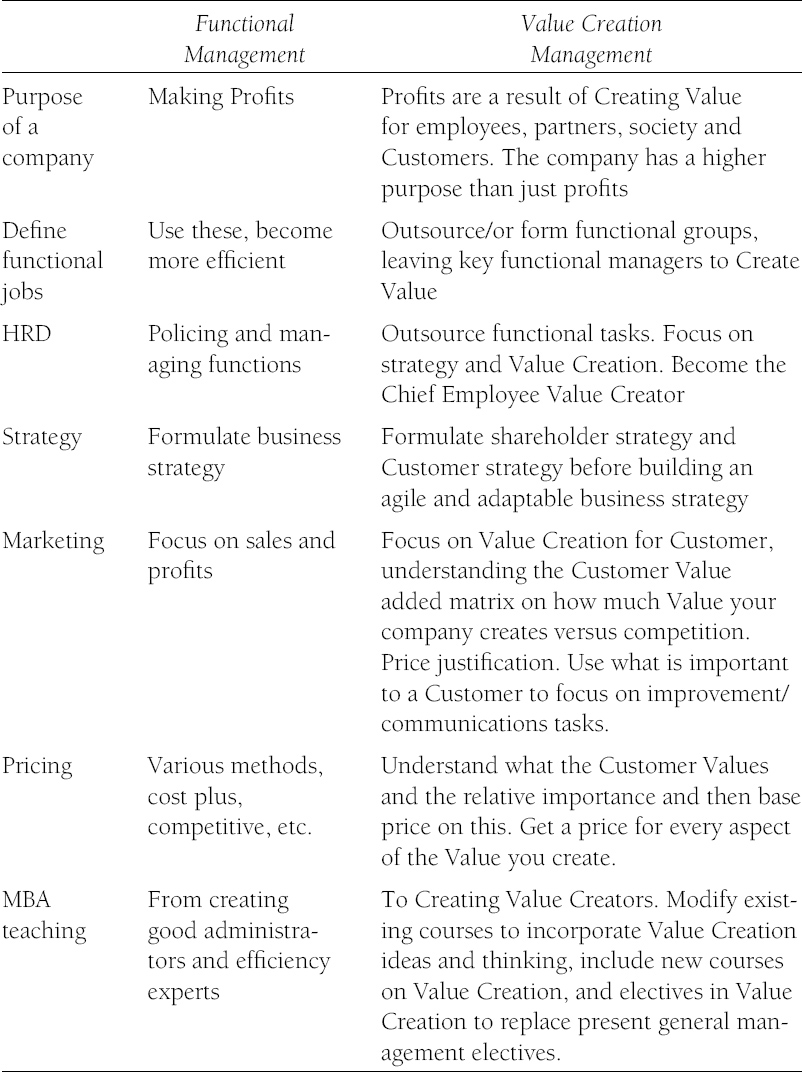
Only CEOs can assess what their real role is. For success, management gurus state that leaders must set the right priorities (and I would say that one of the high up in importance is a real Customer priority), hire the right people, and then be able to establish a relationship with people. Yet another role is to ensure that your company survives for the long term and so does he. Notice that the average life of a company was 28 years in 1974, while in 2008 it was about 12 years (see Figure 1.4 on page 20). And a CEO ran a company for an average of 10 years in 2008, whereas today, the CEO lasts for only about 2 years—a result of short-term focus and inadequate attention to the Customer. Mckinsey reports that the number of companies dropping out of the top three rankings in their industry increased from 2% in 1960 to 14% in 2008. What's more, market leadership is proving to be an increasingly dubious prize: The once strong correlation between profitability and industry share is now almost non-existent in some sectors. “According to our calculation,” says Mckinsey,7 “the probability that the market share leader being also the profitability leader declined from 34% in 1950 to just 7% in 2007.”
Customer rewards to companies that add more Value include:
- A 1% increase in satisfaction/Value typically increases share price by 4.6% (based on a 10-year University of Michigan study).8
- A 5% increase in Value increases return on investment (ROI) by 7.5–10%.
- Market share follows Customer Value created. Companies with over 40% market share tend to have 30% more ROI than companies with 10% market share (PIMS9 data over 1,000 American companies).
- PIMS data also show that the top quartile of Value Creating companies for Customers had 30% more ROI than the ROI of those companies creating the least amount of Value.
- Share of wallet increases significantly with increase of Customer Value.
Companies, likewise, have to Create Value for their employees and Customers, partners and unions, and become firms of endearment and great at creating happiness (as exemplified by Zappos, the clothing and shoe company led by Tony Hsieh, whose philosophy is to have a human face and deliver happiness). They then create inordinate Value for their shareholder and investors. They attract the best talent and retain the high Value Customers. Such companies are termed as firms of endearment (see the book of like name by Raj Sisodia, David Wolfe and Jagdish Sheth)10 and have radically new rules for business. Firms of Endearment created a 1,026% return over a 10-year period, eight times more than the S&P return in that period. And in 5 years they returned 128% versus the S&P return of 13%, all by focusing on the Customer and endearing themselves to their employees and partners. Such a focus on Customers leads to higher profits. And therefore, companies need a Chief Value Creator (the CEO), a Chief Employee Value Creator (Chief of HRD), and a Chief Customer Value Creator (generally the COO).
Value Creation11 in the past was thought of as Creating Value for the shareholder,12 the investor, or the company. Today the intended recipients of Value Creation are your employees, Customers, partners, labor unions, society and, thereby, the shareholder or investor.
This book gives the CEO what he wants to know about Value Creation and success, and how to balance the elements of Value Creation.
It tells you why the intended recipients of Value Creation are important to the CEO's success, and to the well-being, prosperity, and longevity of the corporation. It shows you how to Create Value and how it relates to success. It helps you take the steps toward changing an entrenched mind-set and become flexible and creative.
Value creating companies tend to be long-term and long-lasting companies. They have capital self-actualization or display conscious capitalism, create emotional bonds, and understand that love is a killer differentiator. Share of wallet is replaced by heart share.
CEOs are painfully aware that their business, employees, and Customers will undergo a sea change. Product and market expectations will change in the new digital world. Competition will become more intense and Customers will demand their rightful role as sustainers of your company. Therefore, the future will require agility, adaptiveness, and ambidextrousness (3As) and the ability (the 4th A) of CEOs to Create Value. Some CEOs may find it convenient not to focus on Customer relations, particularly with pressures to innovate and deliver new products fast and through e-commerce opportunities. But these CEOs will still need the 4As to be winners.
What prevents companies from being more focused on Customers?13 Is it because that is the way we always did business (if not broke, why fix it)? Is it the way we were taught to manage businesses and Customers? Or were the Customers passive and less demanding? Or was the competition less intense? Or did competition do what we do? Or is it because of President Eisenhower's14 differentiation between urgent and important work (we tend to prioritize urgent work and, therefore, feel we are doing the right things)? Or is it that short-term focus on improving the bottom line has deluded managers to expect long-term sustenance from the Customer, come what will? (Value Creation will improve both short-term and long-term profit, once it takes hold as a corporate culture.)
It also could be that major global think tanks and B schools continue to focus on process and system improvements, while also looking at non-financial parameters. One example is The Value Creation Journey.15
The book is divided into sections that are of interest to CEOs, and it also points out that Value Creation impacts all aspects of our business life. The book shows that if the Value Creation mind-set change materializes in a company, competitors will find it difficult to emulate and catch up, unlike products whose lead times are becoming low. The book is like a Swiss army knife with tools that the CEOs can utilize: what they could look at and why, and Value Creation for Customers, employees, partners, society, and thereby for the organization.
How do CEOs ensure they remain ahead of competition? How do CEOs make certain Customers, employees, and investors want to stay with them? The stakeholders want more Value Creation from the CEO. This book is a collection of chapters that tells you how to Create Value and become enduring and successful business leaders. Read about Value Creation and its benefits to you and your company and stakeholders in the chapters that help CEOs become business heroes.
You can read any essay when you have a couple of minutes.
Benefits of Value Creation
Value Creation is the next big management practice
Getting your entire ecosystem to resonate with you and your company ensures business leadership, longevity, and long-term success. Value Creation helps you and your executives to do this at little cost, improving your Customer Value Index score indicating that your Customers can reward you with loyalty and market share!
Using Customer power and ratings ensure disruptive and continued success. Value Creation changes mind-sets of people (employees and Customers) for conquering the future. The brand is being replaced by the informal Customer score on the net. The Value Creation Index score will reflect Customer sentiment and your future.
Recognizing the role of an executive (and the company, which is made up of people) is to Create Value (and prevent destruction of Value) for himself, his employees, his partners, and society and thereby create long-term and sustainable shareholder wealth.
For the Executive and Worker
Becoming educated on the latest management ideas of Value Creation leading to self-improvement and to superior performance and Value Creation for other employees, the department, and the company will help executives transform their role from just being good and efficient functional administrators to becoming conscious and inspired Value Creators.
For the CEO
Value Creation is a strategic and practical guide for CEO success and leadership style. It refocuses on important work and not just on urgent work and shows the CEO how focusing on Value Creation is a natural business practice that does not add to costs but to success and profits. Decisions and dilemmas can be managed through Value Creation.
For the partners
Value Creation for partners (supply and delivery chain and unions) will make them loyal and go the extra mile for you.
For society
Creating Value for society and having Values that resonate with employees and Customers will make you a preferred employer and company of choice for the Customer, and they will reward you with more business and/or higher prices. Values Create Value.
For the company
Improved performance from executives (as discussed earlier).
Instituting the Value Creation culture will ensure that Value Creation precedes extraction of Value for the company from the executives.
Value Creation refocuses management thinking on Creating Value for the employees, Customers, partners in delivery and supply chains, unions and their people, and society which in turn grows shareholder wealth.
| Figure P.1: Value Creation Positively Impacts Your Stakeholders | |
|---|---|
| Employees | • Becoming educated on the latest management ideas of Value Creation leading to Self Improvement and to superior performance and Value Creation for other employees, the department and the company and avoiding Value Destruction. |
| Customers | • Increase Value to Customers, increasing loyalty, market share, and the Customer asset. Create Value for the Customer before you extract Value. |
| Partners | • Creating Value for your partners (supply and delivery chain and unions) will increase Value for you, as they become more loyal to you and go the extra mile to benefit you. |
| CEO | • Value Creation is a strategic and practical guide for CEO success and leadership style: refocuses on important work and not just on urgent work. Shows the CEO how focusing on Value Creation is a natural business practice, and it does not add to costs but to success and profits. decision-making can be made by understanding what creates more Value, and helps in managing dilemmas. |
| Society | • Creating Value for society and having Values that resonate with the Customer will make you a preferred employer and company of choice for the Customer, and they will reward you with more business and/or higher prices. Values Create Value. |
| Company | • Value will be created for the company, it will get longevity and long-term success, and increased ROI. Value Creating companies will get a higher Customer Value Index, and become more desirable to your Customers and non-Customers. |
| Shareholder | • Shareholder wealth will increase in the short and long term. Their company will be more respected and profits and share price will go up. A 1% increase in Customer Value will increase share price 4.6%. |
The Book Layout
The major part of this book is about why Value Creation is important, how it impacts the thinking of CEOs in the short term versus long term, and how you can add Value to Customers, employees, and build Value Creation in various departments. We talk about Creating Value in training, in leadership, and in making the Customer your partner and ambassador. Our suggestion to the CEO is to change the focus of departments such as HR and IT to become Customer focused and become line managers. We dwell upon reducing the focus of executives on routine and functional tasks and concentrate on important Value Creation jobs instead, that is, “outsource” routine work. We discuss future, self-tuning companies and why they should have agility, adaptation, and ambidextrousness. Such companies are run by able CEOs, moving from ‘selling to Customers’ to becoming the Customers buying aide. We show how your Customer Value Index can be improved through Value Creation.
This book also discusses the change in market environment, the Customers and companies of the future, and the changing ecosystem.
The book, early on, examines why Value Creation is important to CEOs and why embracing this management practice is a sustainability and growth necessity for them. Having understood this, the book tells business leaders how they can become Value Creators for the business and the Customer, and how they can use Value Creation for the Customer for their own and their company's good.
Next, the book shows how the CEO's and the company's Values and ethics are important and Create Value for the Customer and, thereby, immense Value for the company. From this, the CEO is given ideas on business transformation to create more Value.
The logic for Creating Value for the employee and how to do so is examined. Following this are chapters that discuss how various Chief Experience Officers (CXOs) can Create Value (HRD, Marketing, Finance, and others).
Value Creation is executing proactive, conscious, inspired, and imaginative actions that create better gains or benefits for Customers and all stakeholders, including enhanced ROIs.
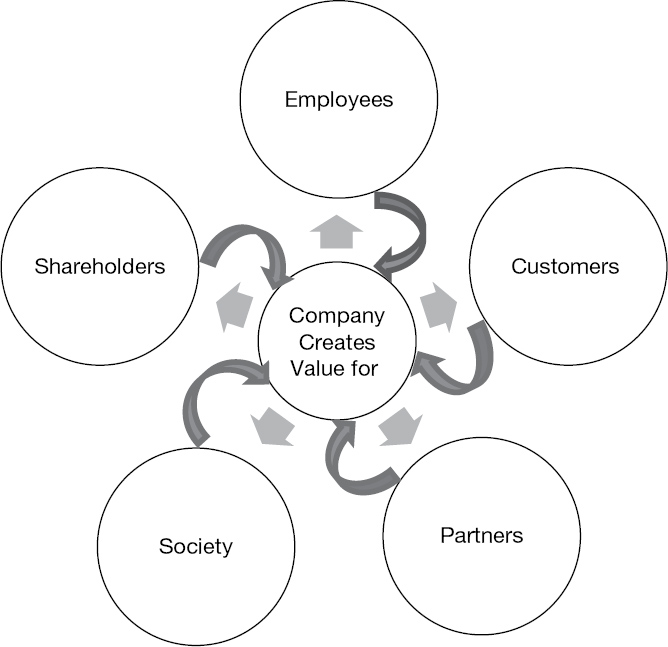
The company will think of new products and services that Create Value for the Customer, hopefully disruptively.
Value will be created for the company; it will get longevity and long-term success and increased ROI. Value creating companies will get a higher Customer Value Index and become more desirable to your Customers and non-Customers (your competitor Customers and Customers not in your segment).
For the Shareholder
Shareholder wealth will increase in the short and long term. Their company will be more respected, and profits and share price will go up. A 1% increase in Customer Value will increase share price by 4.6%. Shareholders will put in more quality investments.
More granular is how Value Creation can be increased in Customer service and in strategies to increase loyalty. And then, we come to the profit part on how to increase prices and Value to the company.
We then show how Value Creation can be used in education and how it is a more universal tool usable outside of business in society.
Lastly, the book helps the CEOs to drive their companies to a leadership role and to increase profits through Value Creation. Value Creation implementation steps are discussed.
The appendices have interesting articles on Value Creation, and more Value Creation ideas and definitions.
Background: The Evolving Ecosystem
To understand the need for Value Creation as an important management practice, we must understand the environment and the ecosystem. In this section, we will look at the change in the market environment, the evolving ecosystem including the changing Customers and the changing companies.
Change in the Market Environment
Technology and disruption, digitization, emerging countries as market powerhouses, social conflict of the haves and the have-nots, religious militancy, aging and youthing16 (baby boomers aging, millennials entering the Customer stream), rapid changes, and unbelievable and unseen opportunities have to make CEOs rethink their businesses and their purpose. On top of that, more and more CEOs are seeing the wisdom of long-term thinking versus the potential harmfulness of short-term-ness, and are crafting a purpose for the corporation. Purpose is more than just profits, but a reason to exist meaningfully in this world where we are using 150% of our resources. Purpose therefore demands focus on sustainability and citizenship. Both corporate consciousness and capital consciousness advise the separation of shareholders from the corporation and suggest that eventually enlightened shareholders/owners will emerge. CEOs also need a purpose. For both the company and the CEO the purpose has to define who you and the company are and what makes you distinct and different.
For business schools and other institutes
Value Creation will lead to changing the education and B school paradigm, and teaching Value Creation will become the prime role of a leader and general managers. Teachers should Create Value for the students while teaching and interacting with them. The B school program has to be modified to make Value Creation a general management elective. Current courses can be modified to show how to Create Value. For example, engineering students can be taught how to Create Value in the real world.
This thinking becomes more important because a CEO is forced into the new digital world of artificial intelligence (AI), unbridled gadgetry using biotech and bio instruments, the Internet of Things, more workers and unemployment, lesser/more dependency on the worker. The CEO has to think about spending power, inflation, currencies and payment means, definitions of geographies, markets and industries whirlpooling together into indiscernible continua, while social and government stakeholders will impact micro and macro marketplaces (micro meaning the individual, macro meaning everywhere). Bundle this with active, forceful, and destructive Customer reactions, better knowledge assessment, and anticipation with the half-life of new technologies reducing, and you can easily see that the CEO's life is not easy!
What does a CEO do to get ready for this new world?
First he has to realize that his role is to Create Value and balance this for all the stakeholders, while understanding that they are all interconnected. He has to lead by learning how to create this Value in a fast moving world where his stakeholders are changing and are becoming more demanding. The CEO always knew this, but did not prioritize this role as the world had been slow moving and the demands from the employees, partners, Customers, society, and government had been less intense. Thus, he has to re-learn and change focus and direction to be the winner in the coming decades. This book helps him to do this, to consider options and show why and how to balance the seemingly conflicting (but actually complementary) pulls and pushes on him.
Management gurus urge CEOs to embrace these new paradigms. It just is not possible to become enlightened without taking the first few steps while grappling with competitive pressures, changing technological and product landscapes, growing employee and Customer demand, compulsion to perform for the short term, and so on. But what is important is to take the first baby steps toward the new paradigm, while wrestling with transforming existing thought processes.
This new thought process is Value Creation. It is not really a new thought process; it always existed, but it has been relegated to the back burner, and Value Creation continued as a normal course of doing business (and mainly for the investor or owner). Value Creation by those who could create meant going beyond what was expected from you in your job. People were not conscious; they were Creating Value or destroying Value. And therefore the effort was muted. By making Value Creation a mainstream activity, CEOs can then embark on changing for the future.
Value Creation is for society also,17 and we discuss its role in education and in society (examples include the Value of an address [giving digital addresses to people who are homeless or in slums and do not have a proper address], government).
In a way, Narendra Modi, the prime minister of India, has embarked on changing India by talking about Creating Value for the underprivileged, the industry, the common man, the bureaucrats, and society at large.
But how is this Value Creation going to happen—not just by throwing money at the problem? It starts by building the self-esteem of the downtrodden or the citizen when he is harassed and bullied by the government (read income tax, read municipal corporation, read the courts, and so on). How do we get this person's self-esteem18 up? He has to feel good about himself and his environment. He has to feel adequate, important, and wanted.
And this, from the point of view of the CEO, is true of the front-line people and the other staff. How do we make them feel wanted and important? This book tells you how to build this self-esteem and get a feel-good factor for these people. This is the first step to Value Creation.
It is only people with self-esteem who can become aware of their environment and, more importantly, of their role in their own success and the success of those around them including the corporation. This is the first ABCD step (awareness, belonging, communicating and Creating Value, and not destroying Value). And it is only the aware who can Create Value. If you are not cognizant of (good and bad) things happening around you, you cannot effect change or want to change and, therefore, cannot improve or Create Value.
So this book tells you how to make your people Value Creators for their employees, Customers, partners, and society and how this contributes to the growth of your company and your success.
For society, we tell you the Value of the Values that you, the CEO, and your company stand for. Values include morals, ethics, lawfulness, sustainability, charity, goodness, conscious leadership, conscious capitalism, and culture.
We tell you how Values Create Value. We tell you how to Create Value for your Customers and how that Creates Value for you and your company.
This, then, is the company of the future.19 And this depends on you, the CEO. Mckinsey, citing AI gains, has shown how robots are replacing executives (it is happening as robots replace law clerks, pathologists, retail aisle placers, and petroleum geologists). My answer is that this will happen if the executive is not Creating Value! Even more, could Customers who Create Value for the company replace managers who are creating less Value? Humans decide what technology should do, and technology may decide what humans should do (or we hope should help humans do so). Thus, AI and technology may change the face of call center responses, the way we approach Customers and business.
The revolution has started with the release of the Journal of Creating Value20 and key management gurus agreeing that Customer Value is crucial for businesses.21 I (as have others) have delivered courses on Value Creation (such as one for engineers, and others for HR professionals, CFOs, front-end staff, IT, and so on).
To start, let us examine the Customer and the company of the future.
Customers and Companies of the Future
Before we can go into Value Creation, we must embrace the future, and then respond to our best thinking on the future. Let us define the future as the foreseeable one for 5–10 years from now. We have to start with Customers and then asses how companies have to adjust to the changing Customer.
The Customer of the Future
The Customer, in the future, will perform more due diligence before buying, become more digital, look at more options, listen to others’ opinions and digital word of mouth, and have less time and desire to physically ‘browse’. He will want to browse and buy more on the net. He will be looking for confidence and reliability in the supplier. He will want interaction when and where he wants and how he wants. He will be better informed, more price-sensitive, and often will come to buy with his mind made up. Often, he will wish to interact with people who can change his behavior or the way he lives, buys, or thinks.
He will bypass brand for social media scores (brand equity is giving way to social media score equity!)
Imagine the Customer selfie and how it reflects his life and lifestyle. Marketers can look for the first time at the Customer's life through his eyes on Facebook, for example. The consumer is saying look at the world through my eyes.
Because of all this, the Customer will leave a trail that big data can and should pick up. While concerned about his privacy, he will allow companies to track him and please him because as they become knowledgeable about him and his needs, appreciative of his habits, availability, strengths, and weaknesses, they will become more relevant to his needs and to customize for him.
The opportunity and ability of companies to get their work done by Customers will increase. Thus, a car manufacturer can alert a Customer that his car is on the assembly line and the Customer can see it. Conversely, the Customer might want to know if his delivery is on time, and it can be tracked, like if his pizza is on its way and what the expected time of arrival (ETA) is. This will be true for the service person: where he is or whether he is carrying a part I need. This ability exists today but will become more universal, and follow-up by the company will become less and by the Customer more.
The Customer would like the delivery process to be different, where he can pick up purchases close to his home, rather than sitting and waiting for delivery. The convenience of the Customer will become an important selling point, as will concern for his time, energy, and psychic needs.
The first thing that is bound to happen is that conventional selling will change and Customers will deal with people who can present them with product and service options that they want and when they want them (and help them buy and become their buying aides). They want something relevant and desirable to them at a particular point in time. Companies have to help Customers in the Customer decision journey. Thus, if camping, they may want location of good burger shacks or the right insect spray, or if in a mall, options and the best way to navigate to shirts (and stores, and other options).
Funnel systems of selling and time of sales are getting outmoded. Dynamic and iterative buying process on a 24×7 basis will become more prevalent. Which means sellers will need an adaptive and innovative selling method and thinking.
Conventional selling will become modified to being more relevant to the Customer (Customer relevance will become a selling point). Crowd selling to Customers will give way to focused selling of relevant items to those Customers looking to or thinking of buying (or should be thinking of buying).
In the physical world, an example of Customer relevance and crowd selling is like going to a fair and having hawkers selling curios, snacks, etc. Once the Customer seems attracted, one-to-one selling takes place. (The Customer's virtual buying guide will direct him to the desirable curios or snacks.)
This happens in traditional malls, particularly in the East (Thailand, Korea, India, etc.), where the sellers sit outside the shops, looking for interested Customers (though they do try to interest Customers, which sometimes becomes intrusive). Customer aggregations will reduce as marketers concentrate on being relevant and customized. The Customer no longer needs to go to crowded places where there is a variety of stores. The stores will come to him.
Thus, relevant, discrete, and unobtrusive selling to individuals will become more appropriate. This is how the e-selling mode will further develop.
The buyer may also look for those sites that provide him with this buying (I am differentiating buying from selling) facility.
The Customer will start to look at sites/stores that give him options to explore and select, and to have different payment and credit options. He will want to be able to get to adaptive sites that will let him experience the product, as an example, a sofa and how it would look in the room; a car and its leg-room.
Ted Rubin, a digital media expert, talks about a hybrid store building that serves a community allowing a great digital and thereby a great Customer experience. He suggests a video that answers questions even before they are asked. I would say that the Customer wants to be able to see and play with the products, such as a laptop, TV, or a car, on the net to get a feel for it, just like he can peek into a book today. Or he wants to be able to see the physical features of an air conditioner or a refrigerator on the video and how these features work, and see how he can control the temperature, air swing, etc. Else he might want to feel the leg-room on a particular seat in a plane, or the best way to get onto a cruise ship to avoid lines. Google, for example, has some of these features and can alert Customers on the best route, least wait, or airline arrivals.
The Customer will want customized products (color, size, delivery and assembly method and timing, etc.). These will have profound impact on the manufacturing companies. This change has started but will become more universal. Flexible manufacturing and delivery will replace manufacture of scale, where scale used to be a competitive advantage.
Companies have to employ and use big data and social media to pinpoint the Customers’ needs and his location so as to be able to understand the Customer and service him. Companies have to be data-driven; also, they should be able to comprehend Customers and their needs, manage leads better, get involved, and integrate social media.
Sometimes, Customers may find it easier to engage with existing suppliers and get them to collaborate and solve their problems, co-create, or develop new products and services for them.
Accenture suggests that while Customers are better informed, all this can cause overload. Worse still, Accenture adds that they will face confounding web sites, huge call center wait times, and difficulty solving their problems no matter which channel they use. “It all adds up to increased Customer switching that has put an estimated $6.2 trillion [up from 4.9 trillion 5 years ago] in revenue opportunity in play globally.”22
Already Customers are available on (or they may have access to) the net. Perhaps, they will be hardwired, or their brain waves will be tapped (already there is talk of controlling your TV with brain waves).
The Customer could provide this (or capture and then supply as needed) to selected suppliers. Brain wave mapping will make him a more intelligent buyer, and the supplier who has such information from the Customer will become more effective. Perhaps the supplier will know before the desire is articulated what he needs to do. The Customer is already getting wired 24×7 through devices. Perhaps there will be some neural wiring allowing him to understand his needs better. This will change the buying and selling paradigm even further.
Will the Customer be able to tap into AI to articulate his needs, or evolve his thinking on what he wants? Will he be able to assess what he really wants not what he thinks he wants? And which company can help him?
Products will change beyond our imagination. For example, there will be different transportation systems, electric and solar flight pods, and liquid nitrogen engines. Will there be space travel, or time transfer or teleportation? Will science fiction become real, or can we make it real? (Science fiction in medicine and health care, for example, is becoming a reality.) These are real challenges in front of marketers. Products will change our thinking—the Customers’ and the companies’.
Finally, while all of this may lead to less interaction, the Customer will expect companies to be truly H2H (Human to Human) as and when he wants.
The Company of the Future
As with Customers, there will be many different companies of the future!
The first challenge is to understand and perceive the Customer of the future. Should one be re-active or proactive? As the Customer becomes more dynamic, the management has to follow suit and become more adaptive. The strategies can no longer be static, they have to become iterative and vibrant, and change with the market. This changes the strategy paradigm, where we let the marketplace decide and change our direction, or we can change the direction of the marketplace by anticipating the Customer as his needs are developing, changing, and to capture this to be able to make the Customer want to buy from you (forget selling?).
An example of being proactive is to become a self-tuning organization.23 Companies such as Google, Netflix, Amazon, Microsoft, Apple, and Alibaba employ this to understand the Customers’ needs. They use their knowledge to deepen their interaction with their existing Customers to collaborate better, to offer them better solutions, products, or services which are thought out jointly with Customer or the understanding of the Customer.
The other central thought is about more self-tuning and aligning of Value co-creation, where firms will emulate Apple, AirBnB, and Trip Advisor. The idea is to convert Customers from just being transactional buyers to avid promoters of the brand while working together to create mutual Value, strategies, products, and refinements. This makes the Customer an active player, than just a passive buyer, and excited about talking about the brand. (The brand score is giving way to the Customer score!) These companies can then access the Customer's networks (see section, Creating Value from Your Customer's Network, Chapter 3). We want Customers to go from being transactional, supportive, and promoters to be co-creators and feel like co-owners. Just see the apps that support Apple and Android.
This transforms the company into just supporting buying by Customers to making them partners. It gives companies better insight, faster knowledge of Customers, reduces costs, and increases self-tuning (flexibility). Thus, companies have to find such Customers and visualize through self-tuning where and how to operate, trace, follow, and gain partnership positions with the Customer. It is happening and will happen more. You will have to change your company's direction in this fashion.
Change is a strategic thought process and requires the 4As. The first three As are agility adaptation, and ambidextrous (see the Self-tuning Organization), and the fourth is ability of CEOs or able CEOs. Ambidextrous means a company has to be an exploiter (of Customer's preferences) and an explorer (offering things beyond what the Customer has thought, so that new preferences can appear) simultaneously.
Remembering the Customer's needs evolve depending on where he is and what he is thinking, what new products, apps, and services come his way, companies have to be relevant and collaborative and able to supply him what, where, and when he wants, and even before he knows that he wants.
Find the Customer, where he is, supply him with what he wants or make him want something right then and there. The Customer may be wired, and it is possible that his neural impulses could be tapped to provide what he really wants not what he thinks he wants. The Customer is partially wired through cell phone or internet watch, because his position is known through tracking of his actions, such as selfies and conversations with his friends, etc. Google already knows when I send a message to a friend suggesting a con call and puts it on my calendar, or my flight plans. See Doc Searls article in Appendix I
Retail stores will have to be digital and physical (physi-digi24 versus digi-physi25). They will have to build a community that communicates with them. They will need to supply great H2H experience even though hidden in the net. Stores like Tesco are without walls (with online portals), selling non-traditional items like financial services, and allowing other companies to access their resources and programs.
Videos that allow Customers to interact, explore, understand, feel, become comfortable with, and want to buy will be developed and be self-tuning to the needs of the Customer.
Anticipatory service and products will become a norm and the Customer will have better, informed choices.
As companies change and focus toward the Customer, they will be forced to self-tune to the employees and their needs. Departments (will there be any? I doubt it) will have an H2H interaction with employees, sharing, co-creating, co-working/thinking, and collaborating together. The employees will be diverse and creative in different ways and companies will have to foster an atmosphere of creativity, constant change, adaptability, and agility.
Such employees could experiment, do market research in different ways to provide products to the Customer that are adapted to his needs.
Many thinkers suggest that offices should be in the cloud; not physically existing. People will get out of the box into a great big co-connected and innovative space, with freedom and flexibility. Intrapreneurs and intra-owners26 will be cultivated. They will work in an open source environment with few secrets.
Such thinkers feel that the concept of the CEO is dead, and managers and gatekeepers will disappear. This is simplistic, and managing complex, flexible, adaptive and agile companies will require different type of management systems, those which are more focused on Creating Value for the stakeholders. The rigid organograms and structures will disappear as internal competition and collaboration dictate different hierarchies.
I believe that the office of the cloud is clouded with digital thinking and does not represent the huge manufacturing and physical world. True, some multinational offices may become cloud-based because of necessity, but by and large the manufacturing company of the future (and other companies) will change less drastically. Manufacturing companies, railroads, airlines, and hotels will need people to run them. They will not get entirely robotized in 10 years (and someone will have to manufacture and program robots, unless robots become self-generating). Workers, employees, and physical locations will remain. Manufacturing will become more digitized or digitally driven (processes, quality, improvements, information, and so on).
What will change is that companies will shift to new products, fast introduction, short shelf life, and customized and flexible manufacturing so that assembly line products will be distinct. That is, every subsequent product will be different from the first one in consumer-based manufacturing. This has happened in furniture, where one line can produce a table, followed by an office chair with customized upholstery followed by a sofa. Inventory goes down and wait time for products reduces. Or they will go to smaller lines.
Even more interesting would be digi-physi using techniques like 3D printing to produce the same products in different part of the world after digitizing, transferring, and producing. Distributed manufacturing would make the world shrink and impact companies.
Certainly, for many mass products such as cement, fertilizers, salt, steel, aluminium, etc., conventional high-speed manufacturing and subsequent transportation, warehousing, and delivery will continue. Here, the biggest change will come from product development, like better crop nutrients, that can be delivered without wastage and without contaminating the environment. Quantities of crop nutrient will drastically reduce, changing the current manufacturing techniques. Agriculture will be more technical in seeds and products.
The major changes will come from big data in space, robotics and autonomous systems, synthetic biology, regenerative medicine, agri-sciences, advanced materials, and energy (including storage). Just the spending in manufacturing using the Internet of Things (Mckinsey study)27 might be as high as 1.2–3.7 trillion dollars in 10 years and all spending would be 4–11 trillion dollars.
The changes that will come will be in the selling, anticipating needs, iterative and adaptive selling, and production control and sequencing. Changes in shipping and delivery will happen. Delivery chains will move from a centralized system to a localized system of delivery. I think the idea of drones, drop boxes or dropping smaller products at a pick-up point, like current post offices where you are given a code to retrieve your product, will reduce costs. Your presence or waiting at home will disappear except for large products.28
Company thinking will become more Customerized (customized for individual Customer). Companies will become a hybrid structure, where they are accessible and approachable the way the Customer wants it. The rise of digital has given Customers many channels and avenues. It has given companies the same power, if they can use it in a self-tuning, intelligent way.
Companies will also become more society-centric, where their Values will Create Value for the Customer, employees, partners, and society.
Companies will have to understand that loyalty no longer is what they thought it was. Loyalty will have to be a collaborative, adaptive process between the company and the Customer. The company will have to be loyal to the Customer, too.
What I fear most with companies and employees led by digitized, canned programs, where their innovativeness will come from using known techniques and cookbooks for unknown applications, is that they will lose their ability to think of problems in a fundamental, common sense way and become followers of the “cloud,” without understanding the basics and the science behind what makes things happen.
The future will provide new ways of Creating Value for the Customer.
- Loading...
Get a 30 day FREE TRIAL
-
 Watch videos from a variety of sources bringing classroom topics to life
 -
Read modern, diverse business cases
-
Explore hundreds of books and reference titles
Read next

More like this
Sage Recommends
We found other relevant content for you on other Sage platforms.
Have you created a personal profile? Login or create a profile so that you can save clips, playlists and searches