
Summary
Contents
Subject index
People are the most important resource for today’s organizations. Organizations must invest in their employees to sustain a competitive advantage and achieve their strategic objectives. Strategic Training and Development translates theory and research into best practices for improving employee knowledge, skills, and behaviors in the workplace. Authors Robyn A. Berkley and David M. Kaplan take a holistic and experiential approach, providing ample practice opportunities for students. A strong focus on technology, ethics, legal issues, diversity and inclusion, and succession helps prepare students to succeed in today’s business environment.
Preface
Preface
Welcome to Strategic Training and Development. We have written this textbook because we believe that employees represent the most valuable resource that organizations possess. But to fully actualize their potential, organizations need to do more than simply reward them or engage in sophisticated selection techniques. Training and development represent complementary functions for advancing both individual and organizational goals.
This textbook is designed for both advanced undergraduates and graduate students who are interested in learning how to successfully design and implement training and development initiatives. The textbook takes a holistic approach that covers all aspects of training and development while balancing accessibility and practicality. Further, the experiential components of the textbook facilitate those completing courses using this textbook to hit the ground running as training and development professionals after they finish the class.
The accessible and practical design of the textbook also makes it approachable and valuable to corporate trainers and those engaged in continuing professional education. In addition to the professional focus of the textbook, the information it contains is valuable on a more personal level. Specifically, everyone will have a career, and this textbook provides insights for how people can be more personally successful, even as they are learning how to unlock the potential of others.
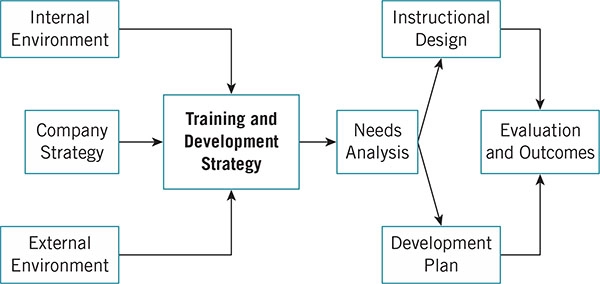
The inclusion of strategic in our title is purposeful because we believe strongly that training and development are most effective when they are part of an overall corporate strategy. Multiple components of this textbook reinforce this point. First, we have developed an organizing framework, shown below, which provides an overview of how all the important elements that impact training and development should be organized to maximize effectiveness. This framework begins with those factors that drive the provision of training and development and ends with evaluation, which both documents the benefits of training and development and facilitates improvement. Second, we include a semester-long project (Appendix A), which allows students to experience all aspects of training and development. Third, the importance of strategy is addressed across multiple chapters.
The flowchart reads as follows:
Internal Environment, Company Strategy, and External Environment lead to the Training and Development Strategy, which leads to Needs Analysis.
Needs Analysis is composed of Instructional Design and Development Plan, together which lead to Evaluation and Outcomes.
The component Training and Development Strategy is highlighted.
Our Vision
Our textbook focuses on individual concerns while also recognizing the important role of partnerships in the training and development process. Trainers, as an extension of human resource departments, need to be strategic partners so their initiatives will be successful. Conceptualizing training and development as a partnership also emphasizes the responsibilities that trainers, coaches, and mentors have in the process of individual learning and growth. Further, the text discusses external resources and opportunities available to an organization (e.g., the government) for providing training and development.
Our emphasis on individual concerns manifests itself in multiple ways in the design of the textbook. First, this textbook goes into depth on the individual differences (e.g., learning styles and motivations) that impact learning and the transfer of training. Second, the textbook focuses on interpersonal skills (e.g., feedback) that are critical at the individual level for training to be effective. Third, the textbook places emphasis on the development of employees, which, by its nature, tends to be customized to the individual. Fourth, the textbook includes reflections and lessons for the students/readers to implement as they manage their own careers. Finally, the textbook focuses on training topics such as the delivery of diversity and cross-cultural training, which requires employees to focus on individuals.
What Makes Our Book Unique
- Focus on organizational strategy and how it should interconnect with training and development, as well as how both strategy and training and development interact with other human resource functions.
- Emphasis on practical skills; moving from theory to implementation. The book includes ample opportunities to practice skills through classroom and homework assignments.
- Information on how to leverage external resources and partnerships.
- Recognition of how technology impacts and creates opportunities for training and development.
- Greater attention to development-related activities and research including career theories and succession planning.
- Extensive discussion of diversity and inclusion, as well as the ethical implications, as key aspects of training and development.
Features
In each chapter, we include the following features to help students reflect upon and become confident in their ability to provide training and development:
- The visual of our strategic framework and where the chapter maps onto it.
- Opening vignettes to get students interested in the material that is covered in the chapter.
- Learning Objectives, Chapter Summaries, and Key Terms to reinforce important points and facilitate student comprehension.
- Ethical scenarios so that students understand the complexity and dynamics of providing training and development.
- Experiential exercises to give students an opportunity to practice what they are learning, including a semester-long project.
Content
Our textbook is divided into 13 chapters, plus an introduction and three appendices:
- “Introduction to Training and Development” provides an overview of training and development as both an organizational function and an individual career path. Discussion of the ADDIE instructional design model as it maps to our textbook is also highlighted.
- Chapter 1, “Training and Development Strategy,” opens up the textbook to reinforce its strategic focus. This chapter defines strategy while also explaining how training and development fits into it along with other human resource functions.
- Chapter 2, “Legal Issues in Training and Development,” reviews the major pieces of legislation that impact the delivery of training and development. This includes laws focused on providing equal employment opportunities to all employees, as well as those pieces of legislation that mandate or encourage the provision of training.
- Chapter 3, “Needs Analysis,” focuses on three levels of analysis that organizations need to consider in order to effectively provide employees with training and development. These include the organization level, job level, and person level.
- Chapter 4, “Learning Theories,” examines the research on how people learn, and how this knowledge can be utilized to make training and development more effective. Among the scholarship that is discussed in this chapter is Bloom’s Taxonomy, as well as an important focus on adult learning theories and how they apply to training and development.
- Chapter 5, “Training Evaluation: Reaction and Learning,” emphasizes the importance of evaluation by focusing on Kirkpatrick’s first two levels. The topic of backwards design is introduced to reinforce the importance of determining what needs to be evaluated before the training program is designed and implemented. This is followed with a focus on developing learning objectives that are linked to the training. Lastly, the New World Kirkpatrick Model is introduced, and the first two levels of the model, Reaction and Learning, are addressed in depth.
- Chapter 6, “Training Evaluation: Transfer and Results,” continues the discussion on training evaluation by addressing Kirkpatrick’s remaining two levels, on-the-job behavior through knowledge transfer and organization-level results. This chapter focuses on the tight relationship between company strategy and training and development activities and addresses the importance of assessing key metrics to determine positive training outcomes.
- Chapter 7, “Learning Methods,” provides options for how training and development can be delivered as well as advice for which option may be best given goals and the situation. These options are divided into those that are traditional (e.g., lecture) and those that are experiential (e.g., role plays).
- Chapter 8, “Delivery Options for Face-to-Face Training,” covers the various instructional settings that are available for providing training and development. Among these is on-the-job training. The chapter contrasts both formal and informal varieties of training activities.
- Chapter 9, “Technology-Mediated Training and Development,” offers insights into the way that technology impacts training and development. This includes what are now traditional ways of providing e-learning, as well as how it continues to evolve (e.g., use of mobile devices). Further, it addresses important issues concerning accessibility of training and development.
- Chapter 10, “Careers and Succession,” explains that while we all have careers, the nature of those careers can be very individualistic. This chapter looks at both how careers evolve over time and how individuals perceive and manage their careers. As well, this chapter focuses on succession planning as an extension of career theories, and discusses how to identify and support high-potential employees.
- Chapter 11, “Employee Development,” focuses on the vast array of activities an organization can use to develop employees beyond basic training needs. This includes both formal and informal programs, including mentoring and coaching. A more in-depth look at mentoring and coaching activities is addressed. Along with general development activities, the chapter addresses specific leadership development activities to develop the next generation of leaders.
- Chapter 12, “Practical Skills for Training and Development,” presents interpersonal skills that make trainers and developers more effective when they are proficient at them. The skills covered in this chapter include active listening and providing feedback. The chapter provides opportunities for personal growth in addition to learning about these interpersonal skills.
- Chapter 13, “Training for Differences: Understanding Culture and Diversity,” discusses how to make organizations more inclusive and individuals more culturally competent. Differences ranging from macro (national culture and organizational culture) to micro (individual) levels of diversity are addressed along with the training programs utilized to train for those differences. Specific attention is given to orientation programs to integrate employees into the company culture, and diversity training initiatives.
- Appendix A, “Semester-Long Project,” is an opportunity for individuals to put into practice all that they have been learning about in the textbook. The project coincides with the ADDIE model for instructional design and provides a guideline for students to conceptualize, design, and implement their own training program for class.
- Appendix B, “External Partnerships,” shares information about how external agencies can facilitate the provision of training and development. Attention is given to government agencies, community colleges, and labor unions, and the specific programs and policies they use to support training initiatives.
- Appendix C, “Managing a Training Session,” provides more practical and granular detail on how to design and implement training and development. Guidelines on how to lead a training session and develop materials are provided.
Online Resources
Log on to: study.sagepub.com/berkley
The Instructor Teaching Site is intended to enhance your use of Strategic Training and Development by Robyn A. Berkley and David M. Kaplan. The materials on the site are geared toward increasing your effectiveness with this material and maximizing the potential for your students to learn.
- Microsoft® Word test bank: This test bank offers a diverse set of test questions and answers for each chapter of the book. Multiple-choice, matching, and short-answer questions for every chapter help instructors assess students’ progress and understanding.
- Microsoft® PowerPoint® slides: Chapter-specific slide presentations offer assistance with lecture and review preparation by highlighting essential content, features, and artwork from the book.
- Instructor’s manual: The instructor’s manual contains numerous resources for each chapter, including learning objectives, key concepts, suggested teaching strategies, resources, suggested exercises or projects, and answers to end-of-chapter questions/activities. These resources are collated in the instructor’s manual files.
- Multimedia resources: Videos, articles, and helpful links reinforce and further engage learners.
- Tables and figures from the book.
- Loading...
Get a 30 day FREE TRIAL
-
 Watch videos from a variety of sources bringing classroom topics to life
 -
Read modern, diverse business cases
-
Explore hundreds of books and reference titles
Read next

More like this
Sage Recommends
We found other relevant content for you on other Sage platforms.
Have you created a personal profile? Login or create a profile so that you can save clips, playlists and searches