
Summary
Contents
Collaborative Leadership School Climate Leadership Coaching Special Feature: Hattie’s research Special Feature: Early Warning System Special Feature: Coaching cycle 6 Influences That Matter Most Instructional leadership Assessment capable learners Feedback Collective efficacy Family engagement Professional development Essential elements of school climate Inclusive Curriculum Images that represent students School board policies Student codes of conduct Understanding minoritized populations Common language 5 Priorities for Leaders Community Engagement Communication Collective Efficacy Politics of Distraction Time management Focus on collaboration using structures leaders have in place (i.e. faculty meetings, teacher observations, etc.) Focus on fostering a school climate that increases self-efficacy & collective efficacy Focus on building the self-efficacy of leaders through leadership coaching Meet, Model, Motivate Leadership Growth Cycle They choose an area of growth How to implement collaborative leadership through goal setting Focus on leadership styles Negotiator Regulator Bystander Collaborator Who should read? District, building leaders, teacher leaders, instructional coaches Who should read? District, building leaders, teachers, school psychologists, school counselors Who should read: Potential leaders. New leaders. Any leader who wants to grow
Preface
Why We Need Coaches in Educational Leadership
Coaching typically involves two or more people working together to help each other grow professionally and personally. Many of us think of sports when it comes up, but coaching has been a part of the educational profession for decades. What began as peer coaching in education has evolved into instructional coaching and now leadership coaching.
This book focuses on the art of coaching and how leadership coaches can work with principals. Additionally, it also dives into how principals can use the art of coaching to coach their assistant principals and interns. Everyone can benefit from coaching, and school principals need to have the coaching mindset with their assistant principals as much as a coach needs to have the mindset with the leaders they work with.
Anyone who has been in a leadership position knows that leadership is not for the faint of heart. There are so many different issues demanding leaders’ time. Pont, Nusche, and Moorman (2008) indicated the following:
- More and more tasks have been added to school leaders’ workload.
- Most of the school leadership tasks are carried out by one individual.
- Most school leaders receive insufficient preparation and training.
Leaders are charged with many responsibilities. Viviane Robinson (2011) noted the most important aspects of instructional leadership (listed here in order from most effective to student learning to least effective):
- Leading teacher learning and development
- Establishing goals and expectations
- Ensuring quality teaching
- Resourcing strategically
- Ensuring an orderly and safe environment (p. 9)
Unfortunately, too many leaders believe they have to be experts at every single one of these responsibilities. We need to change this way of thinking. No one person can meet all of the demands of school leadership by himself or herself. And no one needs to be an expert at everything. What leaders need is the confidence to know that they can meet their leadership responsibilities by working with their staff and school community so they can change the climate and culture of a building. Only then will they see vast improvements in student and adult learning. Self-efficacy (belief in one’s capability of achieving a goal) is at the heart of how we move forward.
In this book, you will be drawn into an ongoing narrative illustrating the complexities of both leadership coaching and running a school. The narratives herein depict the real struggles of real people, not some easy scenario where everyone jumps on board at the beginning and all problems are solved with one quick conversation. We know that is not what truly happens in schools.
The book also includes K–12 student vignettes where students from North America, Australia, and Europe offer suggestions of what they want from their school leaders, their teachers, and their schools.
Stories Matter
This book is a departure from my previous books because it is essentially a narrative. Typically, I have written books on education grounded in research, which also offer practical suggestions on how to take that research and use it in the school building or classroom. With this book, I decided to take a risk and instead write a narrative involving multiple characters. I believe stories have a way of drawing us in a little deeper and help us see how ideas really do play out. The unfolding story that takes place between Michelle (a coach) and Gavin (a school principal) shows the relationship between a coach and leader. However, I wanted a real story, so I added in other characters and real-life situations that play out in our schools. These stories will hopefully make you feel as if you are in the story with Michelle and Gavin.
As you read, you will discover the evolution of the coaching relationship among Michelle, Gavin, and other characters. In many of the chapters, additional characters are highlighted to help you gain a deeper understanding of where diverse personalities and roles function in the larger narrative between Michelle and Gavin. We all have a story, and our story is the reason we approach situations from different perspectives.
Audience for This Book
This book is for leadership coaches who want to deepen their impact with the leaders they coach. Additionally, this book is for principals who want to use the art of coaching to have an impact on their assistant principals. And finally, this book is for principals who want to be coached, because you will find suggestions on how to move forward even if you do not have access to a full-time leadership coach.
If you are a coach who coaches principals, you will find—suggestions on how to approach principals new to coaching, ways to set goals, insights into areas of leadership that need coaching support, and the necessary components of the coaching process.
If you are a principal being coached by a leadership coach, you will find—ways to advocate for your goal, ideas that may cause you to reflect on how you receive feedback, and ways to identify particular areas that you might want to focus on as a leader.
If you are a principal who coaches assistant principals, you will find—how important it is for you to coach your assistant principal, areas where your assistant principal needs support, and suggestions on how you can build collective efficacy with your assistant principals, which will in turn help them become better leaders and help improve your leadership practice as well.
The Self-Efficacy of Leadership
As a leader, have you ever felt insecure—that level of insecurity that makes you wonder if you are cut out for the role? Then as your insecurities seem to be getting the best of you, is there a day that comes when you feel as though there is a flow to the work and you’re on top of the world because everything is going well?
I, too, had my share of both good and bad days, but what seemed to always make the situation better was surrounding myself with people I could learn from and talk to about anything. Having a confidant or critical friend is important for our growth as leaders. We need people who can ask the right questions and give us insight into the issues we are facing because they have faced it before.
We all know that leadership is complex work. It involves being a manager, disciplinarian, instructional guide, and collaborative motivator. For school leaders to have a real impact on student learning, they need to collaborate with many different stakeholders in order to change the climate and culture of a building. To me, climate is how students, staff, and families feel when they walk into a school building. Do they see images on the walls that are representative of the school’s student population? Do they feel like members of the school community, or do school staff make them feel as though they are visitors within their own school?
Culture is a bit different and is something that happens over the long term. Culture is what happens after teachers and leaders have been there for a while. This means, in a positive culture, people work hard to meet the needs of students and empower them so their student voice feels valued. A negative culture is one that has low expectations of students, and year after year students enter into the school knowing teachers, staff, and leaders think less of them.
We need positive school climates and cultures where voices feel valued. Gone should be the days when leaders handpicked only yes-men and women for stakeholder groups. In order to be optimally effective, we must collaborate with people who challenge our thinking.
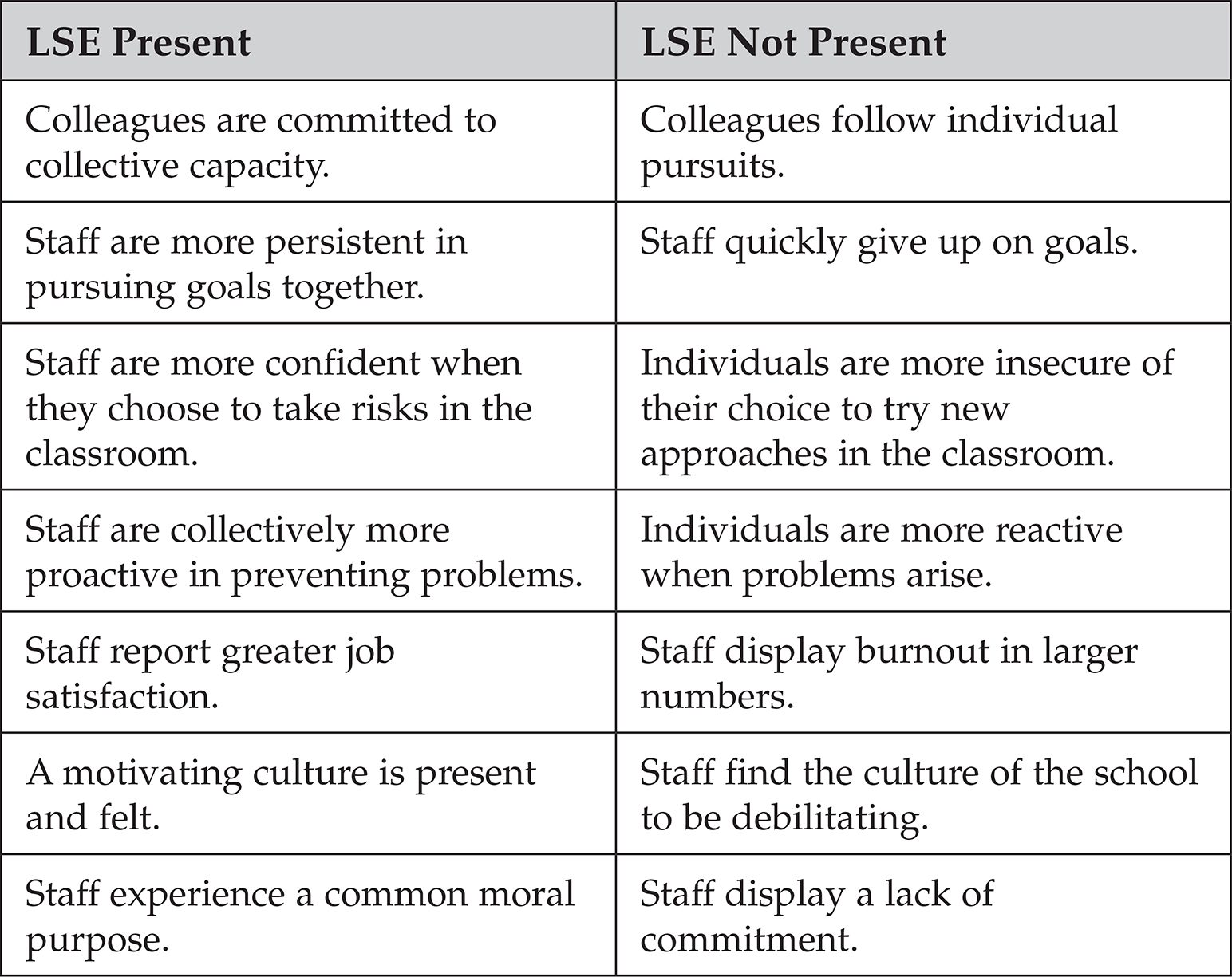
Leadership self-efficacy (LSE) is about principals understanding themselves as leaders and then figuring out how they (as coaches) can help teachers and school staff develop their own leadership skills. School cultures where the principal functions as both a leadership coach to others and a strong collaborative leader have seen significant benefits in attaining common goals, working effectively together as a team, and promoting a climate that is welcoming and nurturing to all. LSE plus collaborative leadership lead to collective self-efficacy where, together, the school staff work as an effective team and are therefore far more effective in improving student learning overall (see Figure I.1).
Figure I.1 Effects of Leadership Self-Efficacy in a School
Adapted from Leithwood and Jantzi (2008).
Leadership Shouldn’t Be a Solitary Pursuit
We work better when we learn collectively with others. That collective work provides us with people to have deep conversations with, and they challenge our thinking around the topic we are working on. Good leaders inspire people to authentically work together through challenging each other around a problem of practice in order to improve their educational surroundings. Getting people to work together is part of collective efficacy, which is the extension of self-efficacy.
Coaching leaders is a way to help them grow in their leadership practices, which will benefit everyone in the school community. That is why I believe that principals should be encouraged, and given the autonomy, to coach their assistant principals. It’s a win-win for everyone and will help build capacity in a school community.
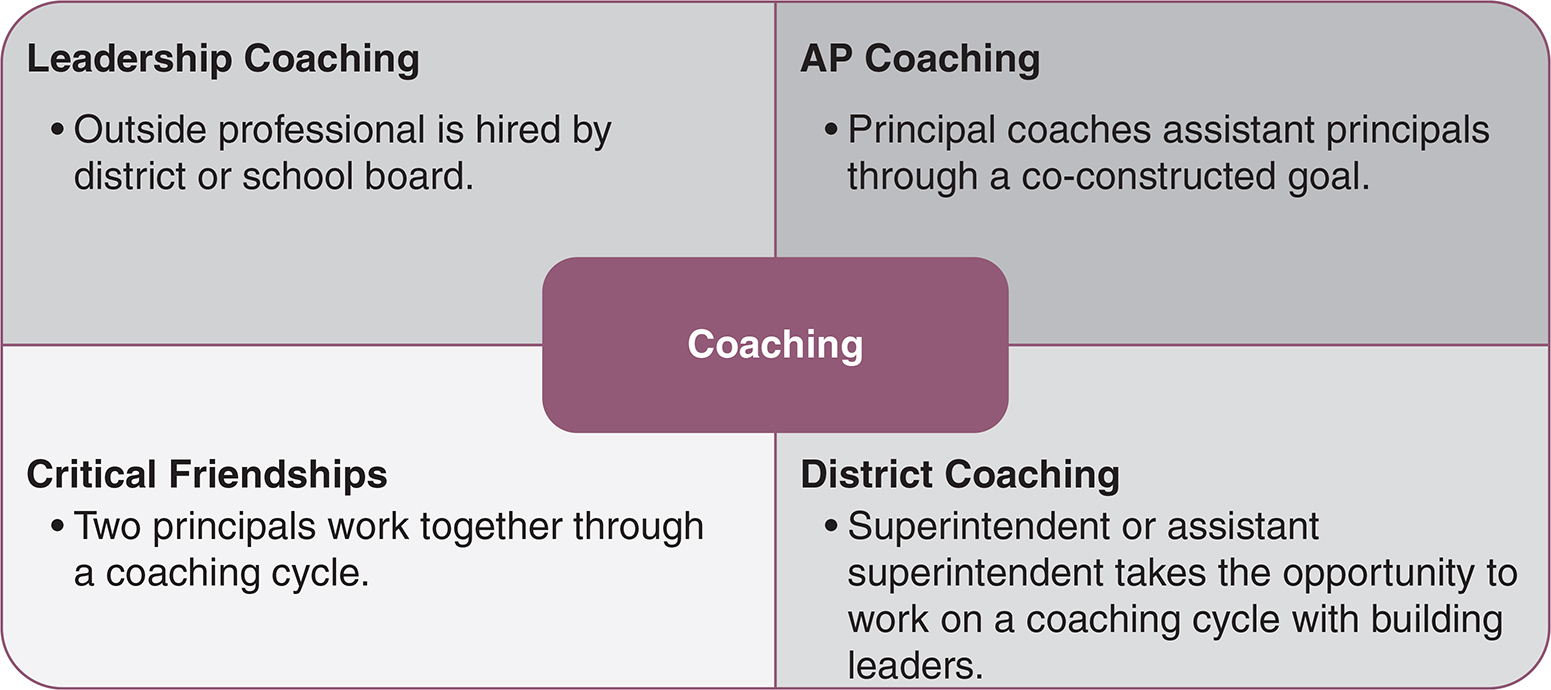
Coaching doesn’t necessarily mean that school districts have to bring in coaches from an outside agency. Sometimes coaching happens when two leaders work together in a critical friendship. In some districts, the superintendent or assistant superintendent works on a goal with a principal and they go through a coaching cycle together. In some small districts (in the United States) or school boards (in Canada), district leadership has the capacity to coach building leaders. Likewise, in some large districts or school boards, regional superintendents and assistant superintendents have the capacity to coach principals. Unfortunately, some districts and school boards do not have the capacity for these types of coaching relationships. In these districts, it might be a good option to explore hiring coaches from outside the district or pairing up principals with each other to work as peer coaches or mentor coaches where more experienced principals mentor newer principals.
All principals, whether veterans or novices, can benefit from working on a goal with a leadership coach. Furthermore, all principals can guide and mentor their own staff by serving as coaches to assistant principals and aspiring teacher leaders. Coaching happens when two people work together around a goal and look for improvement in the impact they are having on those around them, including students, teachers, and families (see Figure I.2).
Figure I.2 Four Types of Coaching Relationships in Education
Coaches need to understand self-efficacy if they are to help people meet their maximum potential. Simply being in a position of leadership doesn’t mean those individuals have the skills to help those around them improve. Likewise, being leaders doesn’t mean they know how to improve or know what to improve upon. Some leaders only focus on what to fix outward and never spend enough time looking inward to see what needs fixing first.
Coach’s Corner
Virtual Coaching
Leaders in small districts often work with coaches via Twitter, Voxer, Skype, or other online tools. Distant coaches may not be able to travel to the location of the principal, but they can act as a sounding board for leaders, helping to guide them through a problem or practice. I believe the jury is still out where virtual coaching is concerned because I wonder if you can ever have an authentic conversation about impact if the two parties never meet.
- How do we know the leaders do what they say they do?
- Where is the evidence of impact?
School leaders are often so busy that they do not have the time or presence of mind to examine the merits of the goals they are currently pursuing or how they can improve their current strategies to have a deeper impact in achieving their current goals. They also often neglect to take the time to understand their skill set, and they rarely get feedback that focuses on their self-efficacy as a leader. This is where coaching comes in. Committing to a period of coaching for a set length of time helps leaders work toward a goal and hone particular leadership practices so that they can tackle their leadership responsibilities with fresh perspectives and renewed motivation.
Whether you are a seasoned coach, a leader looking to be coached, or a leader looking for guidance on how to coach burgeoning leaders among your staff, this book offers insights, reflection questions, tips, and much more.
Special Features
In this book you will find the following:
- More authentic stories, less educational rhetoric—This book is different because it shares exchanges between people, much like Patrick Lencioni did in his 2005 book, Overcoming the Five Dysfunctions of a Team.
- The collaborative leadership growth cycle—The goal of this graphic is to provide leaders with a starting point and offer them very specific steps to take to reach their goal.
- Four priorities—Research has revealed four priorities that school leaders are most concerned about. This book offers practical strategies supported by research to help school leaders meet those four priorities. The priorities are collective efficacy, communication, student and community engagement, and the political climate.
- Stories from the field—Interwoven in the ongoing narrative are real vignettes from leaders and students.
- “Coach’s Corner”—Throughout the book there are several practical suggestions on how you can move forward in your coaching and leadership practice.
- Discussion questions—At the end of each chapter you will find actionable questions for leadership coaches to use with their leader-coachees.
In the End
This book is about understanding our impact. It is about raising our own leadership self-efficacy and helping to raise it in others. Leadership coaching can be one way to help leaders hone in on a goal that will be both personally and professionally impactful.
The mindsets of the coach and the person being coached are critical factors in the success of the coaching endeavor. Both parties have to want to be engaged in the process. In the following chapters, readers will read the fictional story of new school leader Gavin and his leadership coach Michelle. Their story will provide insights as to how coaching can work. While the story is not autobiographical, some of the issues experienced by Gavin and Michelle are those I went through as a principal.
Coaching is about fostering a confidential relationship between coach and leader, where they learn from one another and focus solely on the decisions they come to together, rather than goals imposed from others. It is imperative that district leaders invest in principals and aspiring principals. This means providing leaders with the support they need to develop self-efficacy and improve their practice as collaborative leaders.
Get a 30 day FREE TRIAL
-
 Watch videos from a variety of sources bringing classroom topics to life
 -
Read modern, diverse business cases
-
Explore hundreds of books and reference titles
Read next

More like this
Sage Recommends
We found other relevant content for you on other Sage platforms.
Have you created a personal profile? Login or create a profile so that you can save clips, playlists and searches