
Summary
Contents
Subject index
How to Use This Directory
The Washington Information Directory is designed to make your search for information quick and easy.
Each chapter covers a broad topic, and within the chapters information is divided into more specific subject areas. This arrangement allows you to find in one place the departments and agencies of the federal government, congressional committees, and nongovernmental organizations that have the information you need.
The directory divides information sources into three main categories: (1) agencies, (2) Congress, and (3) nongovernmental organizations. Each entry includes the name, address, and telephone and fax numbers of the organization; the name and title of the director or the best person to contact for information; press, hotline, and TTY numbers and Internet addresses whenever available; and a description of the work performed by the organization. Congressional committees and subcommittees appear in a box at the beginning of each chapter; a full entry for each committee appears in the first appendix.
How Information is Presented
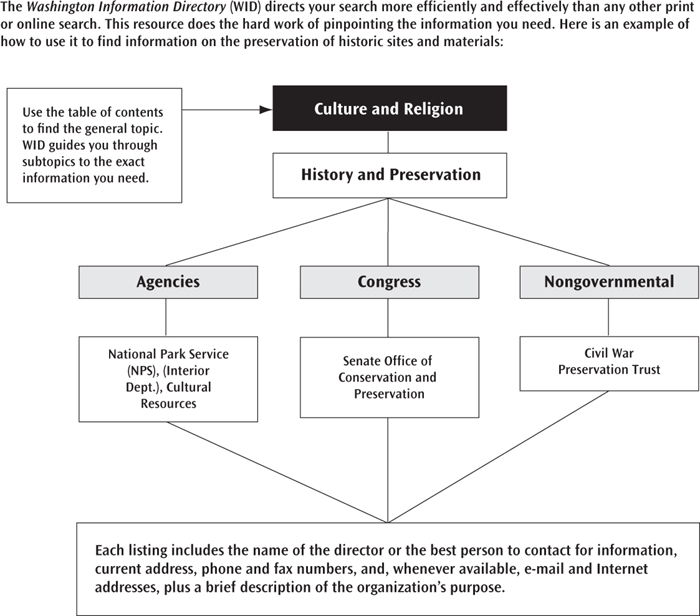
The following examples represent the three main categories of entries and the other resources provided in the directory. The examples are drawn from the History and Preservation section in Chapter 4, Culture and Religion.
Agencies
In the first category, government agencies are listed. For example, the National Park Service and its acronym appear in bold type. Next, in parentheses, is the name of its parent organization, the Interior Department. Entries may also include the name of an office within the agency, in this case the Office of Cultural Resources.
National Park service (NPs), (Interior Dept.), Cultural Resources, 1849 C St. N.W., #3128 20240-0001; (202) 208-7625. Fax, (202) 273-3237. Janet Matthews, Associate Director.
Oversees preservation of federal historic sites and administration of buildings programs. Programs include the National Register of Historic Places, National Historic and National Landmark Programs, Historic American Building Survey, Historic American Engineering Record, Archeology and Antiquities Act Program, and Technical Preservation Services. Gives grant and aid assistance and tax benefit information to properties listed in the National Register of Historic Places.
Congress
Congressional committees and subcommittees relevant to each chapter are listed in a box in the beginning of each chapter. Each committee's phone number and Web site are listed here. For a complete listing of congressional committees, including their full contact information, leadership, membership, and jurisdictions, please refer to the first appendix. Entries that appear under the “Congress” heading within each chapter are agencies under congressional authority, such as the Government Accountability Office or the Library of Congress. Each entry includes a description of the agency's activities relating to the section in which it appears.
Senate Office of Conservation and Preservation, S416 CAP 20510; (202) 224-4550. Carl Fritter, Director.
Develops and coordinates programs related to the conservation and preservation of Senate records and materials for the secretary of the Senate.
Nongovernmental
Thousands of nongovernmental groups have headquarters or legislative offices in or near Washington. Their staffs are often excellent information sources, and these organizations frequently maintain special libraries or information centers. Here is an example of a group with an interest in the preservation of historic sites:
Civil War Preservation Trust, 1331 H St. N.W., #1001 20005; (202) 367-1861. Fax, (202) 367-1865. O. James Lighthizer, President.
General e-mail, info@civilwar.org
Membership: preservation professionals, historians, conservation activists, and citizens. Preserves endangered Civil War battlefields throughout the United States. Conducts preservation conferences and workshops. Advises local preservation groups. Monitors legislation and regulations at the federal, state, and local levels.
How the Washington Information Directory Works
Charts and Boxes
This directory includes organization charts to make the hierarchy of federal departments and agencies easy to grasp, as well as reference boxes that provide essential agency contacts and other information. On the topic of historic sites, you can locate the National Park Service within the Interior Department (see chart on p. 277) or consult a list of sites administered by the National Park Service (see box on p. 136). A general organization chart for the federal government appears on page 843.
Reference Resources
Tables of Contents
The table of contents (p. iii) lists the directory's chapters and their major subheadings. A list of reference boxes and organization charts within the chapters is provided on page v. Each chapter opens with a detailed table of contents; for convenience, here again we list the boxes and charts that appear in the chapter.
Congressional Information
A section on the 111th Congress, beginning on page 724, provides extensive information about members and committees:
State Delegations. Here (p. 725) you can locate senators, representatives, and delegates by state (or territory) and congressional district.
Committees. These sections list the jurisdictions and memberships of committees and subcommittees of the House (p. 730) and Senate (p. 804), as well as the joint committees of Congress (p. 802). Also included are party leaderships and partisan committees of the House (p. 750) and Senate (p. 818).
Map of Capitol Hill
Members' Offices. For the House (p. 751) and Senate (p. 819), we provide each member's Capitol Hill office address, telephone and fax numbers, Internet address, key professional aide, committee assignments, and district office contact information.
Ready Reference
A section of reference lists, beginning on page 838, provides information on the following subjects:
Government Information on the Internet. Organized by branch of government, this section (p. 840) lists Web addresses for locating information on the White House, cabinet departments, Congress, and the judiciary.
State Government. The list of state officials (p. 844) provides the name, address, and telephone number for each governor, lieutenant governor, secretary of state, attorney general, and state treasurer.
Diplomats. The foreign embassies section (p. 853) gives the names, official addresses, and telephone numbers of foreign diplomats in Washington; the names of ranking U.S. diplomatic officials abroad; and the phone numbers for State Department country desk offices.
Federal Laws on Information. This section presents current information on the Freedom of Information Act (p. 866) and privacy legislation (p. 869).
Indexes
Use the name index (p. 871) to look up any person listed in the directory. Use the organization index (p. 909) to find a specific organization or agency. Use the subject index (p. 965) to locate a particular area of interest. If you need information on a specific topic but do not know a particular source, the index has entries for chapter subsections to help you find where that topic is covered. For example, on the subject of equal employment for women, you can find index entries under Equal Employment Opportunity as well as under Women.
Reaching Your Information Source
Phoning and Faxing
Call information or toll-free numbers first. Often you can get the answer you need without searching any further. If not, an explanation of your query should put you in touch with the person who can answer your question. Rarely will you need to talk to the top administrator.
Offer to fax your query if it is difficult to explain over the phone, but make sure that the person helping you knows to expect your fax. Faxing promptly and limiting your transmission to a single page should bring the best results.
Remember that publications and documents are often available from a special office (for federal agencies, see p. 92) and, increasingly, on Web sites. Ask whether there is a faster way than by mail to receive the information you need.
Keep in mind the agency or organization, not the name of the director. Personnel changes are common, but for most inquiries you will want to stay within the organization you call, rather than track down a person who may have moved on to a new job.
Concerning congressional questions, first contact one of your members of Congress; representatives have staff assigned to answer questions from constituents. Contact a committee only if you have a technical question that cannot be answered elsewhere.
Writing
Address letters to the director of an office or organization—the contact person listed here. Your letter will be directed to the person who can answer your question. Be prepared to follow up by phone.
Using the Internet
Most agencies and governmental organizations have sites on the Internet (for federal departments and agencies, see pp. 99, 840–842) and an e-mail address for general inquiries. Information available from these sources is expanding and is usually free once you are online. If you have Internet access, try the Web site, but bear in mind that this approach is not always faster or better than a phone call: connections can be slow, menus can be complex or confusing, and information can be incomplete or out of date.
As with faxing, reserve e-mail for inquiries that may be too complex for a phone call, but phone first to establish that someone is ready to help.
Addresses and Area Codes
Listings in the directory include full contact information, including telephone area code and, when available, room or suite number and nine-digit zip code. If an office prefers a mailing address that is different from the physical location, we provide both. Note that a call to a few listings—for example, the Social Security Administration headquarters in Baltimore and a small number of nonprofits in outlying suburbs—will incur a long distance charge.
Washington, D.C., Addresses
For brevity, entries for agencies, organizations, and congressional offices in the District of Columbia (area code 202) do not include the city as part of the address. Here is the beginning of a typical Washington entry:
Equal Employment Opportunity Commission (EEOC), 131 M St, N.E. 20002; (202) 663-4001.
To complete the mailing address, add “Washington, DC” before the zip code.
Building Addresses
Departments and agencies generally have their own zip codes. Updates to our directory reflect the increasing use of street addresses by the federal government. Federal offices at the following locations are listed by building name or abbreviation:
The White House. Located at 1600 Pennsylvania Ave. N.W. 20500.
Dwight D. Eisenhower Executive Office Building. Located at 17th St. and Pennsylvania Ave. N.W. 20500.
New Executive Office Building. Located at 725 17th St. N.W. 20505.
Main State Building. Located at 2201 C St. N.W. 20520.
The Pentagon. Located in Arlington, Virginia, but has a Washington mailing address and different zip codes for each branch of the military.
Navy Annex. Located at Columbia Pike and Southgate Rd., Arlington, VA 20370, but most offices use a Washington mailing address.
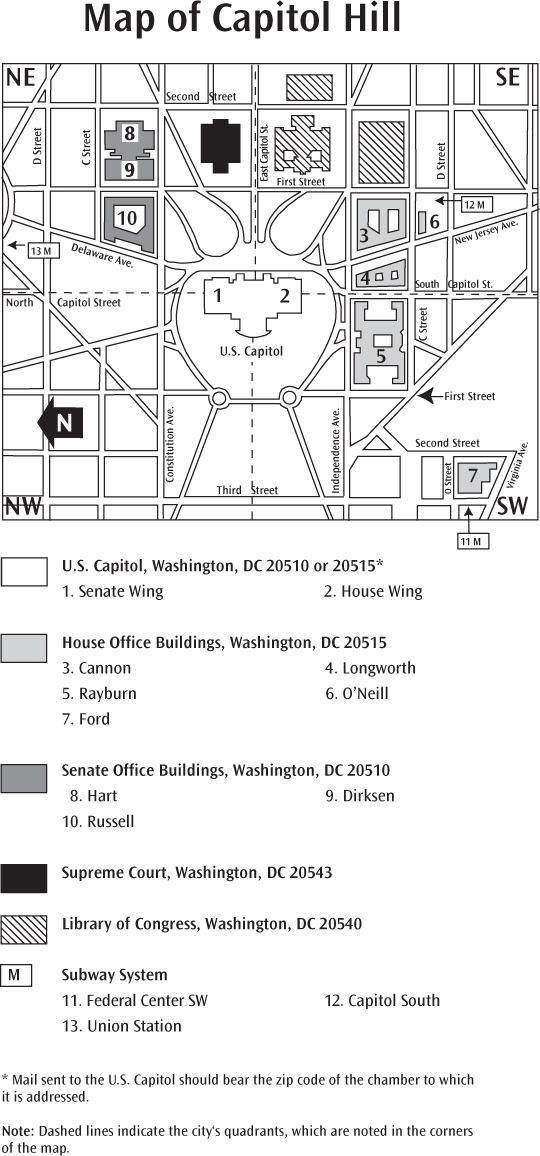
U.S. Capitol. Abbreviated as CAP; the letters H and S before the room number indicate the House or Senate side of the building. Zip codes are 20510 forthe Senate, 20515 for the House.
Senate Office Buildings. Mail for delivery to Senate office buildings does not require a street address. The zip code is 20510. Abbreviations, building names, and street locations are as follows:
SD Dirksen Senate Office Bldg., Constitution Ave. between 1st and 2nd Sts. N.E.
SH Hart Senate Office Bldg., 2nd St. and Constitution Ave. N.E.
SR Russell Senate Office Bldg., Constitution Ave. between Delaware Ave. and 1st St. N.E.
House Office Buildings. Mail for delivery to House office buildings does not require a street address. The zip code is 20515. Abbreviations, building names, and street locations are as follows:
CHOB Cannon House Office Bldg., Independence Ave. between New Jersey Ave. and 1st St. S.E.
FHOB Ford House Office Bldg., 2nd and D Sts. S.W.
LHOB Longworth House Office Bldg., Independence Ave. between S. Capitol St. and New Jersey Ave. S.E.
OHOB O'Neill House Office Bldg., 300 New Jersey Ave. S.E.
RHOB Rayburn House Office Bldg., Independence Ave. between S. Capitol and 1st Sts. S.W.
John Adams Building. Abbreviated as Adams Bldg.; located at 110 2nd St. S.E.
- Loading...
Get a 30 day FREE TRIAL
-
 Watch videos from a variety of sources bringing classroom topics to life
 -
Read modern, diverse business cases
-
Explore hundreds of books and reference titles
Read next

More like this
Sage Recommends
We found other relevant content for you on other Sage platforms.
Have you created a personal profile? Login or create a profile so that you can save clips, playlists and searches