
Summary
Contents
Subject index
“The Mating Game is a comprehensive, multidisciplinary, introductory text about human mating relationships aimed specifically at a university audience. It progresses beyond a psychological or biological/physiological stance and encompasses a wide array of disciplines. The comprehensive review and up-to-date information contained in The Mating Game not only provides answers to questions about important life events but also encourages readers' interest in the field of interpersonal relationships and human mating.
The Mating Game: A Primer on Love, Sex, and Marriage, Second Edition, is the only comprehensive, multidisciplinary, introductory text about human mating relationships aimed specifically at a university audience. It progresses beyond a psychological or biological/physiological stance and encompasses a wide array of disciplines. This comprehensive review of theory and empirical research takes an integrated perspective on the fundamental human experiences of love and sex. Strongly grounded in methodology and research design, author Pamela C. Regan offers relevant examples and anecdotes along with ample pedagogy that will spark debate and discussion on these provocative and complex topics.
New to the Second Edition
Freshly presented material, with reorganized text that provides a smoother transition between major sections; Reviews of the most recent theoretical and empirical work in the areas of love, sexuality, mate selection, and marriage; New information on the phenomenon of “cyber-flirting” and the development of romantic relationships over the Internet; Inclusion of cutting-edge biochemistry research, including a discussion of cutting-edge research on the biochemistry of passion and affection; Discussion of emerging research on non-heterosexual relationships and cross-cultural dynamics; Expanded chapters on critical topics and an important new chapter on relationship intervention
Intended AudienceThis text is ideal for upper level undergraduate or graduate students in psychology, family studies, and sociology, who will find this engaging text a valuable tool for course-related research activities, as well as for self-awareness.
Marriage and Mate Selection
Marriage and Mate Selection
Chapter Outline
- Mating Systems Across Cultures
- The Nature of Marriage
- The “Rules” of Marriage
- Types of Marriage
- Division of Labor
- Marital Satisfaction: How Happy Are Married Couples?
- Has Marriage Changed Over Time?
- Same-Sex Marriage
- Cohabitation: An Alternative to Marriage
- Summary
As discussed in Chapter 3, some romantic relationships pass beyond initial attraction and continue to develop over time until they reach a state of relative permanence; the partners become “steady” dates, they move in together, they form a civil union or domestic partnership, or they marry. In this chapter, we examine research on mate choice and on marriage, cohabiting relationships, and other forms of committed, long-term relationship. Because marriage historically has been socially and legally defined as a heterosexual relationship, much of the existing literature—and thus, much of our discussion—is focused on the experiences and outcomes of heterosexual married couples.
Mating Systems across Cultures
The norms or general “rules” that govern mate selection and reproduction differ across cultures. Cultural anthropologists, ethnographers, and other social scientists have identified several mating systems that occur (with varying degrees of frequency) in human societies around the world. These include polygyny, which literally means “many females” and refers to a mating system in which men marry multiple women; polyandry (“many males”), which is defined as a system in which women pair with multiple men; monogamy, which encompasses both monogyny (“one female”) and monandry (“one male”) and refers to a system in which two individuals pair bond; and polygynandry (“many females and males,” also called cenogamy), which is defined as group marriage or a system in which husbands and wives share the same spouses (Fisher, 1989; Goodwin, 1999). Some marriage arrangements are more prevalent than others. One of the most comprehensive sources of cross-cultural information on mating systems is the Ethnographic Atlas. The Atlas contains data on a variety of sociocultural features (e.g., economy, living arrangement, family organization, mode of marriage, kinship terminology, community size) that characterize more than 1,100 human societies located in Africa, the Mediterranean, Eurasia, the Pacific, North America, and South America. In 1967, ethnologist George Murdock presented information on a subset of 862 of those societies in a special edition of the journal Ethnology. Examination of this information, summarized in Table 4.1, reveals that polyandry is much less common than either polygyny or monogamy. For example, only 4 societies (less than 1%) explicitly endorse a mating system based upon a single woman marrying multiple husbands. Monogamy, either between a man and woman who marry and then live within an extended family or who marry and then form a single independent family, is the predominant mating system in 137 societies (16%). By far, the most common form of marital arrangement is polygyny; a total of 713 (approximately 83%) of the societies included in the Atlas permit this mating arrangement. Polygyny is common in 379 of those societies and is practiced on a limited basis within the remaining 334 societies.
Table 4.1 Prevalence of Mating Systems Across 862 Human Societies
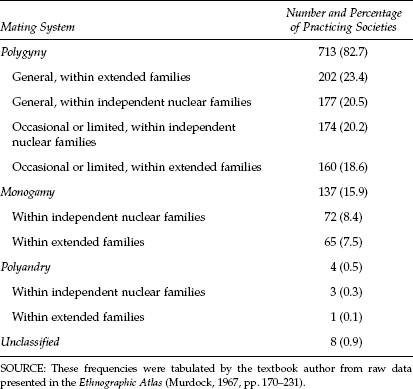
In all but a handful of human societies, then, women practice monandry; a woman marries one man at a time (although in polygynous societies, her spouse may have multiple wives). Similarly, although the data at first glance suggest a high frequency of polygyny, a closer look reveals that men also tend to practice monogyny; they marry one woman at a time. Based on his own analysis of the Atlas data, Pierre van den Berghe (1979) reported that only about 10% of the men in polygynous societies actually have more than one wife. Thus, the most frequent type of mating arrangement is that of one man and one woman. As noted by evolutionary scientists Martin Daly and Margo Wilson
...
- Loading...
Get a 30 day FREE TRIAL
-
 Watch videos from a variety of sources bringing classroom topics to life
 -
Read modern, diverse business cases
-
Explore hundreds of books and reference titles

Read next

More like this
Sage Recommends
We found other relevant content for you on other Sage platforms.
Have you created a personal profile? Login or create a profile so that you can save clips, playlists and searches