
Summary
Contents
Subject index
Integrating social development with social work education, this book meets a crucial need for social work educators, scholars, and students. Unlike theory works which list out the skills required for the practice of social work methods but do not enable development of these skills, this manual discusses concrete exercises for the development of method-linked skills. The book carries a continuous thread of discourse on how to develop interactive work ability in individuals to ensure holistic professional development. It facilitates the inculcation of professional and global competencies essential for a social worker in a student.
Self-Development
Meaning of Self-Development
Self-development is a sum total of many aspects, qualities and abilities that one possesses and how these are used to maximise one's effectiveness as a functioning individual. As social workers, we look at self-development in the following context:
- Having a realistic self-concept: This implies positive and healthy appreciation of oneself, understanding one's capacities and limitations, and overcoming negative and unrealistic ideas about oneself.
- Acquiring internal control over the self: This means the ability to define ‘self’ independently. This understanding should not be coloured by what others feel about you.
- Understanding the cognitive, affective and behavioural aspects of the self: This implies being sensitive to one's own feelings, sharpening emotional responses and developing a range of behavioural capacities which would be appropriate to different situations.
- Achieving congruence between different aspects of the self: Behaviour is a reflection of our intellectual process and emotional reactions. This, therefore, involves achieving congruence among cognitive, affective and behavioural aspects.
Need for Self-Development for Social Workers
- Clear understanding of the self helps in understanding one's identity. It clears doubts and feelings of inadequacy. This results in clarity of role and improvement in professional performance.
- Understanding oneself means knowing the factors or forces which build one's confidence, situations which bring out the best in oneself, how to relate to persons who are dissimilar to oneself.
- Acceptance and respect of the self becomes the basis for accepting the other person's uniqueness, weaknesses, qualities and complexities. If we do not accept others as they are, we will not be able to value their experiences or encourage them to use their experiences for growth and self-development. The reciprocal relationship between acceptance and respect of the self and that of others can be explained with the following figure.
Figure S1.1 Reciprocal Relationship: Self and Others
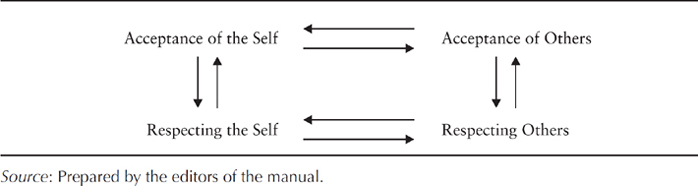
Respect indicates concern about the other person in ‘totality’. Concern for others is fundamental in social work.
Understanding development of the self can be a context for understanding the other person's process of development. Social workers must be able to answer the question, ‘How do I learn and grow?’ This in turn helps social workers to appreciate the process of how others learn and grow.
In the process of self-awareness, one learns to be flexible and open. These qualities enable the social worker in building trusting relationships with others.
The Workshops for Self-Development
In the section on self-development, three modules are to be conducted on the following topics:
- Understanding perception.
- Self-awareness.
- Sensitivity.
Self-development is a goal of every individual. The professional needs to be consciously developed. One of the important components of personality is perception. Since we understand and interpret the world around us through the perceptual processes, our values and attitudes, our understanding of our own behaviour and that of others will depend upon how we perceive and interpret. Hence, understanding our own perceptions is the first step in self-development.
Similarly, self-awareness is a continuous and dynamic process. Trainee social workers (TSWs), need to continuously examine their own feelings, attitudes and behaviours, when they are interacting with others. The exercises on self-awareness take the trainees towards a step-by-step understanding of the process of self-awareness.
...
- Loading...
Get a 30 day FREE TRIAL
-
 Watch videos from a variety of sources bringing classroom topics to life
 -
Read modern, diverse business cases
-
Explore hundreds of books and reference titles

Read next

More like this
Sage Recommends
We found other relevant content for you on other Sage platforms.
Have you created a personal profile? Login or create a profile so that you can save clips, playlists and searches