
Summary
Contents
Subject index
Creative Management and Development has been updated with newly commissioned and leading edge chapters on intuitive cognition, complexity, emotion, team innovation, development, and well-being. The textbook retains seminal papers on creativity, perception, style, culture, and sustainable development. The contributors to this textbook represent a broad spectrum of perspectives from among the most distinguished names in the field. They give a clear overview of the topics discussed while explaining their practical implications. This textbook is published as a Course Reader for The Open University Course Creativity, Innovation and Change (B822) but will engage and challenge students interested in creative ways of managing, different approaches to developing creativity in organizations and creative leadership.
Beyond Sense-Making: Emotion, Imagery and Creativity
Beyond Sense-Making: Emotion, Imagery and Creativity
Weick (1995) highlighted the importance of appreciating that it is the ‘sense’ that people make of their work environment that determines their decisions and actions, rather than the organization's or people's ‘objective’ properties. People at work clearly engage on an ongoing basis in sense-making. The appreciation that organizations ‘benefit’ from employees securing and deploying their understanding effectively has led to an acceptance that time spent reflecting on (Seibert and Daudelin, 1999) and in (Schon, 1991) action is key to work practice. The conscious use of reasoning undoubtedly helps us explain some aspects of our world. Since meaning making is not simply a psychological process that takes place in individuals' minds, the social nature of work means that we can explore and create shared meaning. Stahl sees shared meaning as an ‘essentially social activity that is conducted jointly – collaboratively – by a community, rather than by individuals who happen to be co-located’ (2003: 523). Meaning is socially produced and situationally interpreted. But do our intrapsychic and social efforts to explain occupy an exaggerated position in our accounts of work? This chapter explores evidence of the potential to move beyond rationality and understanding in work settings and considers why such potential is resisted within organizations.
In examining decisions and actions at work we see many other facets of people than their semantic understanding and their reasoning processes. Analysis of work practices in terms of a more comprehensive framework suggests that there are many features of thinking that appear to be relegated in our accounts or even largely denied (Sparrow, 1998). I argue that it is ‘only through the broad elicitation of all of these aspects that organizations can achieve the comprehensive self-insight in practitioners, and mutuality of insight, that modern and future organizational decision-making requires’ (1998: 44). A possible framework is presented in Figure 6.1. This framework brings together three key features of thinking.
Figure 6.1 Basic forms of thought
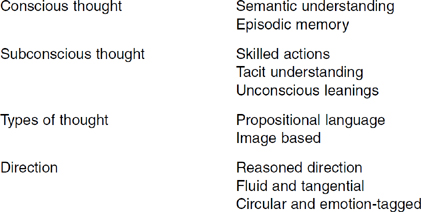
First, it highlights the levels of consciousness at which different kinds of thinking occur. At the conscious level is our semantic understanding (i.e. knowledge and models of the world) and our episodic memories (information that is held together in our mind, as a sequence of events as occurred in the experience itself). So we may know that London is the capital city of England or that Trafalgar Square is in London. We may also recall our walk to Trafalgar Square from Leicester Square as an episodic memory. Both semantic understanding and episodic memories are mental material that we can consciously access and process.
Some of our mental processes operate at a sub-conscious level. When we use the term ‘skilled’ at using a computer keyboard, we note that the person's decisions and actions are not consciously controlled but have become ‘automatized’. Skills entail the use of mental material that has been learned and over time has become so automatic that we don't have to think much about it. Similarly, we often find ourselves manifesting another aspect of sub-conscious thinking: operating upon a tacit feel for a situation. The use of the term tacit knowledge in this regard means the use of a deep sense of a situation that has not been arrived at through conscious reasoning, nor reflected upon during skill acquisition, but is the product of pure experiential learning and acquired latently. Some people use the term intuition to refer to this kind of knowledge. Some psychologists argue that there is a level of consciousness below the sub-conscious level, where unconscious interpretation occurs. Jung, for example, suggested that we develop deep-seated thinking preferences combining two personality attitudes (introversion and extraversion) and four functions or modes of orientation (thinking, sensation, intuition and feeling). Jung (1921) noted that ‘For complete orientation all four functions should contribute equally: thinking should facilitate cognition and judgment, feeling should tell us how and to what extent a thing is important or unimportant to us, sensation should convey concrete reality to us through seeing, hearing, tasting etc. and intuition should enable us to divine the hidden possibilities in the background’ (par 900). He highlighted how the four functions are not equally at one's disposal and that the thinking preferences not brought into frequent use operate ‘in a more or less primitive and infantile state’ (par 955).
...
- Loading...
Get a 30 day FREE TRIAL
-
 Watch videos from a variety of sources bringing classroom topics to life
 -
Read modern, diverse business cases
-
Explore hundreds of books and reference titles

Read next

More like this
Sage Recommends
We found other relevant content for you on other Sage platforms.
Have you created a personal profile? Login or create a profile so that you can save clips, playlists and searches