
Summary
Contents
Congress and the Nation is the most authoritative reference on congressional trends, actions, and political and policy controversies. This award-winning series documents the most fiercely debated issues in recent American politics, providing a unique retrospective analysis of the policies the U.S. Congress. Organized by policy area, each chapter contains summaries of legislative activity, including bills passed, defeated, or postponed. No other authoritative source guides readers seamlessly through the policy output of the national legislature with the breadth, depth, and authority of Congress and the Nation.
Congress and the Nation is the most authoritative reference on congressional trends, actions, and political and policy controversies. This award-winning series documents the most fiercely debated issues in recent American politics, providing a unique retrospective analysis of the policies the U.S. Congress. Organized by policy area, each chapter contains summaries of legislative activity, including bills passed, defeated, or postponed. No other authoritative source guides readers seamlessly through the policy output of the national legislature with the breadth, depth, and authority of Congress and the Nation.
Chapter 16
Chapter 16
Congress and Government
Congress
Introduction
Reform pressures swept Congress in the 1965—68 period, and Congress responded in characteristic fashion. As in the past, it showed little disposition to effect the bold reforms its critics demanded, but some modest changes were achieved.
The most decisive action came in the area of greatest criticism, Congressional ethics. Haunted by the case of Robert G. (Bobby) Baker, former Secretary to the Senate Majority, and confronted by ethical charges against two of its Members, Rep. Adam C. Powell (D N.Y.) and Sen. Thomas J. Dodd (D Conn.), Congress attempted to provide itself with written rules of ethical behavior, and ethics committees were created in the Senate and House. Both chambers approved limited financial disclosure requirements but rejected the more stringent disclosure proposals of the reformers.
In other areas, reform proposals made less headway. Congress did not complete action on a comprehensive legislative reorganization bill, and attempts to liberalize the Senate cloture rule ended in failure. However, efforts to curb the obstructive power of the House Rules Committee enjoyed some success. Highlights of action:
Ethics.
One of the late House Speaker Sam Rayburn's (D Texas 1913—61) often-quoted rules of politics was that the ethics of a Member of Congress should be judged not by his peers in the House but by the voters once every two years. By the mid-1960s, it had become clear that neither Congress nor the public felt this was enough.
Demands for action on Congressional ethics intensified in 1963 with charges that Robert G. (Bobby) Baker had used his office as Secretary to the Senate Majority to promote outside business interests.
Largely because of embarrassments caused by the Baker case, the Senate in 1964 established a Select Committee on Standards and Conduct to investigate “allegations of improper conduct” by Senators and Senate employees.
The Committee's first inquiry began in 1966. It involved charges by syndicated columnists Drew Pearson and Jack Anderson that Sen. Thomas J. Dodd (D Conn.) had misused political campaign funds contributed to him and had committed other offenses. The Committee in April 1967 recommended that the Senate censure Dodd for misuse of political funds and for double-billing for official and private travel. The Senate censured Dodd on the first charge by a 92-5 roll-call vote but refused, by a 51-45 vote, to censure him on the second charge. The action marked the seventh time in its history that the Senate had censured one of its members.
For a discussion of Congress in the Postwar Years (1945—64), see Congress and the Nation, Vol. I, p. 1407; for lobbying activities, 1945—64, see Vol. I, p. 1545.
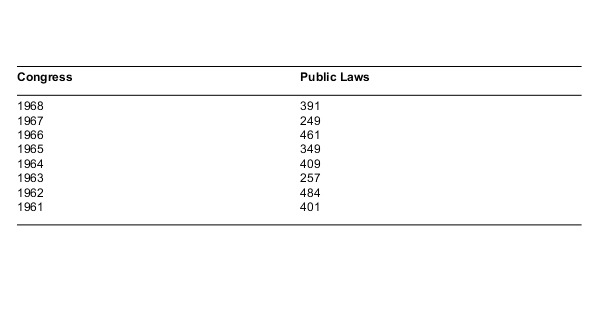
In 1968, a total of 391 bills became public laws. This was 142 more than the 1967 total but 70 fewer than in 1966. The highest number of public laws for any one year since 1950 was 638 in 1956. The lowest number was the 1967 figure. Following is a list of the number of public laws enacted since 1961:
Meanwhile, ethical storms were raging in the House over the activities of Rep. Adam C. Powell (D N.Y.). The controversial Harlem Negro came under fire on a variety of counts, ranging from a libel action against him in New York state to charges of misusing Government funds. However, his downfall began in 1966 as the result of a revolt in his own committee over legislative business.
...
Get a 30 day FREE TRIAL
-
 Watch videos from a variety of sources bringing classroom topics to life
 -
Read modern, diverse business cases
-
Explore hundreds of books and reference titles

Read next

More like this
Sage Recommends
We found other relevant content for you on other Sage platforms.
Have you created a personal profile? Login or create a profile so that you can save clips, playlists and searches