
Summary
Contents
Congress and the Nation is the most authoritative reference on congressional trends, actions, and political and policy controversies. This award-winning series documents the most fiercely debated issues in recent American politics, providing a unique retrospective analysis of the policies the U.S. Congress. Organized by policy area, each chapter contains summaries of legislative activity, including bills passed, defeated, or postponed. No other authoritative source guides readers seamlessly through the policy output of the national legislature with the breadth, depth, and authority of Congress and the Nation.
Congress and the Nation is the most authoritative reference on congressional trends, actions, and political and policy controversies. This award-winning series documents the most fiercely debated issues in recent American politics, providing a unique retrospective analysis of the policies the U.S. Congress. Organized by policy area, each chapter contains summaries of legislative activity, including bills passed, defeated, or postponed. No other authoritative source guides readers seamlessly through the policy output of the national legislature with the breadth, depth, and authority of Congress and the Nation.
Chapter 13
Chapter 13
The Presidency, 1965—68
Introduction
When Lyndon B. Johnson won a four-year White House term in his own right in 1964, he amassed the largest vote of any Presidential candidate in history. The victory made him a “consensus President”—both in his own eyes and in the public view of his conduct of the nation's affairs. “Consensus politics” became a term used to describe the Johnson Administration; “consensus” increasingly became a key to the President's mode of operation.
Johnson's performance as President in 1965 resulted in an outpouring of major programs, many of which his predecessors had written off because of unwilling and uncooperative Congresses. Johnson seized the momentum provided by his 1964 landslide victory and the resulting large Democratic majorities in Congress to get his “Great Society” program off to an impressive start.
The monumental record of the first session of the 89th Congress stands as a lesson in Presidential power and leadership. Among the landmark legislative accomplishments of 1965 were medical care for the aged, the first comprehensive plan of federal aid to elementary and secondary education, a historic voting rights act and the first significant reform in immigration legislation in four decades. In 1964, the “war on poverty” was begun.
But by 1966, the “status of the consensus” was a matter of national debate. It was also a matter of grave concern to the President. His motives and policies had undergone increasing questioning and challenge in the face of escalation of the war in Vietnam, a growing economic inflation, and the approaching mid-term Congressional elections.
As the second session of the 89th Congress progressed, the rosy glow of the Johnson courtship waned. During the first session, Johnson had gone further than any recent President in cultivating a harmonious relationship with Congress. Both personally and through the White House legislative liaison staff, he had kept in close touch with Democratic Members. But in 1966, many freshmen Representatives who faced hard re-election battles became increasingly reluctant to bow to White House pressure to support controversial measures when there was no assurance that the Senate would support them.
Discussion of the Presidency and the Executive Branch in 1945—64 will be found in Congress and the Nation, Vol. I, pp. 1432—1438, 1455—1459.
Following are listed the Presidential Boxscore records for President Eisenhower in the 83rd Congress (1953—54, Republican), 84th Congress (1955—56, Democratic), 85th Congress (1957—58, Democratic) and 86th Congress (1959—60, Democratic); for President Kennedy in the 87th Congress (1961—62, Democratic); for Presidents Kennedy and Johnson in the 88th Congress (1963—64, Democratic); and for President Johnson in the 89th Congress (1965—66, Democratic) and the 90th Congress (1967—68, Democratic):
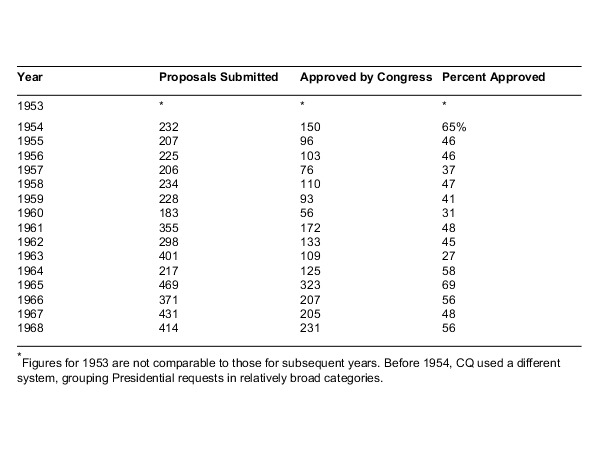
In the Senate, the escalation of the war in Vietnam had led to questions about the administration's judgment and veracity. From 23,000 American military personnel in Vietnam at the end of 1964, the number rose to 181,000 by the end of 1965 and on to 400,000 by the end of 1966. Sen. J. W. Fulbright (D Ark.), chairman of the Senate Foreign Relations Committee, and Sen. Mike Mansfield (D Mont.), the Majority Leader, had begun to criticize war policies. The Senate Foreign Relations Committee in the spring of 1966 held public hearings on the conduct of the war, providing a forum for many leading critics of the war. Fulbright charged that the United States planned to stay indefinitely in Asia to counterbalance Communist China. The Senator said he regretted that he had helped to persuade Congress, in August 1964, to approve the “Gulf of Tonkin” resolution (PL 88-408), which buttressed the legal foundation for American involvement in the war.
...
Get a 30 day FREE TRIAL
-
 Watch videos from a variety of sources bringing classroom topics to life
 -
Read modern, diverse business cases
-
Explore hundreds of books and reference titles

Read next

More like this
Sage Recommends
We found other relevant content for you on other Sage platforms.
Have you created a personal profile? Login or create a profile so that you can save clips, playlists and searches