
Summary
Contents
Subject index
The benchmark First and Second Editions of Comparing Democracies represented essential guides to the global study of elections. Reflecting recent developments in the field, this timely new edition gives an indispensable state-of-the art review of the whole field from the world's leading international scholars. With a completely new thematic introduction which explores how democracy is built and sustained, thoroughly updated chapters (many of which are also new), the Third Edition provides a theoretical and comparative understanding of the major topics related to elections and introduces important work on key new areas. Comparing Democracies, Third Edition will remain a must-read for students and lecturers of elections and voting behavior, comparative politics, parties, and democracy.
Political Participation
Political Participation
In a democracy, every citizen should have the right to express his or her views about what the government should do, should have the right to vote and to have a say about the selection of lawmakers, and should have the right to run as a candidate in elections if he or she so wishes. A democracy is a polity in which citizens are given the opportunity to participate.
Many democratic theorists argue that without substantial citizen participation democracy falls short of its goals (Pateman 1970) and that as a consequence the quality of democracy in a given polity can be ascertained by the degree of citizen involvement. Participation is a “good” thing, and a crucial challenge is to understand why so many people remain “passive” citizens.
A different perspective is offered by rational choice, a theoretical model inspired by an economic perspective according to which individuals make decisions after having considered the expected benefits and costs of the various options (see, especially, Downs 1957; Olson 1965). Rational people realize that their individual participation, by itself, is very unlikely to affect the course of events the expected benefits of getting involved are minimal, they will be inclined to stay home and invest more time and energy in private matters. They will “free ride” and let others participate if they wish to. From such a vantage point, participation appears “irrational” and the challenge is rather to account for the fact that quite a few people do get involved.
The chapter examines the nature, amount, and determinants of political participation. Because of the central place of elections in democracies, I distinguish between electoral and non-electoral participation.
Voter Turnout Over Time
Table 8.1 shows mean turnout by decade in democratic legislative elections held since the 1960s. An election is deemed to be democratic when it takes place in a country with a score of 1 or 2 on the Freedom House ratings of political rights the year the election was held. Turnout is measured as a percentage of those registered who cast a vote.1
TABLE 8.1 Voter turnout by country and decade
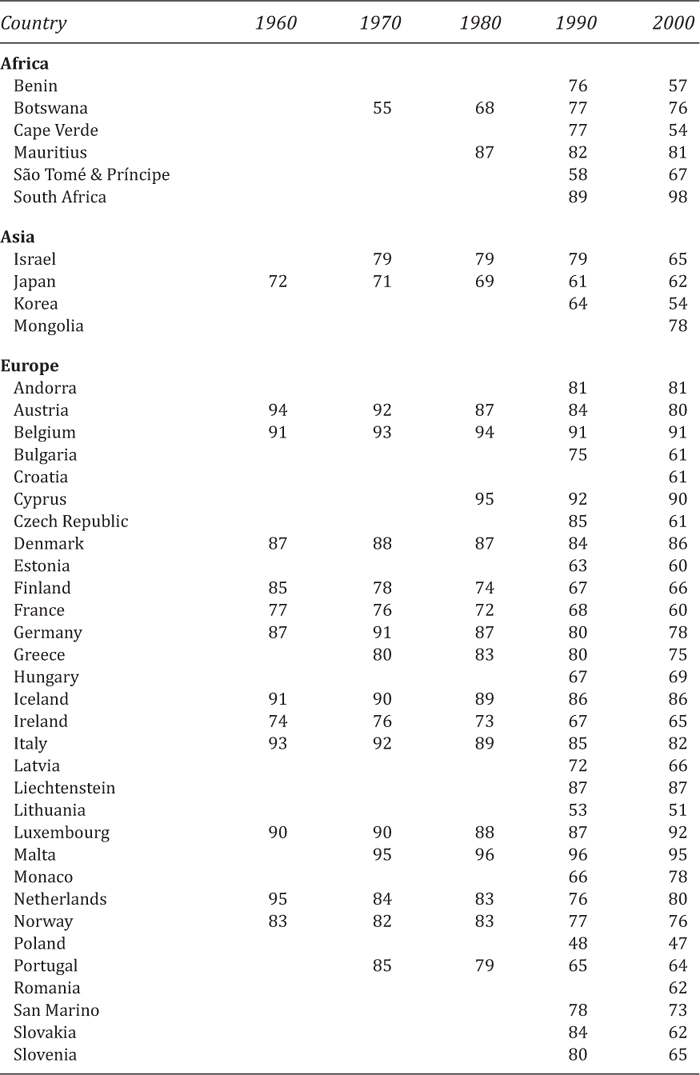
TABLE 8.1 Voter turnout by country and decade
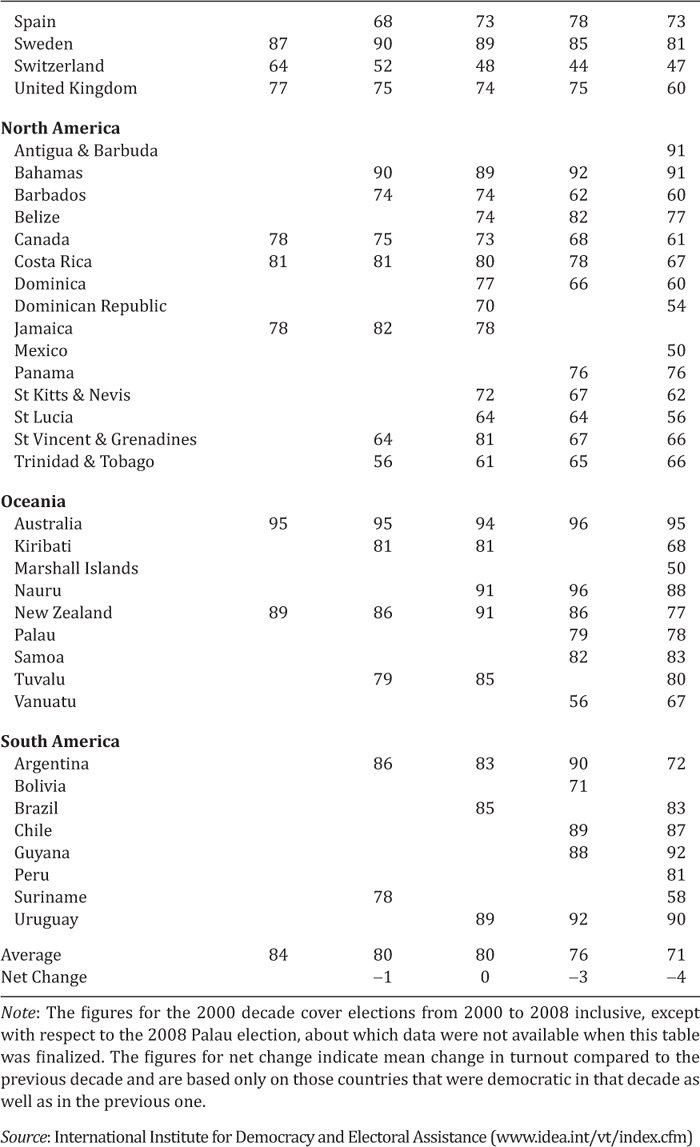
Mean turnout in legislative elections is now around 70%. Whether this is high or low depends on one's expectations. The bottom line, however, is that in almost all elections, voters outnumber abstainers and that typically between two-thirds and three-fourths of those registered cast a vote.
Table 8.1 shows that turnout has declined in the recent past. Mean turnout from the 1960s through the 1980s was close to 80%. There has been a substantial turnout decline, and the decline can be observed in almost all countries. The only countries where turnout has not gone down since the 1980s are: Botswana, Luxembourg, Bahamas, Belize, Trinidad & Tobago, Australia, and Uruguay. In the opposite direction, mean turnout has declined by more than 10 points in each of the following countries: France, Portugal, the United Kingdom, Barbados, Canada, Costa Rica, Dominica, St Vincent & Grenadines, Kiribati, and Argentina.
A number of studies have shown that the turnout decline is concentrated among the youth (Blais et al. 2004; Clarke et al. 2004: ch. 8; Lyons and Alexander 2000; Miller and Shanks 1996: ch. 5; Wass 2007; Wattenberg 2007: ch. 4). This suggests that the decline is the result of generational replacement. This, of course, raises the question of why recent generations are less prone to vote, a question that we address below. This trend has spurred great concern about how to get more young people to the polls, including some consideration for compulsory voting (see Milner 2002; Wattenberg 2007: ch. 7).
...
- Loading...
Get a 30 day FREE TRIAL
-
 Watch videos from a variety of sources bringing classroom topics to life
 -
Read modern, diverse business cases
-
Explore hundreds of books and reference titles

Read next

More like this
Sage Recommends
We found other relevant content for you on other Sage platforms.
Have you created a personal profile? Login or create a profile so that you can save clips, playlists and searches