
Summary
Contents
Subject index
The recent findings from cognitive science – one of the fastest growing disciplines worldwide – presented in the volume will serve as a useful resource for scientists/psychologists working in the area. The book highlights the current trends in major sub-disciplines in cognitive science and contains high quality succinct papers covering current challenges, with cross-linking of different interfacing disciplines like psychology, neuroscience, computer science, linguistics, and philosophy.
Study of Basic Associative Processes Contributes to our Understanding in Cognitive Science*
Study of Basic Associative Processes Contributes to our Understanding in Cognitive Science*
Introduction
We would like to illustrate, from our work and that of our colleagues, a basic research finding that shows that the cognitive processes presumed to underlie choice and decision-making can be dramatically influenced by simple associative mechanisms. Moreover, we want to show that this same basic animal research can be translated into applications with human patients and that such translation is taking place today.
It is a long and complicated story, but not uninteresting because it reflects how our psychological science is self-correcting and how with that self-correction come new insights and new treatment options. In this story, we shall go from learning theory to the animal laboratory, to tests with normal persons, to applications with clients. We will skip some of the steps and details, but all the links are there.
Let us begin our research presentation with some reflections on early theory and its transformation. The behaviouristic associationism that so dominated Western research and thinking in the first half of the 20th century springs from the research and theorizing of Thorndike (1911).
Thorndike argued that learning was the development of associations between a stimulus (environment) and a response (action) that was “stamped in” because the sequence was followed by a reinforcer (see Figure 1.1A). For Thorndike, the reinforcer was a catalyst establishing the stimulus-response (S-R) learning, but the reinforcer was not itself part of what was learned (see Figure 1.1B). According to the theory, it really did not matter what the particular reinforcer was—or even if the same reinforcer was used all the time—the behaviour in question just had to be reinforced.
FIGURE 1.1 Illustration of behavioural stream and three theories of action of reinforcers. SD = discriminative stimulus, R = response, SR = reinforcer
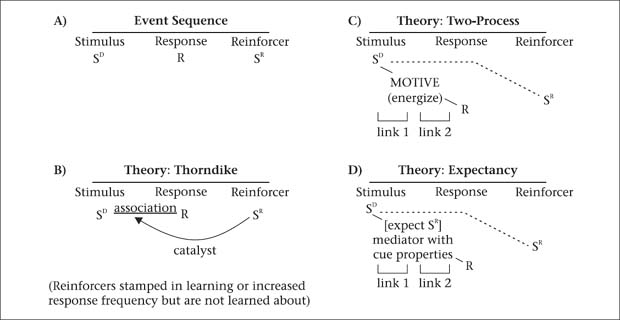
One fascinating thing about this theory is its dominance despite the fact that it conflicts with our private conceptions of “why” we do things; introspection suggests that we do them to get to a particular goal, rather than as goalless automatons. Nonetheless, Thorndike's theory—with Spence's (1937) extension—was very successful in accounting for many observed phenomena of learning and choice behaviour and made interesting predictions (for example, both transposition and when it would fail).
Theorists like Tolman (1945) tried to incorporate learning about goals (“cathexes”) into the then-current theories of learning. They were not very successful in this in their time, but they did get later theorists thinking about the functions of reinforcers and the outcomes of choices.
Perhaps the best known of these attempts is Mowrer's two-process theory (1947). In part, Mowrer invoked this theory in an attempt to explain avoidance behaviour—behaviour which prevented the occurrence of an aversive event (for example, a rat learning to jump a barrier in a shuttle-box in order to avoid an electrical shock, the upcoming presentation of which was signalled by a tone). The theoretical question of interest was, since the result of a successful avoidance response was a non-event (for example, the tone is turned off and there is no delivery of shock), what was motivating avoidance behaviour?
...
- Loading...
Get a 30 day FREE TRIAL
-
 Watch videos from a variety of sources bringing classroom topics to life
 -
Read modern, diverse business cases
-
Explore hundreds of books and reference titles

Read next

More like this
Sage Recommends
We found other relevant content for you on other Sage platforms.
Have you created a personal profile? Login or create a profile so that you can save clips, playlists and searches