
Summary
Contents
Subject index
This 42 chapter volume represents the state of the art in visual research. It provides an introduction to the field for a variety of visual researchers: scholars and graduate students in art, sociology, anthropology, communication, education, cultural studies, women's studies, ethnic studies, global studies and related social science and humanities disciplines.
The SAGE Handbook of Visual Research Methods encompasses the breadth and depth of the field, and points the way to future research possibilities. It illustrates “cutting edge” as well as long-standing and recognized practices. This text is not only “about” research, it is also an example of the way that the visual can be incorporated in data collection and the presentation of research findings. Contributors to the book are from diverse backgrounds and include both established names in the field and rising stars. Chapters describe a methodology or analytical framework, its strengths and limitations, possible fields of application and practical guidelines on how to apply the method or technique.
The Sage Handbook of Visual Research Methods is organized into seven main sections:
Framing the Field of Visual Research; Producing Visual Data and Insight; Participatory and Subject-Centered Approaches; Analytical Frameworks and Approaches; Vizualization Technologies and Practices; Moving Beyond the Visual; Options and Issues for Using and Presenting Visual Research
32 Interactive Media Representation
32 Interactive Media Representation
Introduction
In a paper first published in Visual Anthropology (Coover, 2001) and later revised in the CD-Rom Cultures in Webs: Working in Hypermedia with the Documentary Image (Coover, 2003), I discussed how semantic theories of metaphor, cinematic theories of montage and cognitive theories of what Goodman (1978) called ‘worldmaking,’ might be reconceived as strategies of ethnographic media production. Drawing examples from the films of Gardner and Östör (Forest of Bliss, 1986), Trinh (Naked spaces: living is round, 1985), and others, I looked at how approaches combining these strategies might advance ethnographic praxis.
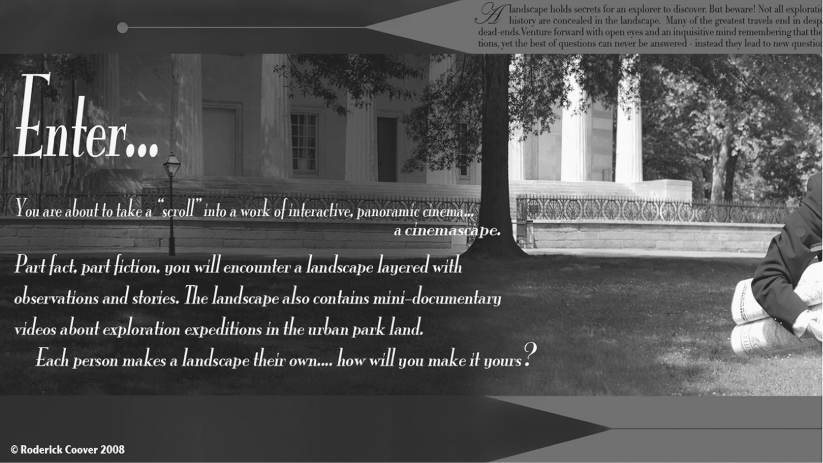
This chapter expands these themes from the perspective of multimedia presentational practices. I will discuss ways in which digital tools might further the integration of diverse disciplinary and modal strategies in cultural research and representation, and I argue that new media tools transform how users engage with materials. The essay draws upon issues that arose when I was making multimodal interactive works, among them Cultures in Webs (2003), Outside/Inside (2007a) (see Figure 32.1), and Voyage Into The Unknown (2008). The chapter gives special attention to ways that techniques of layering and compositing contribute to how works are made, and, in drawing parallels with Certeau's description of walking in his essay, ‘Walking in the City’ (1984), I will consider how digital panoramas and other scrolling environments raise possibilities for user agency.
Rhetoric and Poetics
From note-takers to cooks, amateur photographers to telephone conversationalists, we are all medium-makers. Whether one is simply forwarding e-mails with attachments or designing complex systems, almost everyone who uses a computer is a multimedia-maker. Digital technologies shape how one imagines, constructs, and exchanges ideas. Our electronic communications are shaped by pre-existing conventions (of writing, pictorial representation, etc.), technological constraints (of the processor, memory, software, data transfer, etc.), interface, and use.
Figures 32.1–32.18 Outside/Inside is an interactive scrolling panorama that was commissioned for the Museum of the American Philosophical Society, Philadelphia, and exhibited 2007–2008. © Roderick Coover 2007.
Digital theorist Lev Manovich has been a proponent of the argument that digital tools are giving rise to a new language, albeit a hybrid one—a way of communicating that includes both prior methods of expression and new ones (Manovich, 2001). In writing about the impact of design software like Adobe After Effects® on how images are edited and how they are used, Manovich writes,
(T)he working method is neither animation nor graphic design nor cinematography, even though it draws from all these areas. It is a new way of making image media. Similarly, the visual language is also different from earlier languages of moving images. (2006: 5)
Layering and compositing are among the processes shaping this visual language. Layered tropes, juxtaposed paths, modally varied arguments, and active choice-making are all devices of the digital rhetoric and poetics of the language(s) of digital media which are being incorporated by the makers of media works and are being interpreted by users, who may in turn, even directly within a work, become makers themselves. The impact on documentary production is significant.
First, hybrid spaces that combine text and video in shared environments challenge single-channel cinematic conventions of linearity and montage. The debate about these seemingly dialectical aspects of cinema— a debate characterized but never resolved by many of the great texts of film theory such as Eisenstein (1947) and Bazin (1967)—dissolves when, in digital works, long takes coexist with montage sequences. The practical result for the creators of motion media works is that much of what used to end on up on the cutting-room floor or as little used master video tapes on the edit room bookshelves is now available. In interactive works, users may have the opportunity to access source materials and judge the maker's choice-making. This also allows one ethnographer's process to be compared with another's, and another's and another's.
...
- Loading...
Get a 30 day FREE TRIAL
-
 Watch videos from a variety of sources bringing classroom topics to life
 -
Read modern, diverse business cases
-
Explore hundreds of books and reference titles

Read next

More like this
Sage Recommends
We found other relevant content for you on other Sage platforms.
Have you created a personal profile? Login or create a profile so that you can save clips, playlists and searches