
Summary
Contents
Subject index
The Handbook of Community Practice is the first volume in this field, encompassing community development, organizing, planning, and social change, and the first community practice text that provides in-depth treatment of globalization—including its impact on communities in the United States and in international development work. The Handbook is grounded in participatory and empowerment practice including social change, social and economic development, feminist practice, community-collaboratives, and engagement in diverse communities. It utilizes the social development perspective and employs analyses of persistent poverty, policy practice, and community research approaches as well as providing strategies for advocacy and social and legislative action.
Community-Based Research: Rationale, Methods, Roles, and Considerations for Community Practice
Community-Based Research: Rationale, Methods, Roles, and Considerations for Community Practice
Community-based research has increasingly become a fundamental and critical competency of community practice. Since the publication of the first edition of this text, community practitioners have made significant progress in understanding and using community-based research methods, including utilizing geographic information systems (GIS), neighborhood indicators, and randomized control trials. There is also increasing interest among practitioners, researchers, and students in learning how to apply and use community-based research methods to guide practice. In the first edition of this handbook, Chow and Crowe (2005) stated, “Community-based research aims to apply methods of data collection and analysis to generate findings that have highly practical results” (p. 604). The practical results of community-based research are particularly important to community members, practitioners, policymakers, and funders in designing interventions, policies, and/or strategies that benefit a geographic or population-based community (Kingsley, McNeely, & Gibson, 1997, as cited in Chow & Crowe, 2005).
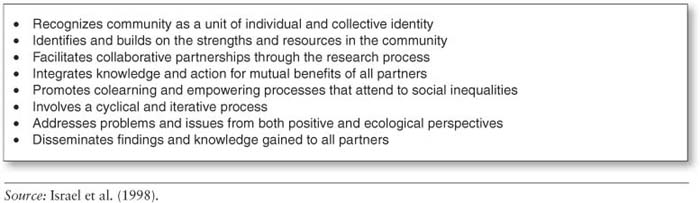
The key principles of community-based research developed by Israel, Schulz, Parker, and Becker (1998) for public health researchers are particularly applicable to community practice. These principles (see Figure 38.1) emphasize the collaborative nature of community-based research and the focus on action-oriented results. The essence of community-based research is the use of participatory methods, collaboration with community members and other key stakeholders on the design, and the implementation and use of research to build individual, organizational, and community capacity (Coulton, 2005; Israel et al., 1998). Moreover, community researchers aim to develop sustainable changes in communities, not solely short-term improvements (Coulton, 2005).
One of the main goals of community practice is to empower communities to work collaboratively to address their most difficult problems and improve their overall quality of life. Facilitating, growing, and building power in communities is also central to community practice. One of the main benefits of community-based research is how it contributes to the knowledge or evidence in the field. Israel and colleagues (1998) argue that the knowledge gained through community-based research is power that “can be used by all partners involved to direct resources and influence policies that will benefit the community” (p. 181). Marginalized communities have traditionally had limited access to resources and decision-making processes affecting their quality of life. By engaging these communities, researchers can increase their access to knowledge and information about social, economic, political, and environmental issues that impact their lives, and work with them to integrate this knowledge into strategies to create community and social change. In partnership with communities, powerful opportunities can be created for science and community stakeholders to work together to ensure a more balanced set of political, economic, social, and cultural priorities, which can satisfy the demands of researchers as well as the needs of disadvantaged communities (Hatch, Moss, Saran, Presley-Cantrell, & Mallory, 1993, as cited in Israel et al., 1998).
Figure 38.1 Key Principles of Community-Based Research
The Role of the Researcher in Community-Based Research
The term community-based research is broad and can refer to research that involves different levels of community engagement, uses various methods, and requires researchers to occupy a variety of different roles and possess a range of different skills and values. The levels of engagement in community-based research can be categorized as research on the community, research in the community, and research with the community.
...
- Loading...
Get a 30 day FREE TRIAL
-
 Watch videos from a variety of sources bringing classroom topics to life
 -
Read modern, diverse business cases
-
Explore hundreds of books and reference titles

Read next

More like this
Sage Recommends
We found other relevant content for you on other Sage platforms.
Have you created a personal profile? Login or create a profile so that you can save clips, playlists and searches