
Entry
Reader's guide
Entries A-Z
Subject index
Environmental Management
Human societies have always had environmental impacts; the major differences between early human civilizations and our contemporary problems are the scales at which humans impact the environment (local/regional/global) and rates of environmental degradation. Human impacts have been magnified by various interconnected factors including population growth and mass consumption. This has led to habitat loss/fragmentation, soil erosion and nutrient depletion, biodiversity loss, water deficits and contamination, food shortages and famines, unsustainable food systems, toxic emissions, chemical pollution, and heavy reliance on nonrenewable resources. Thus, human populations, natural resources, technologies, development, and environmental health are closely/inseparably interrelated. The “environment” is increasingly being managed to meet the goals of sustainability, although the effectiveness of environmental management is debatable.
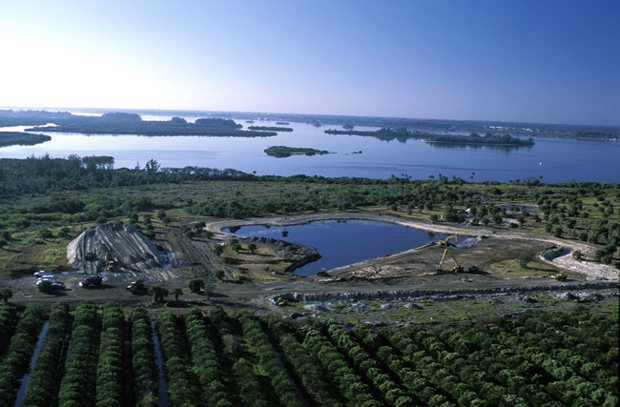
In an example of ecosystem restoration, the U.S. Fish & Wildlife Service conducted this wetlands habitat restoration project in a former orange grove to benefit the birds of Florida's Pelican Island Wildlife Refuge.
There are several major challenges for managing our environment that involve balancing many political, ecological and cultural concerns, particularly in rapidly developing countries. High population and economic growth rates have resource consumption and degradation rates larger than the renewable carrying and absorbing capacity. This situation threatens long-term sustainability and exacerbates conflicts between the resource use and users. Existing mechanisms for linking science and policy for environmental management are often highly sectored, whereas the major environmental problems today are increasing across several sectors. Political and administrative support for environmental management is lacking and significant environmental issues (e.g., the effects of agricultural chemicals) are not on policy agendas or actively promoted. Although many environmental and cultural effects of development are proven to be irreversible, the critics of environmental management are taking refuge under the uncertainty and unpredictability of environmental changes and pushing the burden of proof onto the vulnerable poor. Consequently, the lowest economic classes often endure the maximum impact of nonsustainable development as common public resources (e.g., groundwater, grazing areas, community forests, etc.) on which their very survival depends upon are severely degraded. Traditional ecological knowledge, transmitted orally across generations, could play key roles in sustainable environmental management, such as in the areas of ethnobotany, zoology, pedology, and medicine. Unfortunately, the transference of this knowledge is increasingly threatened by globalization processes (e.g., biopiracy) that result in the consequent loss of local identity, collapse of indigenous social structure, gradual decline of traditional ecological knowledge, and a breakdown of traditional social institutions that were responsible for environmental management.
Environmental management is not, as the term suggests, the management of the environment per se but rather the management of inseparable interactions of physical, chemical, and biological (including human) processes and their consequent impacts on the environment. Hence, it necessarily involves the relationships of the human environment, such as the social, cultural, and economic environment with the biophysical environment. Thus, this topic demands inter- and transdisciplinary approaches; for example, to deal with water management problems, one has to deal with a variety of interrelated fields: hydrogeology, eco-hydrology, watershed planning, sociology, cultural anthropology, environmental economics, and so on.
...
- Politics and Ecology
- Politics and People
- Politics Challenges
- Acid Rain
- Afforestation
- Anti-Toxics Movement
- Appropriate Technology
- Biodiversity
- Decentralization
- Deforestation
- Domination of Nature
- Endocrine Disrupters
- Environmental Justice
- Environmental Management
- Equity
- Future Generations
- Global Climate Change
- Globalization
- Groundwater
- Industrial Revolution
- Innovation, Environmental
- Kuznets Curve
- Limits to Growth
- Malthusianism
- Megacities
- Millennium Development Goals
- Nonviolence
- North–South Issues
- Nuclear Politics
- PCBs
- Precautionary Principle
- Regulatory Approaches
- Resource Curse
- Revolving Door
- Risk Assessment
- Risk Society
- Silent Spring
- Structural Adjustment
- Suburban Sprawl
- Sustainable Development
- Technology
- Toxics Release Inventory
- Tragedy of the Commons
- Transportation
- Uncertainty
- Urban Planning
- Wetlands
- Wilderness
- Agenda 21
- Bhopal
- Brundtland Commission
- Bureau of Land Management, U.S.
- Clean Air Act
- Clean Water Act
- Club of Rome
- Copenhagen Summit
- Corporate Responsibility
- Department of Energy, U.S.
- Endangered Species Act
- Environmental Nongovernmental Organizations
- Environmental Protection Agency, U.S.
- Fish and Wildlife Service, U.S.
- Forest Service, U.S.
- Institutions
- Intergovernmental Panel on Climate Change
- Kyoto Protocol
- Land Ethic
- Marine Mammal Protection Act
- Montreal Protocol
- NIMBY
- North American Free Trade Agreement Organizations
- Sagebrush Rebellion
- Stockholm Convention
- Transnational Advocacy Organizations
- Wise Use Movement
- World Trade Organization
- Politics Parties, Systems, and Economics
- Anarchism
- Basel Convention
- Biophilia
- Capitalism
- Citizen Juries
- Commodification
- Common Property Theory
- Conservation Enclosures
- Conservation Movement
- Consumer Politics
- Convention on Biodiversity
- Cost-Benefit Analysis
- Death of Environmentalism
- Democratic Party
- Ecocapitalism
- Ecofascism
- Ecosocialism
- Environmental Movement
- Federalism
- Gaia Hypothesis
- Gender
- Governmentality
- Green Discourse
- Green Neoliberalism
- Green Parties
- Green Washing
- International Whaling Commission
- Intrinsic Value
- Iron Triangle
- Participatory Democracy
- Petro-Capitalism
- Policy Process
- Political Ideology
- Politics of Scale
- Postmaterialism
- Power
- Pragmatism
- Skeptical Environmentalism
- Steady State Economy
- Transnational Capitalist Class
- UN Conference on Environment and Development
- UN Framework Convention on Climate Change
- Utilitarianism
- Water Politics
- Loading...
Get a 30 day FREE TRIAL
-
 Watch videos from a variety of sources bringing classroom topics to life
 -
Read modern, diverse business cases
-
Explore hundreds of books and reference titles

Read next

More like this
Sage Recommends
We found other relevant content for you on other Sage platforms.
Have you created a personal profile? Login or create a profile so that you can save clips, playlists and searches