
Entry
Reader's guide
Entries A-Z
Subject index
Acid Rain
The average pH of rainwater is 5.6 (pH levels are based on the concentrations of hydrogen ions with respect to pure water). Because water reacts with atmospheric carbon dioxide to form carbonic acid, rain is typically slightly acidic. Acid rain (or acid deposition), however, refers to atmospheric precipitates with pH values below that of rainwater. cid-causing contaminants may originate in locations far from the acid precipitation, and so this issue crosses boundaries, necessitating political solutions.
Acid deposition is linked to numerous negative environmental impacts, affecting both the natural and built environments. Soils become more acidified, rendering them less hospitable to certain plants. Higher acid levels in lakes lead to a reduction in fish populations. Highly acidic precipitation exacerbates the weathering of many buildings, which is a particular problem with historical edifices. Limestone, for example, is weathered and eroded by acid rain. Although natural causes of acid rain exist, most acid deposition results from the by-products of anthropogenic actions, such as discharges from industrial activity. Natural causes such as volcanic eruptions, thunderstorm activity and lightning, and fire can, however, affect the atmosphere, leading to acidic precipitation.
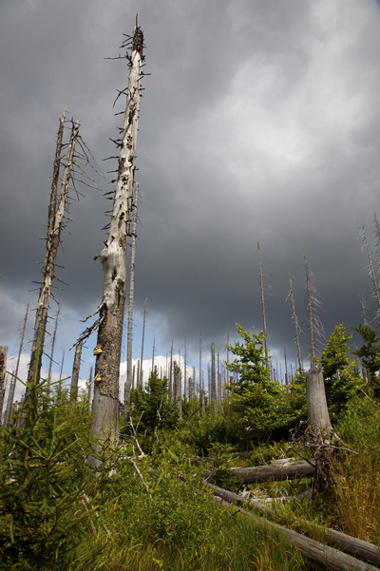
Trees damaged by acid rain and a bark beetle infestation loom above new growth in Germany's Bavarian Forest near Mount Lusen.
Chemically, sulfur and nitrogen oxides produced by industrial operations enter the atmosphere. Among the largest sources of these oxides is the generation of electrical power, in which coal and oil are burned; vehicular traffic also contributes significantly. The consumption of fossil fuels in both cases sends oxides into the atmosphere. Sulfurous emissions, largely from the production of electricity, combine with atmospheric water and oxygen to produce sulfuric acid (H2SO4). Nitrogen oxides, typically from the combustion of petroleum-derived fuels, react similarly to create nitric acid (HNO3).
Although acid rain may stem from pollution from localized point sources, the ramifications extend regionally. As such, acid rain is truly a regional issue. Atmospheric circulation patterns allow for a relatively efficient transport of pollutants to locales far removed from the original source. For example, acid rain in Scandinavia is often a product of oxides generated in Germany. Similarly, the acid rain falling in the northeastern United States can trace some of its origins to industrial activity in the Midwestern states. In the midlatitudes, prevailing winds are westerly; thus, atmospheric currents can transport these pollutants east of their origins. Mitigation of this problem, then, requires regional understandings and cooperation.
The Discovery of Acid Rain
The term acid rain was first used in 1872 by Robert Angus Smith, a Scottish chemist and environmental scientist who developed a simple model of acid deposition in the mid-1800s. His work focused on the British industrial center of Manchester. Despite Smith's initial foray into the problem of acid precipitation, it would be another century before it received the focused attention of scientists. Svante Odén, a Swedish soil scientist, argued that Swedish lakes were suffering environmental degradation that stemmed from acidic compounds generated by industrial activity elsewhere; specifically, (West) Germany and the United Kingdom. Odén's paper was the first to suggest that atmospheric transport could carry industrial contaminants over long distances to cause damage at locations far removed from the original point sources of the pollution. Among Odén's conclusions was that industrial activities and effects were regional, not local, issues.
...
- Politics and Ecology
- Politics and People
- Politics Challenges
- Acid Rain
- Afforestation
- Anti-Toxics Movement
- Appropriate Technology
- Biodiversity
- Decentralization
- Deforestation
- Domination of Nature
- Endocrine Disrupters
- Environmental Justice
- Environmental Management
- Equity
- Future Generations
- Global Climate Change
- Globalization
- Groundwater
- Industrial Revolution
- Innovation, Environmental
- Kuznets Curve
- Limits to Growth
- Malthusianism
- Megacities
- Millennium Development Goals
- Nonviolence
- North–South Issues
- Nuclear Politics
- PCBs
- Precautionary Principle
- Regulatory Approaches
- Resource Curse
- Revolving Door
- Risk Assessment
- Risk Society
- Silent Spring
- Structural Adjustment
- Suburban Sprawl
- Sustainable Development
- Technology
- Toxics Release Inventory
- Tragedy of the Commons
- Transportation
- Uncertainty
- Urban Planning
- Wetlands
- Wilderness
- Agenda 21
- Bhopal
- Brundtland Commission
- Bureau of Land Management, U.S.
- Clean Air Act
- Clean Water Act
- Club of Rome
- Copenhagen Summit
- Corporate Responsibility
- Department of Energy, U.S.
- Endangered Species Act
- Environmental Nongovernmental Organizations
- Environmental Protection Agency, U.S.
- Fish and Wildlife Service, U.S.
- Forest Service, U.S.
- Institutions
- Intergovernmental Panel on Climate Change
- Kyoto Protocol
- Land Ethic
- Marine Mammal Protection Act
- Montreal Protocol
- NIMBY
- North American Free Trade Agreement Organizations
- Sagebrush Rebellion
- Stockholm Convention
- Transnational Advocacy Organizations
- Wise Use Movement
- World Trade Organization
- Politics Parties, Systems, and Economics
- Anarchism
- Basel Convention
- Biophilia
- Capitalism
- Citizen Juries
- Commodification
- Common Property Theory
- Conservation Enclosures
- Conservation Movement
- Consumer Politics
- Convention on Biodiversity
- Cost-Benefit Analysis
- Death of Environmentalism
- Democratic Party
- Ecocapitalism
- Ecofascism
- Ecosocialism
- Environmental Movement
- Federalism
- Gaia Hypothesis
- Gender
- Governmentality
- Green Discourse
- Green Neoliberalism
- Green Parties
- Green Washing
- International Whaling Commission
- Intrinsic Value
- Iron Triangle
- Participatory Democracy
- Petro-Capitalism
- Policy Process
- Political Ideology
- Politics of Scale
- Postmaterialism
- Power
- Pragmatism
- Skeptical Environmentalism
- Steady State Economy
- Transnational Capitalist Class
- UN Conference on Environment and Development
- UN Framework Convention on Climate Change
- Utilitarianism
- Water Politics
- Loading...
Get a 30 day FREE TRIAL
-
 Watch videos from a variety of sources bringing classroom topics to life
 -
Read modern, diverse business cases
-
Explore hundreds of books and reference titles

Read next

More like this
Sage Recommends
We found other relevant content for you on other Sage platforms.
Have you created a personal profile? Login or create a profile so that you can save clips, playlists and searches