
Entry
Reader's guide
Entries A-Z
Subject index
Integrated Pest Management
Integrated pest management, or IPM, is an ecologically based, multipronged approach to managing damage from crop pests below a level that will cause economic loss if no remedial action is taken. The term pest refers to any organism that is detrimental to humans. However, the majority of IPM programs in agriculture have been designed around the control of arthropods, weeds, and plant pathogens. The foundation of decision making in IPM is an understanding of the biology of the pest organism and the ecology of the cropping system. Ideally, IPM relies on cultural, biological, and mechanical practices to prevent competitive species from becoming pests. When crop monitoring indicates that pest populations exceed the economic threshold, a mechanical, chemical, or biological method can be employed to reduce the pest population. By using pest management practices that are effective, economically sound, and ecologically harmonious, IPM is a fundamental component of sustainable agriculture. IPM was developed as an alternative approach to pesticide-centered management programs that were the predominant model for pest management post-World War II, when synthetic pesticides became widely available. Chemical pesticides have been central to industrial agriculture production because they are easy and relatively inexpensive to produce and use, can be persistent, and are effective against a broad array of insects. Undoubtedly, chemical pesticides have been important in reducing economic damage from insect pests and the diseases they can carry. However, the dependence on chemical pesticides as the principal defense against pest damage has led to many deleterious agricultural, social, and ecological effects including pesticide resistance, pest resurgence, mortality of natural biological control organisms leading to secondary pest outbreaks, health hazards for people in contact with the pesticides (e.g., applicators, farm workers, and consumers), and the contamination of soil, water, and air, which can threaten biodiversity. Rachel Carson's highly influential book, Silent Spring, published in 1962, brought international attention to the ecological dangers of widespread pesticide use. In 1972, the term integrated pest management was formalized in a letter to Congress by President Richard Nixon requesting further development of IPM concepts and application.
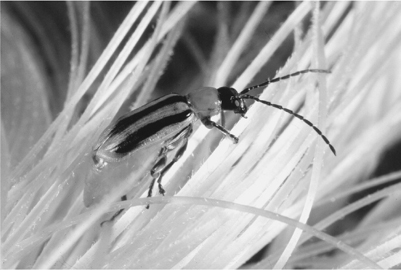
Integrated pest management requires in-depth knowledge of pest organisms such as this western corn rootworm, photographed in its adult stage while it sought pollen in strands of corn silk.
There are six essential components to an IPM program: (1) the people who make decisions about production and manage the crops in the field, (2) the knowledge about a crop production system and a pest that informs management decisions, (3) the cultural practices that give crops the competitive advantage over pests, (4) a system of monitoring the crop for the presence of pests and beneficial organisms and for crop damage by the pest, (5) an economic threshold to aid decisions about treatments, and (6) reduced risk control options including biological control, mechanical control, and pesticides of low toxicity.
How IPM Works
The fundamental guideline of an IPM program is to apply knowledge of the population biology and ecology of the pest organism and its natural enemies to the design of agroeco-systems that are resistant and resilient to pest outbreaks. Pest populations are naturally controlled by a number of factors including weather, disease, predators, and parasites. For example, the seeds of many weeds cannot germinate unless the right temperature, moisture, and light conditions are present. Similarly, the growth rate of insect pest populations is directly related to the amount of time accumulated within an optimal temperature range, known as degree-days. IPM practitioners can take advantage of phenological restrictions by cultivating host crops when environmental conditions are less favorable for the development of the pest organism, but sufficient for the crop. Often just small amounts of time without initial pest competition can help crops develop to the point where they can tolerate pest presence without loss in productivity or marketability.
...
- Food Challenges
- Animal Welfare
- Beyond Organic
- Cheap Food Policy
- Crop Genetic Diversity
- DDT
- Debt Crisis
- Disappearing Middle
- Export Dependency
- Famine
- Farm Crisis
- Fast Food
- Food Processing Industry
- Food Safety
- Food Security
- Genetically Modified Organisms
- Grain-Fed Beef
- High Fructose Corn Syrup
- Integrated Pest Management
- Irradiation
- Mad Cow Disease
- Malthusianism
- Mechanization
- Millennium Development Goals
- Modernization
- Nitrogen Fixation
- Organochlorines
- Origin Labeling
- Peasant
- Pesticide
- Productionism
- Proletarianization
- Recombinant Bovine Growth Hormone
- Roundup Ready Crops
- Salmonella
- Sewage Sludge
- Soil Erosion
- Sustainable Agriculture
- Swidden Agriculture
- Weed Management
- Food Economics and Trade
- Food Farm and Industry
- Agrarian Question
- Agrarianism
- Agribusiness
- Agricultural Commodity Programs
- Agricultural Extension
- Agrodiversity
- Agroecology
- Agrofood System (Agrifood)
- Aquaculture
- Biodynamic Agriculture
- Biological Control
- Bt
- Composting
- Confined Animal Feeding Operation
- Contract Farming
- Cooperative
- Corn
- Cover Cropping
- Crop Rotation
- Dairy
- Dioxins
- Factory Farm
- Family Farm
- Fertilizer
- Fruits
- Grazing
- Hunting
- Intercropping
- Irrigation
- Legume Crops
- Low-Input Agriculture
- Meats
- Nanotechnology and Food
- Organic Farming
- Plantation
- Rice
- Salmon
- Seed Industry
- Soil Nutrient Cycling
- Soybeans
- Substitutionism
- Sugarcane
- Urban Agriculture
- Vegetables
- Wheat
- Yeoman Farmer
- Food Laws, Agreements, and Organizations
- Archer Daniels Midland
- California Certified Organic Farmers
- Certified Humane
- Certified Organic
- Codex Alimentarius
- Commons ConAgra
- Department of Agriculture, U.S
- Diamond v. Chakrabarty
- Doha Round, World Trade Organization
- Fair Labor Association
- Fair Trade
- Farm Bill
- Federal Insecticide, Fungicide, and Rodenticide Act
- Food and Agriculture Organization
- Food and Drug Administration
- Food First
- Food Justice Movement
- Food Quality Protection Act
- Food Sovereignty
- Institute for Agriculture and Trade Policy
- International Coffee Agreement
- Land Grant University
- National Organic Program
- North American Free Trade Agreement
- Northeast Organic Farming Association
- Ogallala Aquifer
- Public Law 480, Food Aid
- Sustainable Fisheries Act
- United Farm Workers
- Wal-Mart
- Foods and Lifestyle
- Loading...
Get a 30 day FREE TRIAL
-
 Watch videos from a variety of sources bringing classroom topics to life
 -
Read modern, diverse business cases
-
Explore hundreds of books and reference titles

Read next

More like this
Sage Recommends
We found other relevant content for you on other Sage platforms.
Have you created a personal profile? Login or create a profile so that you can save clips, playlists and searches