
Entry
Reader's guide
Entries A-Z
Subject index
Markets (Organic/Farmers)
Markets are places where the exchange of goods and services occurs. Specifically, in relation to green consumerism they are places where organic foods are sold, but they may also be associated with notions of buying local, supporting local firms, lowering food miles, and slow food. Originally, in the 1920s, organic food tended to be marketed through small-scale, informal links directly between farmers and consumers. Direct marketing continued to be the main way in which organic food was sold up until the 1950s and 1960s. By the 1970s, in both Europe and the United States, retail health-food outlets specializing in organic products started to appear. These were often run by people who were part of alternative movements and were concerned with a variety of issues such as the industrialization of farming and social justice within developing countries.
However, by the mid-1980s and early 1990s the production of organic produce increased rapidly. Small-scale shops were no longer able to handle the volumes involved, and a number of other market outlets developed. These included conventional supermarkets, which have increasingly stocked organic produce, encouraged by the premium prices available. The 1990s and early 2000s have also seen a growth in large-scale box schemes, such as Abel & Cole and Riverford Organics in the United Kingdom and the Good Food Box in Canada. At the same time, farmers markets have burgeoned in both the United States and Europe as a medium that includes the sale of organic produce in a way that encourages the connection of producers and consumers. Small-scale vegetable box schemes have also grown, as have specialized organic food outlets—especially in countries such as Germany and the Netherlands.
Farmers markets have burgeoned in both the United States and European Union countries. The sale of organic produce encourages a closer connection between producers and consumers
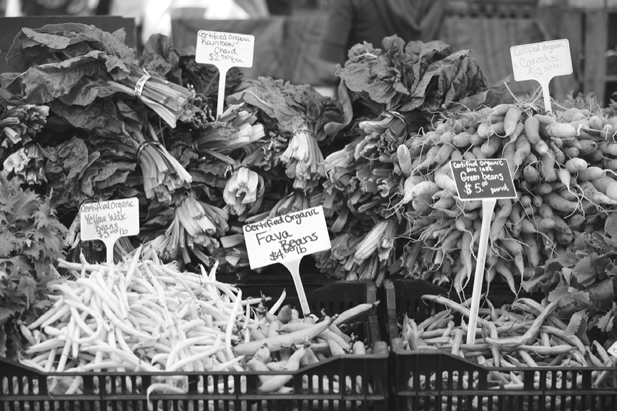
The net result of these processes is that there is now a wide range of markets for organic food. It is also evident that there is some kind of division between those that involve a degree of direct marketing—wherein there is contact between the producers and consumers of the products involved—and outlets where the produce is more anonymous and distanced, whereby institutional organic regulations become more important.
Starting Small
Specialized independent retail outlets have been an important market for organic produce since the 1960s, when in many cases they may have been run as not-for-profit food cooperatives. Initially, the emphasis was on retaining direct links with the place of production and on encouraging the consumption of locally grown food, but throughout the 1970s and 1980s, they often became more specialized and urban based. Indeed, in countries such as the Netherlands and Germany, specialized shops selling only organic products were the most important market outlet for organic produce. However, by the mid-1980s and early 1990s, in part following deliberate attempts by certain players within the organic movement (such as the Soil Association in the United Kingdom), the scale of organic food production increased markedly and the role of independent retail outlets declined, relative to other markets. Nevertheless, they still have an important role to play in certain countries (e.g., Germany), as well as in the guise of farm shops, which continue to be a significant market outlet in some countries.
...
- Green Consumer Challenges
- Affluenza
- Air Travel
- Carbon Emissions
- Commuting
- Conspicuous Consumption
- Disparities in Consumption
- Dumpster Diving
- Durability
- E-Waste
- Electricity Usage
- Energy Efficiency of Products and Appliances
- Food Additives
- Food Miles
- Genetically Modified Products
- Greenwashing
- Healthcare
- Insulation
- Lawns and Landscaping
- Materialism
- Needs and Wants
- Overconsumption
- Pesticides and Fertilizers
- Pets
- Pharmaceuticals
- Positional Goods
- Poverty
- Pricing
- Quality of Life
- Resource Consumption and Usage
- Solid and Human Waste
- Super-Rich
- Symbolic Consumption
- Waste Disposal
- Windows
- Beverages
- Bottled Beverages (Water)
- Coffee
- Confections
- Dairy Products
- Fish
- Meat
- Poultry and Eggs
- Slow Food
- Tea
- Vegetables and Fruits
- Water
- Green Consumer Products and Services
- Adhesives
- Apparel
- Audio Equipment
- Automobiles
- Baby Products
- Books
- Car Washing
- Certified Products (Fair Trade or Organic)
- Cleaning Products
- Computers and Printers
- Cosmetics
- Disposable Plates and Plastic Implements
- Floor and Wall Coverings
- Fuel
- Funerals
- Furniture
- Garden Tools and Appliances
- Grains
- Home Appliances
- Home Shopping and Catalogs
- Homewares
- Internet Purchasing
- Lighting
- Linen and Bedding
- Magazines
- Malls
- Mobile Phones
- Packaging and Product Containers
- Paper Products
- Personal Products
- Recyclable Products
- Seasonal Products
- Services
- Shopping
- Shopping Bags
- Sports
- Supermarkets
- Swimming Pools and Spas
- Television and DVD Equipment
- Tools
- Toys
- Green Consumer Solutions
- Biodegradable
- Carbon Credits
- Carbon Offsets
- Certification Process
- Composting
- Consumer Activism
- Downshifting
- Ecolabeling
- Ecological Footprint
- Ecotourism
- Environmentally Friendly
- Ethically Produced Products
- Fair Trade
- Gardening/Growing
- Gifting (Green Gifts)
- Green Communities
- Green Consumer
- Green Consumerism Organizations
- Green Design
- Green Discourse
- Green Food
- Green Gross Domestic Product
- Green Homes
- Green Marketing
- Green Politics
- Local Exchange Trading Schemes
- Locally Made
- Markets (Organic/Farmers)
- Morality (Consumer Ethics)
- Organic
- Plants
- Product Sharing
- Public Transportation
- Recycling
- Regulation
- Secondhand Consumption
- Simple Living
- Sustainable Consumption
- Vege-Box Schemes
- Green Consumerism Organizations, Movements, and Planning
- Advertising
- Commodity Fetishism
- Consumer Behavior
- Consumer Boycotts
- Consumer Culture
- Consumer Ethics
- Consumer Society
- Consumerism
- Demographics
- Diderot Effect
- Environmentalism
- Fashion
- Final Consumption
- Finance and Economics
- Frugality
- Government Policy and Practice (Local and National)
- Heating and Cooling
- International Regulatory Frameworks
- Kyoto Protocol
- Leisure and Recreation
- Lifestyle, Rural
- Lifestyle, Suburban
- Lifestyle, Sustainable
- Lifestyle, Urban
- Organisation for Economic Co-operation and Development (OECD)
- Production and Commodity Chains
- Psychographics
- Social Identity
- Taxation
- United Nations Human Development Report 1998
- Websites and Blogs
- Loading...
Get a 30 day FREE TRIAL
-
 Watch videos from a variety of sources bringing classroom topics to life
 -
Read modern, diverse business cases
-
Explore hundreds of books and reference titles

Read next

More like this
Sage Recommends
We found other relevant content for you on other Sage platforms.
Have you created a personal profile? Login or create a profile so that you can save clips, playlists and searches