
Entry
Reader's guide
Entries A-Z
Subject index
General Electric (GE)
General Electric (GE) is one of the largest global business conglomerates, with 2007 revenue of $183 billion. It has over 300,000 employees in 100 countries, with 50 percent of employees outside the United States. The American company, founded by Thomas A. Edison, has operated for 120 years. GE is the only company listed in the Dow Jones Index that was in the original index in 1896.
For the 21st century, GE has adopted a new green philosophy, which more or less coincided with the ascension of Jeffrey R. Immelt as chief executive officer in 2001. Its green initiatives have intensified since 2005, when GE coined the term ecomagination for its various efforts. GE is now a major force in renewable energy with green initiatives, including solar and wind power; diesel–electric locomotives; lower emission aircraft engines; sodium-based batteries; energy-efficient lighting; water purification; biomass, hydro, geothermal, and other renewable power projects; and financing for other companies’ green energy efforts.
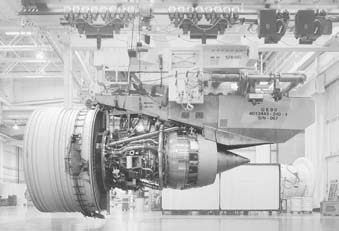
Perhaps better known for making Energy Star–rated home appliances and compact fluorescent lighting, General Electric has long produced energy-efficient, wide-body aircraft engines, such as this GE90-115B model
GE has been named on the Dow Jones Sustainability World Index as one of the world's leaders in environmental, social, and economic programs, and applauded by Greenpeace for its commitment to incorporate Greenpeace's climate-friendly technology into refrigerators to be sold in the U.S. market. But it has also been awarded its share of dubious distinctions, placing number six on a list of U.S. companies ranked by releases of toxic chemicals in 2005 as compiled by the University of Massachusetts’ Political Economy Research Institute (PERI).
Environmental watchdog groups frequently accuse the company of greenwashing, that is, using misleading advertising to project an unwarranted image as an environmental leader.
There is no question that over the years GE has had its share of environmental problems. It continues to manufacture pollution-generating, global-warming products (appliances, plastics, fossil-fuel-fired turbines, diesel locomotives), and to invest in the petroleum industry, nuclear energy and coal-fired plants. Nor can its past history of dumping 1.3 million pounds of polychlorinated biphenyls into the Hudson River in the 1960s and 1970s be ignored. The company's response to the continuing problems associated with their dumping has been widely criticized as inadequate and defensive.
The company faces ongoing pollution issues both at home and abroad. It released more than 4 million tons of toxics into the air, and more than 7 million tons of toxics into rivers and lakes in 2004. GE's website does not list toxic release amounts, but does provide metrics for the number of releases related to global operations—98 in 2007 and 70 in 2008. For those same years, they report fines of $236,000 and $96,000, respectively. GE corporate policy is to comply with all applicable laws.
The 2005 ecomagination campaign aimed to double revenues from environmentally friendly products. After reporting $14 billion in revenues from ecomagination products and services in 2007, GE increased its annual sales revenue target for 2010 from $20 billion to $25 billion. To expand the product line, GE reinvests ecomagination revenues in “cleantech” development at triple the rate of its research and development in general. GE began with 17 ecomagination products in 2005. Today, the portfolio exceeds 60 products and pervades every one of GE's businesses.
...
- Business Organizations, Movements, and Planning
- Balanced Scorecard
- Best Available Control Technology
- Best Management Practices
- Ceres Principles
- Certification
- Closed-Loop Supply Chain
- Compliance
- Core Competencies
- Corporate Social Responsibility
- Cost-Benefit Analysis
- Demand-Side Management
- Discounting
- Dow Jones Sustainability Index
- Ecoeffectiveness
- Ecoefficiency
- Ecoindustrial Park
- Ecological Economics
- Economic Value Added
- Emissions Trading
- Energy Performance Contracting
- Energy Service Company
- Environmental Accounting
- Environmental Assessment
- Environmental Audit
- Environmental Economics
- Environmental Impact Statement
- Environmental Indicators
- Environmental Management System
- Environmental Marketing
- Environmental Risk Assessment
- Environmental Services
- Environmentally Preferable Purchasing
- Equator Principles
- Extended Producer Responsibility
- Extended Product Responsibility
- Externalities
- Factor Four and Factor Ten
- Fair Trade
- Genuine Progress Indicator
- Global Reporting Initiative
- Global Sullivan Principles
- Industrial Ecology
- Industrial Metabolism
- Industrial Nutrients
- Informational Regulation
- Integrated Bottom Line
- International Organization for Standardization
- ISO 14000
- ISO 19011
- Leadership in Green Business
- Life Cycle Analysis
- Material Input per Service Unit (MIPS)
- Maximum Achievable Control Technology
- National Priorities List
- Natural Capital
- New Source Review
- Quantitative Risk Assessment
- Recycling, Business of
- Reverse Logistics
- Service Design
- Social Return on Investment
- Steady State Economy
- Stewardship
- Supply Chain Management
- Value Chain
- Business Profiles
- Green Business Challenges
- Green Business Solutions
- Abatement
- Appropriate Technology
- Bio-Based Material
- Biofuels
- Biological Resource Management
- Biomimicry
- Bioremediation
- Biotechnology
- Blended Value
- Brownfield Redevelopment
- Carbon Neutral
- Carbon Sequestration
- Carbon Trading
- Cause-Related Marketing
- Clean Fuels
- Clean Production
- Clean Technology
- Cogeneration
- Conservation
- Coopetition
- Cradle-to-Cradle
- Deposit Systems
- Distributed Energy
- Ecolabels
- Ecosystem Services
- Ecotourism
- Environmental Justice
- Green Building
- Green Chemistry
- Green Design
- Green Retailing
- Green Technology
- Green-Collar Jobs
- Gross National Happiness
- Integrated Pest Management
- Organic
- Pollution Offsets
- Pollution Prevention
- Precautionary Principle
- Remanufacturing
- Resource Management
- Responsible Sourcing
- Restoration
- Right to Know
- Seventh Generation
- Six Sigma
- Smart Energy
- Social Entrepreneurship
- Social Marketing
- Socially Responsible Investing
- Superfund
- Sustainability
- Sustainable Design
- Sustainable Development
- Systems Thinking
- Take Back
- Upcycle
- Voluntary Standards
- Waste Reduction
- Loading...
Get a 30 day FREE TRIAL
-
 Watch videos from a variety of sources bringing classroom topics to life
 -
Read modern, diverse business cases
-
Explore hundreds of books and reference titles

Read next

More like this
Sage Recommends
We found other relevant content for you on other Sage platforms.
Have you created a personal profile? Login or create a profile so that you can save clips, playlists and searches