
Entry
Reader's guide
Entries A-Z
Subject index
Extended Product Responsibility
The prevention and reduction of environmental pollution, as well as the promotion of sustainable consumption and production (SCP), are fundamental to safeguard the Earth's capacity to support life, to respect the limits of the planet's natural resources, and to ensure a high level of regenerative development. Consumption and production of goods contribute significantly to global warming, pollution, material use, the increase of hazardous waste, and the depletion of the planet's natural resources. Extended product responsibility establishes a framework that supports and encourages SCP. In contrast to Extended Producer Responsibility, which places the burden on the producer, Extended Product Responsibility stresses that all the actors in a product chain should work together to ensure more efficient use of natural resources, thereby reducing waste and energy during all stages of a product's life, from extraction of raw materials to manufacturing, transport, consumer use, disposal, and end-of-life treatment. Specifically, extended product responsibility places the initial impetus of sustainability on the designers of a product to select raw materials that come from regenerative sources; assigns responsibility to the product manufacturers to make choices that are in line with sustainable design; calls for environmentally friendly methods of marketing and distribution; and aims for consumers to choose products based on green factors, and then give the materials new life through proper recycling.
Traditional industrial systems and modern manufacturing are based upon a linear economy in which natural resources and valuable materials contained within a product are discarded rather than recovered once that product has been used. In the United States, an example of a linear economy, it is commonly held that cradle-to-grave (nonsustainable) designs, which are responsible for up to 90 percent of all extracted raw materials, end up as waste, according to W. McDonough and M. Braungart in their 2002 research. In response to this growing problem of linearity, the Brundtland Commission published the report “Our Common Future” in 1987, an important contribution to the international objective of sustainable development that aims to ensure that natural resources and finite materials be managed to sustain future generations. In this sustainable management of resources, it is not only the reduction of end-use waste that is a cause for concern but also the wasting of resources. In contrast to linear economies, closed-loop economies make an important contribution to sustainable resource management and positive patterns of production and consumption by (1) promoting the utilization of existing resources by reintroducing materials within society into the market; (2) encouraging increased efficiency through better and more ecologically sound design; and (3) adopting cleaner production technologies. The main objective of a circular economy is to achieve no waste at any point in the life cycle of a product through environmentally responsible product development and product recovery.
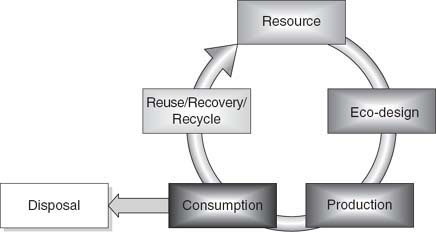
From this background, it is clear that extended product responsibility can be considered as a product systems approach to resource conservation, waste reduction, and sustainability. It is a term that is prevalent in U.S. discussions on the management of resources and waste in business and industry, but it has not been integrated into law and policy frameworks in Europe. In the European context, the related principle of extended producer responsibility has been considered an important mechanism in securing patterns of SCP. Extended producer responsibility focuses almost exclusively on producers. This concept aims to make producers responsible for their products throughout a product's life cycle. The doctrine encourages producers to facilitate the repair, reuse, disassembly, recycling, and environmentally sound disposal of their products. Most importantly, extended producer responsibility promotes better design and production of goods since the design and development of a product is evaluated by its environmental impact throughout the product's lifetime. The main objective of related ideas in ecodesign, also referred to as design for environment (DFE), is to design products that minimize product life cycle impacts on the environment. To this end, life cycle assessment is the standard procedure used by producers, engineers, and environmental scientists to investigate and assess the environmental impacts of a product and its component parts from raw material extraction to the recycling and disposal of the product. These concepts enable businesses involved at every stage in the product chain to select the most environmentally favorable options early in the design process and to avoid designs that have detrimental environmental consequences.
...
- Business Organizations, Movements, and Planning
- Balanced Scorecard
- Best Available Control Technology
- Best Management Practices
- Ceres Principles
- Certification
- Closed-Loop Supply Chain
- Compliance
- Core Competencies
- Corporate Social Responsibility
- Cost-Benefit Analysis
- Demand-Side Management
- Discounting
- Dow Jones Sustainability Index
- Ecoeffectiveness
- Ecoefficiency
- Ecoindustrial Park
- Ecological Economics
- Economic Value Added
- Emissions Trading
- Energy Performance Contracting
- Energy Service Company
- Environmental Accounting
- Environmental Assessment
- Environmental Audit
- Environmental Economics
- Environmental Impact Statement
- Environmental Indicators
- Environmental Management System
- Environmental Marketing
- Environmental Risk Assessment
- Environmental Services
- Environmentally Preferable Purchasing
- Equator Principles
- Extended Producer Responsibility
- Extended Product Responsibility
- Externalities
- Factor Four and Factor Ten
- Fair Trade
- Genuine Progress Indicator
- Global Reporting Initiative
- Global Sullivan Principles
- Industrial Ecology
- Industrial Metabolism
- Industrial Nutrients
- Informational Regulation
- Integrated Bottom Line
- International Organization for Standardization
- ISO 14000
- ISO 19011
- Leadership in Green Business
- Life Cycle Analysis
- Material Input per Service Unit (MIPS)
- Maximum Achievable Control Technology
- National Priorities List
- Natural Capital
- New Source Review
- Quantitative Risk Assessment
- Recycling, Business of
- Reverse Logistics
- Service Design
- Social Return on Investment
- Steady State Economy
- Stewardship
- Supply Chain Management
- Value Chain
- Business Profiles
- Green Business Challenges
- Green Business Solutions
- Abatement
- Appropriate Technology
- Bio-Based Material
- Biofuels
- Biological Resource Management
- Biomimicry
- Bioremediation
- Biotechnology
- Blended Value
- Brownfield Redevelopment
- Carbon Neutral
- Carbon Sequestration
- Carbon Trading
- Cause-Related Marketing
- Clean Fuels
- Clean Production
- Clean Technology
- Cogeneration
- Conservation
- Coopetition
- Cradle-to-Cradle
- Deposit Systems
- Distributed Energy
- Ecolabels
- Ecosystem Services
- Ecotourism
- Environmental Justice
- Green Building
- Green Chemistry
- Green Design
- Green Retailing
- Green Technology
- Green-Collar Jobs
- Gross National Happiness
- Integrated Pest Management
- Organic
- Pollution Offsets
- Pollution Prevention
- Precautionary Principle
- Remanufacturing
- Resource Management
- Responsible Sourcing
- Restoration
- Right to Know
- Seventh Generation
- Six Sigma
- Smart Energy
- Social Entrepreneurship
- Social Marketing
- Socially Responsible Investing
- Superfund
- Sustainability
- Sustainable Design
- Sustainable Development
- Systems Thinking
- Take Back
- Upcycle
- Voluntary Standards
- Waste Reduction
- Loading...
Get a 30 day FREE TRIAL
-
 Watch videos from a variety of sources bringing classroom topics to life
 -
Read modern, diverse business cases
-
Explore hundreds of books and reference titles

Read next

More like this
Sage Recommends
We found other relevant content for you on other Sage platforms.
Have you created a personal profile? Login or create a profile so that you can save clips, playlists and searches