
Entry
Reader's guide
Entries A-Z
Subject index
Corporations, Transnational
The term transnational corporation, also known as multinational corporation, refers to an enterprise composed of wholly owned or partially owned entities that operate in more than one country. A transnational corporation (TNC) originates in a particular national economy and then expands abroad over time. TNCs are central actors in the globalization of the production of goods and services. Until approximately 50 years go, TNCs tended to be involved with richer countries in producing industrial products and with less developed countries in agriculture and extractive industries. In contrast, in recent decades, TNCs have become important to the emergence of developing economies as major participants in the production of industrial goods and services for global markets.
In 2008, the world's top 100 nonfinancial TNCs, ranked by foreign assets, had 57% of their assets and 58% of their employees outside their home countries (United Nations Conference on Trade and Development [UNCTAD], 2008). These companies therefore had a strong global presence while maintaining significant roots in their home bases. Among these top 100 TNCs, 18 were based in the United States, 15 each in the United Kingdom and France, 13 in Germany, and 9 in Japan. The other 30 companies among the top 100 were in 18 different countries, including 5 in Switzerland, 4 in Spain, and 3 in Sweden. In terms of industrial classifications, 11 of these corporations were in automobiles, 10 each in petroleum and utilities (electricity/gas/water), 9 each in pharmaceuticals and electrical/electronic equipment, and 7 each in telecommunications and food/beverages/tobacco.
Figure 1 Foreign direct investment to developed and developing countries, 1970–2009.;
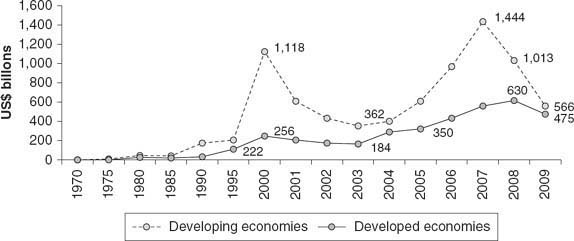
A prime measure of the role of TNCs in countries other than their own is foreign direct investment (FDI). Figure 1 shows the amounts of FDI in nominal U.S. dollars to developed and developing economies from 1970 to 2009. Although the data in the graph are not adjusted for inflation, they nevertheless show the enormous growth in FDI to both developed and developing economies that has occurred in the last two decades.
The United States is by far the world's leading country in outward FDI with 17.4% of the world total in 2007, 17.1% in 2008, and 22.5% in 2009. The United States is also the leading country for inward FDI with 12.7% of the world total in 2007, 18.3% in 2008, and 11.7% in 2009. China is the largest recipient of FDI among developing economies, and in many years second to the United States among all economies. Not including Hong Kong, China received 4.0% of world FDI in 2007, 6.1% in 2008, and 8.5% in 2009. In addition, Hong Kong's share was 2.6% in 2007, 3.4% in 2008, and 4.4% in 2009. By comparison, India's share was 1.2% in 2007, 2.3% in 2008, and 3.1% in 2009.
The data displayed in Figure 1 also show that FDI to developed countries has been extremely unstable since the late 1990s. The sharp increase in FDI to the developed economies in the late 1990s was the result of telecommunications deregulation and the Internet boom, including the rollout of global optical fiber networks. When the Internet boom turned to bust in 2001, FDI plummeted as TNCs cut capital expenditures and several major service providers went bankrupt. Then from 2003 to 2007, there was another boom in FDI to developed economies, driven by both financialization and globalization. The prime form of FDI in this boom was cross-border mergers and acquisitions (M&A), with a heavy involvement of private equity firms and hedge funds. With an increase in global financial activity related to derivative trading, there was an unprecedented amount of FDI related to financial services. Although approximately 90% of the FDI to developed countries came from other developed countries, several TNCs from developing economies invested in greenfield sites in the developed countries.
...
- Activism, Transnational
- Amnesty International
- Anti-Apartheid Movement
- Antiglobalization Movements and Critics
- Antislavery Movements
- Associations
- Charities, Charity
- Civil Society, Global
- Civility
- Connectedness, Global
- Elites
- Foundations
- Foundations, Asian: International Activities
- Foundations, European: International Activities
- Foundations, U.S.: International Activities
- Gay and Lesbian Movement
- Humanitarian Intervention
- Humanitarianism
- Humanity, Concepts of
- Indigenous Peoples' Rights
- International Nongovernment Organizations (INGOs)
- International Nongovernment Organizations, Quasi-Forms
- Open Society Institute
- Opinion, World
- Philanthropy
- Publics and Polis, Global
- Red Cross
- Social Capital
- Social Entrepreneurship
- Social Movements
- Social Networking
- Solidarity Movements
- State–Civil Society Relations
- Uncivil Society
- UN–Civil Society Relations
- Waqfs
- Women's Movement
- World Economic Forum
- World Social Forum
- Air Travel
- Airlines
- Civil Aviation
- Communicative Power
- Computing
- Computing, Personal
- Containerization
- Cybernetics
- Global Communications and Technology
- Handheld Devices
- Information Age
- International Air Transportation Association
- Internet
- Internet Corporation for Assigned Names and Numbers
- Inventions and Discoveries
- Media, Global
- Morse Code
- Nanotechnology
- Navigation Systems
- Postal System, World
- Radio
- Railroads
- Road Signage Systems
- Roads and Routeways
- Silk Road, New
- Space, Outer
- Telegraph, Telegram
- Telephone
- Telephony
- Television
- Transportation Systems
- Universal Postal Union
- Web 2.0
- American Revolution
- Apartheid
- Cold War
- Conflict and Conflict Resolution
- Conquests
- Cooperation
- Cyberconflict
- Deterrence
- Failed States
- French Revolution
- Geneva Conventions
- Genocides
- Global Conflict and Security
- Hiroshima
- Holocaust
- Intelligence Agencies
- Military
- Pariahs, Global
- Peace
- Peace Activism
- Peacekeeping Forces
- Private Security Firms
- Refugees
- Religious Politics
- Revolutions
- Security
- September 11, 2001 (9/11)
- Soft Power Diplomacy
- Terrorism
- Treaties
- War
- War, Civil
- War, Urban
- Wars, New
- Wars, World
- Weapons
- Academy Awards
- Aesthetics
- Al Jazeera
- Americanization
- Architecture
- Art
- Artists
- Blogs
- British Broadcasting Corporation (BBC)
- Cable News Network (CNN)
- Cartoons, Comix, Manga
- Cinema
- Creativity and Innovation
- Creolization
- Cuisine
- Cultural Commons
- Cultural Destruction
- Cultural Diversity, Convention on
- Cultural Hybridity
- Cultural Industries
- Cultural Observatories
- Culture, Notions of
- Educational Systems
- Events, Global
- Film Festivals
- Games
- Genius, Notion of
- Geographic Informational Systems (GIS)
- Global Culture, Media
- Global Intellectuals
- Global Positioning System (GPS)
- Hajj
- Heritage
- Hollywood
- Homogenization
- Journalism
- Knowledge Management Systems
- Knowledge Production Systems
- Leisure
- Lifestyles
- Literature
- McDonaldization, McWorld
- Maps and Map-Making
- Memory
- Memory Wars
- Music
- Myths
- News
- Nobel Prize
- Olympic Movement
- Postmodernity
- Prizes and Awards, International
- Scripts and Writing Systems
- Sites, Global
- Soccer
- Sports, Recreation
- Standards and Standard Setting, Global
- Theater
- Think Tanks
- United Nations Educational, Scientific and Cultural Organization (UNESCO)
- Universities and Higher Learning
- Virtual Worlds
- Wikipedia
- Work
- World Cultures
- World's Fairs
- Acculturation
- Aging Societies
- Assimilation
- Baby Boomers
- Beirut
- Cities
- Communities, Transnational
- Contraception
- Demographic Change
- Demographic Transition
- Deterritorialization and Reterritorialization
- Diasporas
- Dubai
- Family Policies
- Family Systems, Kinship
- Fertility
- Hong Kong
- Immigration
- Immigration and Transnationalism
- Intergenerational Relations
- Johannesburg
- Landless Persons
- London
- Los Angeles
- Malthusian Idea
- Migrant Shopping Patterns
- Migration
- Migration, Illegal
- Migration Policies, Types of
- Mortality
- Mumbai
- New York City
- Overpopulation
- Paris
- Population and Demographic Change
- Population Control Policies
- Population Growth and Population Explosion
- Retirement Systems
- Rio de Janeiro
- Rurality
- Shanghai
- Shelter and Housing
- Singapore
- 68 Generation
- Tokyo
- Undocumented Persons
- Urban Diseconomies
- Urbanization
- Accounting Systems
- Agriculture Sector
- Asian Tiger Phenomenon
- Banking, Offshore
- Banks
- Capitalism
- Consumer Protest
- Consumerism
- Corporations, Transnational
- Currencies
- Data Systems and Reporting, Global
- Dependency
- Dependency Theory
- Depression, Great
- Depression, Recession, and Stagnation
- Deskilling
- Distribution of Wealth, Equitability of
- Dollar
- Economic Crises
- Economic Development
- Economic Ethics
- Economics, Keynesian
- Economy, Informal
- Entrepreneurship
- Euro
- European Central Bank
- Extractive Industries Sector
- Finance, Financial Systems
- Fordism
- Franchise Systems
- Global Economic Issues
- Globalization, Managed (China)
- Gold Standard
- Hedge Funds
- Illegal Trade, Arms
- Illegal Trade, Children
- Illegal Trade, Drugs
- Illegal Trade, Precious Metals
- Industrialization
- Inequality, Global
- Inequality, Global Economic
- International Labour Organization (ILO)
- International Monetary Fund (IMF)
- Investments
- Labor
- Local Exchange and Trading Systems (LETS)
- Longue Durrée, Long Wave Theories of Development
- Manufacturing Sector
- Maquiladoras
- Marketing
- Markets
- Marshall Plan
- McDonaldization, McWorld
- Mercantilism
- Microsoft
- Monetary Policy
- Organisation for Economic Co-operation and Development (OECD)
- Outsourcing
- Peasant Economies
- Petroleum Geopolitics
- Petroleum Economy
- Pharmaceutical Sector
- Poverty and Poverty Alleviation
- Private-Public Partnerships
- Privatization
- Production and Innovation Networks, Global
- Professions
- Protectionism
- Public Goods, Global
- Remittances
- Service Sector
- Sex Trafficking
- Slavery
- Tax Havens
- Taxation
- Technology Sector
- Tobin Tax
- Tourism Sector
- Trade
- Trade Agreements
- Value/Commodity Chains, Global
- Walmart
- World Bank
- World Trade Organization (WTO)
- Acid Rain
- Alternative Energy Sources
- Biofuels
- Biohazards
- Biological Diversity
- Biosphere
- Climate Change
- Deforestation
- Desertification
- Earth Summit
- Electricity
- Energy Efficiency
- Environmental Carrying Capacity
- Environmental Change
- Environmental Movement
- Environmental Rights
- Environmental Security
- Environmental Treaties, Conventions, and Protocols
- Extractive Industries Transparency Initiative
- Fisheries
- Floods, Tsunamis
- Forests
- Global Commons
- Global Environmental and Energy Issues
- Global Warming
- Greenhouse Gases
- International Maritime Organization
- Kyoto Protocol
- Land Use
- Natural Gas
- Nature, Concepts of
- Nuclear Power
- Oceans
- Oil
- Organization of Petroleum Exporting Countries (OPEC)
- Parks, Reserves, and Refuges
- Petroleum Geopolitics
- Polar Regions
- Remediation
- Sustainability
- United Nations Environment Programme (UNEP)
- Waste Management
- Water
- Accountability
- Arab League
- Association of Southeast Asian Nations (ASEAN)
- Borders
- Bretton Woods Agreements/System
- Caliphate
- Charismatic Leaders
- Civilization
- Colonialism
- Democracy
- Dynasties
- Empires
- Empires, Modern
- European Union
- Failed States
- Global Governance and World Order
- Global Order
- Global South
- Governance Networks, Transnational
- Hegemonic Power
- Hollow State
- Independence Movements
- International Relations
- Leadership
- League of Nations
- Legitimacy
- Methodological Nationalism
- Nation-State
- Neocolonialism
- Non-Aligned Movement
- North Atlantic Treaty Organization (NATO)
- Organization of American States (OAS)
- Pan African Union
- Petroleum Geopolitics
- Political Parties, Transnational
- Power, Global Contexts of
- Regional Governance
- Regionalism
- Republics
- Social Democracy
- Sovereignty
- Subsidiarity
- Summits, Summitry
- Transparency
- Treaty of Rome
- United Nations
- Utopia, Dystopia
- Vatican
- Welfare State
- Westphalia, Treaty of, and the Post-Westphalian World
- World Federalist Movement
- World Government
- World Order, Visions of
- Abortion
- Birth Control
- Burial and Crematory Practices
- Diseases
- Drugs and Pharmaceuticals
- Food
- Food and Agriculture Organization of the United Nations
- Global Health and Nutrition
- Health Care Access
- Health Care Systems
- HIV/AIDS
- Hygiene
- Infant Mortality
- Malnutrition
- Medical Systems
- Public Health
- Sexually Transmitted Diseases
- Tuberculosis
- Viruses, Killer
- Viruses and Diseases, Emerging
- World Food Program
- World Health Organization
- Global Historical Antecedents
- Global History, Studies in
- Animal Rights
- Arbitration
- Asylum
- Citizenship
- Civil Rights
- Constitutionalism
- Crime, Transnational
- Dharma
- Free Speech
- Gay Rights
- Global Justice and Legal Issues
- Human Rights, International
- Indigenous Peoples' Rights
- Intellectual Property Rights
- International Court of Justice
- International Criminal Tribunals
- Interpol
- Justice, Transitional
- Justice Movements, Transnational
- Labor Rights
- Law, International
- Law, Regional
- Law, Transnational
- Law, World
- Law of Arctic Regions
- Law of the Sea
- Legal Systems
- Lex Mercatoria
- Natural Law
- Nuremburg Precedent
- Penal Systems
- Policing Systems
- Prisoners' Rights
- Shari'a (Islamic Law)
- Truth Commission
- Universal Jurisdiction
- Women's Rights
- African Diaspora Religions
- African Religions
- Baha'i
- Battle of Badr
- Buddhism
- Capitalism
- Christianity
- Christianity-Related Movements
- Communism, as International Movement
- Communist International
- Communitarianism
- Confucianism
- Cosmopolitanism
- Crusades
- Darwinism and Social Darwinism
- Enlightenment, The
- Ethics, Global
- Fascism
- Feminism
- Freemasons
- Global Religions, Beliefs, Ideologies
- Hare Krishna (International Society for Krishna Consciousness)
- Hinduism
- Hindu-Related Movements
- Humanism
- Idealism
- Ideologies, Global
- Imperialism
- Indigenous Religions, Globalization of
- Individualism
- Islam
- Islam-Related Movements
- Jainism
- Judaism
- Liberalism, Neoliberalism
- Marxism and Neo-Marxism
- Modernization
- Mormonism
- Myths
- Nationalism, Neo-Nationalism
- Neoconservatism
- Populism
- Postmodernism
- Protestant Reformation
- Religious Conversion
- Religious Movements, New and Syncretic
- Secularism
- Shinto
- Sikhism
- Socialism
- Socialist International
- Third Way Movements
- World Religions, Concept of
- Zionism
- Zoroastrianism
- Civil Society, Global
- Demographic Change
- Global Communications and Technology
- Global Conflict and Security
- Global Culture, Media
- Global Economic Issues
- Global Environmental and Energy Issues
- Global Governance and World Order
- Global Health and Nutrition
- Global Historical Antecedents
- Global History, Studies in
- Global Justice and Legal Issues
- Global Order
- Global Religions, Beliefs, and Ideologies
- Global Reporting Initiatives
- Global Studies
- Global Studies, Current Academic Approaches to
- Global Studies, Early Academic Approaches to
- Global Terminology
- Globalization, Approaches to
- Globalization, Measurement of
- Globalization, Phenomenon of
- Globalization and Transnationality Indexes
- Hyperglobalism
- Identities in Global Society
- Inequality, Global
- Proto-Globalization
- Shrinking World Concepts
- World Order, Visions of
- World Society Theory
- World-Systems Perspective
- Class
- Community
- Corporate Identity
- Cosmopolitan Identity
- Ethnic Identity
- Ethnocentrism
- Family
- Family Systems, Kinship
- Gender Identity
- Global Village
- Homophobia
- Identities, Traditional
- Identities in Global Society
- Linguistic Identities
- Marginality
- Modern Identities
- Multiculturalism
- Multiracial Identities
- National Identities
- Otherness
- Racial Identity
- Racial Supremacy
- Regional Identities
- Religious Identities
- Secret Societies
- Tribal Identities
- Universalism
- Values
- Xenophobia
- Loading...
Get a 30 day FREE TRIAL
-
 Watch videos from a variety of sources bringing classroom topics to life
 -
Read modern, diverse business cases
-
Explore hundreds of books and reference titles

Read next

More like this
Sage Recommends
We found other relevant content for you on other Sage platforms.
Have you created a personal profile? Login or create a profile so that you can save clips, playlists and searches