
Entry
Entries A-Z
House of Representatives
The 435 members of the House of Representatives share responsibility with the Senate for writing the nation's laws and overseeing operation of the federal government.
Representatives are elected every two years to represent districts of more than half a million people. Today, they work full time at a job that once took only a few weeks a year. Representatives must attend committee hearings, draft legislation, keep up with floor debate, consider or offer amendments, vote on bills, and respond to constituents' problems. At the same time they must campaign, because a new election is always less than two years away.
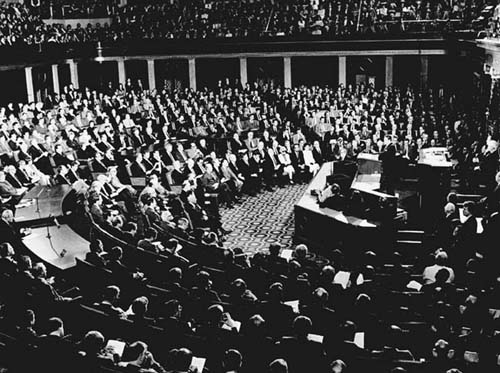
Congressional Quarterly
The rapid rhythm of House procedures and the hubbub caused by the sheer number of representatives contrast sharply with the slower pace and quieter atmosphere of the Senate. The Senate, with one hundred members, is less than one-fourth the size of the House and prefers to operate informally. Senators' six-year terms allow them time between campaigns, a luxury House members do not enjoy.
Maintaining high visibility in their districts and raising campaign funds are part of the routine for most representatives. Most representatives travel home at least every other weekend; travel expenses are usually covered by official allowances. Meanwhile, newsletters are mailed out, letters answered, and individual problems with the federal bureaucracy handled, usually by the representatives' staffs in Washington and in the home district. political action committees and individuals are asked to contribute campaign funds; the solicitation is often accompanied by an invitation to a cocktail party or a speech by the representative. In 2000, the average winning House candidate spent $847,000 on his or her campaign. (See Campaign Financing.)
The House is a complex institution, having at the beginning of 2003 nineteen standing committees, two select committees, and ninety-two subcommittees; decision making is spread broadly. The leadership controls the key gateways to floor action, but participation is open and usually democratic in the first stages of the legislative process, when members question witnesses at hearings or debate amendments during bill-drafting sessions. The House has been most effective under strong leaders, who face the difficult task of satisfying a large and diverse body. (See “Speakers of the House of Representatives” and “House Floor Leaders” in the Appendix.)
More than two centuries of evolution have given the House thick volumes of rules and procedures, but the institution is far from rigid. Its decisions can turn in a matter of minutes on what Speaker Sam Rayburn, a Texas Democrat, called “rolling waves of sentiment.” The basic principle in the House is that all points of view should be heard, but that minorities should not be able to block action. Filibusters, which are common in the Senate, are not allowed in the House. The idea of delaying a vote to accommodate a single member, as the Senate sometimes does, is almost unheard of. “Senate rules are tilted toward not doing things,” said Speaker Jim Wright, also a Texas Democrat, in 1987. “House rules, if you know how to use them, are tilted toward allowing the majority to get its will done.”
...
Get a 30 day FREE TRIAL
-
 Watch videos from a variety of sources bringing classroom topics to life
 -
Read modern, diverse business cases
-
Explore hundreds of books and reference titles

Read next

More like this
Sage Recommends
We found other relevant content for you on other Sage platforms.
Have you created a personal profile? Login or create a profile so that you can save clips, playlists and searches