
Entry
Entries A-Z
Subject index
Fibromyalgia Syndrome: Cognitive-Behavioral Treatment
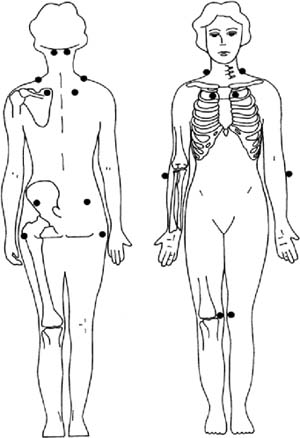
Fibromyalgia syndrome (FMS) consists of a pervasive set of unexplained physical symptoms with generalized pain and hypersensitivity to palpation at specific body locations (tender points, or TPs; Wolfe et al., 1990; see Figure 1) as the cardinal features. In addition, patients report persistent fatigue, sleep disturbance, feelings of stiffness, depression, anxiety, cognitive impairment, and general malaise sometimes referred to as “fibro fog” (Baumstark & Buckelew, 1992). FMS may have an insidious onset without any identifiable cause, may develop following a flu-like illness, or may rapidly develop following a trauma such as a motor vehicle accident or emotional distress (Clauw & Chrousos, 1997; Turk, Okifuji, Starz, & Sinclair, 1996).
Figure 1 Location of Tender Points
The population prevalence of FMS is estimated to range from .66% to 10.50% (Schochat, Croft, & Raspe, 1994). The variability in prevalence may result from differences in classification criteria since not all of these studies used the American College of Rheumatology criteria (Wolfe et al., 1990). Bennett (1995) estimated that approximately 5 million Americans have FMS. FMS is more commonly observed in women, with a female to male ratio of 7 to 1 in those seeking treatment. In community samples, however, the ratio is closer to 3 to 1, females to males.
The Torment of FMS
Beyond the pain and related symptoms, health care providers or the legal system confronts FMS sufferers with a poorly understood disorder that is not well accepted. The lack of objective medical findings to confirm the diagnosis can result in confusion and frustration. Interpersonal relationships often suffer as the impact of FMS extends beyond the physical to affect the emotional, occupational, social, and recreational areas. As symptoms affect more and more of the person's life, psychosocial and behavioral factors come to play an expanding role.
There is growing consensus that FMS reflects an abnormality in central processing of noxious sensations characterized by hypersensitivity to stimulation. In general, biopsychosocial models of pain have been proposed to integrate physical, psychosocial, and behavioral contributions to pain perception and adaptation (Turk & Sherman, 2002).
General Treatment Recommendations
Although FMS has some unique characteristics, many of the traditional cognitive and behavioral interventions have been adapted for use. This entry describes the application of the cognitive-behavioral therapy (CBT) approach highlighting some of the specific features that are particularly important.
Education
Information and reassurance are essential for treating FMS. The lack of a definitive explanation for the symptoms often produces fears that something serious, but as yet unidentified, is causing the symptoms; that the symptoms will become progressively worse; of being told that there is nothing that can be done; of being told that the problems are all caused by psychological factors (i.e., “imaginary and all in their heads”); and that they will be told to learn to live with symptoms without being told how. Consequently, it is essential that treatment begin with information about the nature of FMS, the possible causes, and the contributions of emotional, behavioral, and cognitive factors, as well as physical contributions.
Education includes a discussion of the distinction between acute pain and chronic pain. Acute pain is rightly seen as a signal of harm or potential damage or danger to the body. In the case of FMS, however, the pain is no longer a signal of damage to the body. Thus, it is important to make the distinction between hurt and harm. Patients are informed that they will be asked to increase physical activity and exercise. The clinician should acknowledge that a conditioning program will likely cause some increase in the level of pain as muscles become sore after months or years of disuse but that the exercises will cause no permanent damage.
...
- Loading...
Get a 30 day FREE TRIAL
-
 Watch videos from a variety of sources bringing classroom topics to life
 -
Read modern, diverse business cases
-
Explore hundreds of books and reference titles

Read next

More like this
Sage Recommends
We found other relevant content for you on other Sage platforms.
Have you created a personal profile? Login or create a profile so that you can save clips, playlists and searches