
Entry
Reader's guide
Entries A-Z
Subject index
Ancestors
Ancestors are those who once lived in human society and, having fulfilled certain conditions, are now in the realm of the spirits. One becomes an ancestor by living and dying in a particular way. In African religion, to become an ancestor, one must have lived an exemplary life, shown devotion to one's own ancestors, respected the elders, and had children. Among various ethnic groups, to become an ancestor, one must have died a good death, that is, one's death must not have been by suicide, accident, or other forms of violence, with the possible exception of heroic deaths on the battlefield. In most societies, those dying of epilepsy, leprosy, and lunacy cannot be considered candidates for ancestorhood. This entry discusses the general importance of ancestors in African religion and morality and then looks at particular ways that reverence is shown. It concludes with an examination of how ancestor devotion influences ideas about death and dying.
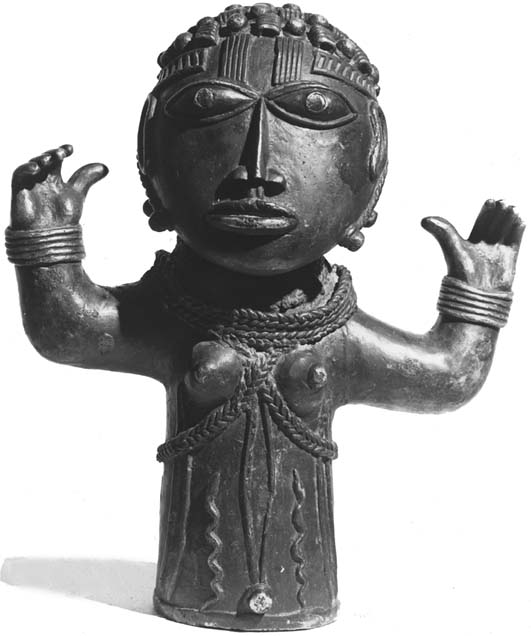
Ancient Benin bronze reflecting an ancestor figure in Nigeria.
Source: Molefi Kete Asante and Ama Mazama.
Veneration is Fundamental
The veneration of the ancestors is a fundamental part of African religion. There is a clear reason for such veneration. The ancestors are respected and venerated because they are elders and have walked the path that living people will walk. They are predecessors to all of those who are living and are in a spiritual state of existence that gives them power to assist those who are living. People have believed for a long time that the ritualized propitiation and invocation of ancestors could influence the fate of the living. This is a belief and practice that has been brought to a complex and elaborated level by thousands of years of African thinking.
Indeed, ancestors serve the living as the living beings serve them. Ancestors assist the living in court cases, in marriage, in mediations between family members, and in health situations; in return, the living offer ceremonies to feed the ancestors. Libations are usually offered through drink or food because the ancestors are believed to continue to live as they did when they were on the Earth. Thus, even in their spiritual state, they need to have sustenance. Offerings may be granted to them individually or collectively or by religious officials who perform on festival occasions.
Everything in life that matters to the order and harmony of society must be approached through the ancestors. This means that in African religion, there is always ancestral priority, presence, and power. The ancestral spirits are the most intimate divinities and must be consulted on important occasions. This is the reason that Africans regard the ancestors as the keepers of morality. One of the ways descendants of the ancestor maintain a balanced society is by avoiding the activities that were considered immoral by the ancestor. The living must do everything they can to avoid leaving the moral path laid down by the departed ancestors. If someone violates the moral path, then it is possible that the ancestors might bring about sudden death.
The social fabric of the African community is woven together by ancestor reverence. It is the source of many domestic and institutional relationships. Therefore, it is necessary to explain that it is not merely a reflection of the supernatural world; it is the only world lived in by many Africans. Thus, the manner of reverence among African people is relatively similar, which makes it possible to speak of the commonalities of ancestor reverence among Africans.
...
- Ancestral Figures
- Communalism and Family
- Concepts and Ideas
- Deities and Divinities
- Abasi
- Agwe
- Aida Wedo
- Aiwel
- Akamba
- Amen
- Anubis
- Anukis
- Apep
- Apis
- Asase Yaa
- Aten
- Atum
- Ausar
- Auset
- Azaka, the Loa
- Bes
- Bondye
- Chi
- Danbala Wedo
- Divinities
- Eleda
- Eniyan
- Ennead
- Esu, Elegba
- Ezili Dantò
- Ezili Freda
- Faro
- God
- Goddesses
- Hapi
- Hathor
- Heru, Horus
- Ibis, Symbol of Tehuti
- Jok (Acholi)
- Khnum
- Khonsu
- Mami Wata
- Mawu-Lisa
- Min
- Montu
- Nana Buluku
- Ngai
- Ngewo
- Nkulunkulu
- Nyame
- Nzambi
- Obatala
- Oduduwa
- Ogdoad
- Ogun
- Olodumare
- Olokun
- Olorun
- Orisha Nla
- Orunmila
- Oshun
- Oya
- Ptah
- Ra
- Ruhanga
- Sekhmet
- Serapis
- Seshat
- Set
- Shango
- Shu
- Songo
- Sopdu
- Tefnut
- Thoth
- Tibonanj
- Wepwawet
- Woyengi
- Yao
- Yemonja
- Zin
- Eternality
- Nature
- Personalities and Characters
- Possessors of Divine Energy
- Rituals and Ceremonies
- Adae
- Agricultural Rites
- Ceremonies
- Circumcision
- Clitorectomy
- Dance and Song
- Desounen
- Harvest
- Incense
- Initiation
- Invocations
- Lele
- Medicine
- Medicine Men and Women
- Mediums
- Mummification
- Music
- Naming
- Offering
- Ohum Festival
- Opening of the Mouth Ceremony
- Puberty
- Purification
- Rain Dance
- Rites of Passage
- Rites of Reclamation
- Rituals
- Seclusion
- Shawabti
- Shrines
- Societies of Secrets
- Yam
- Yanvalou
- Sacred Spaces and Objects
- Akhenaten
- Altars
- Amulet
- Asamando
- Bata Drums
- Boats
- Bois Caiman
- Cowrie Shells
- Crossroads
- Drum, The
- Flag and Flag Planting
- Govi
- Groves, Sacred
- Ikin
- Ilé-Ifè
- Incense
- Kisalian Graves
- Lakes
- Maroon Communities
- Mount Cameroon
- Mount Kenya
- Mountains and Hills
- Oumfò
- Potomitan
- Pyramids
- Rivers and Streams
- Rocks and Stones
- Sarcophagus
- Sphinx
- Totem
- Vilokan
- Waset
- Societies
- Symbols, Signs, and Sounds
- Taboo and Ethics
- Texts
- Traditions
- Akan
- Asante
- Azande
- Baga
- Baganda
- Bakongo
- Bakota
- Balanta
- Balengue
- Baluba
- Bamana
- Bamileke
- Bamun
- Banyankore
- Banyarwanda
- Bariba
- Barotse
- Bassa
- Basuto
- Batonga
- Bete
- Bobo
- Candomblé
- Chagga
- Chewa
- Chokwe
- Convince
- Dagu
- Dinka
- Diola
- Dioula
- Dogon
- Duala
- Efik
- Ekoi
- Ewe
- Fang
- Fon
- Fula (Fulbe)
- Ga
- Gamo Religion
- Gola
- Gurunsi
- Haya
- Hoodoo
- Hutu
- Ibibio
- Idoma
- Igbo
- Jola
- Kabre of Togo
- KalÛnga
- Kirdi
- Kumina
- Lobi
- Lomwe
- Lovedu
- Lugbara
- Luo
- Maasai
- Mende
- Mossi
- N'domo
- North America, African Religion in
- Nuer
- Obeah
- Okande
- Ovambo
- Palo
- Pedi
- Petwo
- Peul
- Rada
- Santeria
- Sara
- Saramacca
- Senufo
- Serer
- Shilluk
- Shona
- Songo
- Sotho
- Susu
- Swazi
- Tallensi
- Teke
- Tellem
- Temne
- Tiv
- Tsonga
- Tswana
- Tutsi
- Umbanda
- Vai
- Vodou and the Haitian Revolution
- Vodou in Benin
- Vodou in Haiti
- Vodunsi
- Wamala
- West African Religion
- Winti
- Wolof
- Xhosa
- Yao
- Yoruba
- Zarma
- Zulu
- Values
- Loading...
Get a 30 day FREE TRIAL
-
 Watch videos from a variety of sources bringing classroom topics to life
 -
Read modern, diverse business cases
-
Explore hundreds of books and reference titles

Read next

More like this
Sage Recommends
We found other relevant content for you on other Sage platforms.
Have you created a personal profile? Login or create a profile so that you can save clips, playlists and searches