
Entry
Entries A-Z
Subject index
Abolition
The movement that advocated the liberation of enslaved African Americans. Even as white Americans won their independence from Great Britain in the Revolutionary War, abolitionists continued to work for the liberation of blacks held in captivity. Over time, more and more whites and former slaves, especially in the Northern states, sought freedom for enslaved African Americans. The number of slaves in the North did fall between the end of the Revolution and 1830, but in the Southern states, slavery remained deeply embedded.
Throughout the first decades of the nineteenth century, a small number of abolitionist groups organized but had little success in ending slavery. In the 1830s, however, the number of abolitionist societies exploded. They became politically active and ultimately gained the support of many Northerners. Nevertheless, it took a Civil War to force the nation to accept an amendment to the Constitution that freed all enslaved African Americans and forever abolished slavery within the United States.
Early Abolition Efforts
In colonial America, the fight against slavery began as a religious movement rather than as a political one. The Quakers led the fight, but even in the 1760s and 1770s, they mostly aimed to rid their own denomination of slave owners. Their message, however, spread and influenced leaders such as Benjamin Franklin and other powerful people in Pennsylvania and New England.
During the Revolutionary War, many patriots found it contradictory to be fighting for their own freedom while Americans held massive numbers of people in bondage. Some questioned slavery on economic grounds. Others advocated ending the slave trade but not freeing the slaves. Still other antislavery advocates opposed only the extension of slavery into the territories. While these divergent interests often merged, the religious abolitionists always fought against the immorality of slavery and remained, throughout, the most radical element in the fight to free the blacks.
Individual colonial legislatures, such as that of Massachusetts, had tried to stop the trading in humans. Following the Revolution, all states but South Carolina and Georgia banned the slave trade. The federal government likewise struck blows against slavery, banning it in the Northwest Territory in 1787 and prohibiting the trans-Atlantic slave trade in 1808. Antislavery campaigns themselves produced few tangible results in the years immediately following the Revolution, although slavery clearly retreated in the North due to a general antipathy there toward the institution.
The antislavery movement in the United States remained ineffective until the 1830s, although reformers continually sought solutions to the slavery problem. One possible solution was recolonization. The American Colonization Society, which was organized in 1816, founded the colony of Liberia in West Africa in 1820 as a haven for freed slaves. Society organizers figured that slave owners would be more likely to free their slaves if the owners thought those freed men would leave the United States.
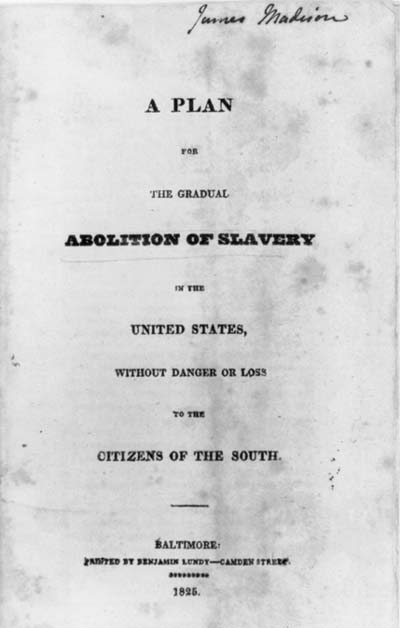
Antislavery document printed in Baltimore, Maryland, in 1825, by Quaker abolitionist Benjamin Lundy, who organized emancipation societies and became a leader of abolition efforts in the 1820s. Before the Civil War, many people spoke out and wrote against slavery. Various periodicals, such as The Liberator, published by William Lloyd Garrison, took up the antislavery cause.
...
- Loading...
Get a 30 day FREE TRIAL
-
 Watch videos from a variety of sources bringing classroom topics to life
 -
Read modern, diverse business cases
-
Explore hundreds of books and reference titles

Read next

More like this
Sage Recommends
We found other relevant content for you on other Sage platforms.
Have you created a personal profile? Login or create a profile so that you can save clips, playlists and searches