

The Hewlett-Packard and Compaq Merger: A Case Study in Business Communication
Case
Supplementary Resources
Abstract
This case examines the business communication issues surrounding the Hewlett-Packard and Compaq merger. The article focuses on the way in which HP communicated with key groups throughout the merger. On September 5, 2001, Hewlett-Packard announced its agreement to buy Compaq in an all-stock transaction valued at $25 billion. Considering the deal’s size and the poor history of tech mergers, the deal was, from the start, a long shot. Spearheaded by HP chairman and CEO Carly Fiorina, the largest deal in tech sector history was initially met with skepticism by many investors and employees of the two companies. However, the deal’s greatest opposition came when heirs of HP’s founders joined forces in their opposition of the merger. Their disapproval of the deal threatened the actual purchase from even taking place, in addition to threatening the success and future of Fiorina herself.
This case was prepared for inclusion in Sage Business Cases primarily as a basis for classroom discussion or self-study, and is not meant to illustrate either effective or ineffective management styles. Nothing herein shall be deemed to be an endorsement of any kind. This case is for scholarly, educational, or personal use only within your university, and cannot be forwarded outside the university or used for other commercial purposes.
2026 Sage Publications, Inc. All Rights Reserved
Resources
Exhibit A-1: Hewlett-Packard – A Brief Timeline
1938: William Hewlett and David Packard, both graduates of the electrical engineering program at Stanford University, start their own business in the garage behind Packard’s rented house in Palo Alto, CA.
1939: Hewlett and Packard formalize their business into a partnership called Hewlett-Packard Co. (HP)
1947: HP is incorporated. Revenue: $851,287. Employees: 111.
1957: HP stock is offered for public trading.
1962: HP makes Fortune magazine’s list of the top 500 U.S. companies for the first time, entering at number 460.
1964: David Packard is elected chairman of the board and William Hewlett is elected president of the company. Revenue: $126 million. Employees: 7,092.
1966: HP forms Hewlett-Packard Laboratories, which becomes one of the world’s leading electronics research centers.
1972: HP introduces the first scientific, hand-held calculator and also enters the business computer market with its minicom-puter. In 2000, Forbes ASAP will name the calculator one of 20 “all time products” that have changed the world.
1977: John Young replaces Hewlett as president of HP, and also becomes CEO in 1978. 1980: HP introduces its first personal computer. Revenue: $3 billion. Employees: 57,196.
1982: Compaq Computer Corporation (which will merge with HP 20 years later) is formed in Houston, Texas. The company is started by three former Texas Instruments executives – Rod Canion, Jim Harris and Bill Murto. On November 4, Compaq introduces its first product, the first portable PC to run 100 percent compatible IBM software.
1985: HP introduces its LaserJet computer printer, which will become the company’s most successful product ever. Compaq is listed on the New York Stock Exchange.
1989: HP celebrates its 50th anniversary and is in the top 50 on Fortune 500 listing. HP Revenue: $11.9 billion. HP employees: 95,000.
1992: Lewis E. Platt succeeds John Young as president of HP.
1993: Compaq introduces its first all-in-one Compaq PC, the Presario family.
1995: Dave Packard publishes The HP Way, a book that chronicles the rise of HP and gives insight into the business practices, culture and management style that helped make it a success. HP revenue: $31.5 billion. HP employees: 105,200.
1997: HP becomes one of the 30 stocks that comprise the Dow Jones Industrial Average.
1998: Compaq acquires Digital Equipment Corporation for $9.6 billion -at the time the largest acquisition in computer industry history.
1999: HP’s board of directors announces its decision to spin off a new company from the existing HP organization. Agilent Technologies consists of HP’s former measurement, components, chemical analysis and medical businesses. HP retains its computing, printing and imaging businesses. Agilent has its initial public offering of common stock on November 18, 1999. HP retains 84.1 percent of common stock. It is Silicon Valley’s largest-ever IPO.
In July, Lew Platt retires, and HP names Carleton (Carly) S. Fiorina as President and CEO.
In November, HP begins a new brand campaign based on a single concept: invent. Print and television ads focus on the company’s history of invention and innovation. The company also introduces a new logo.
Michael Capellas is named CEO of Compaq.
2001: In March, HP creates a new business organization, HP Services. The role of the new organization includes consulting, outsourcing, support, education and solutions deployment.
On September 4, HP and Compaq announce a merger agreement to create an $87 billion global technology leader. HP revenue: 45.2 billion. HP employees: 88,000.
Data source: Timeline at http://www.hp.com/hpinfo/abouthp/histnfacts/timeline/index.html
Exhibit A-2: Stock Price Graph
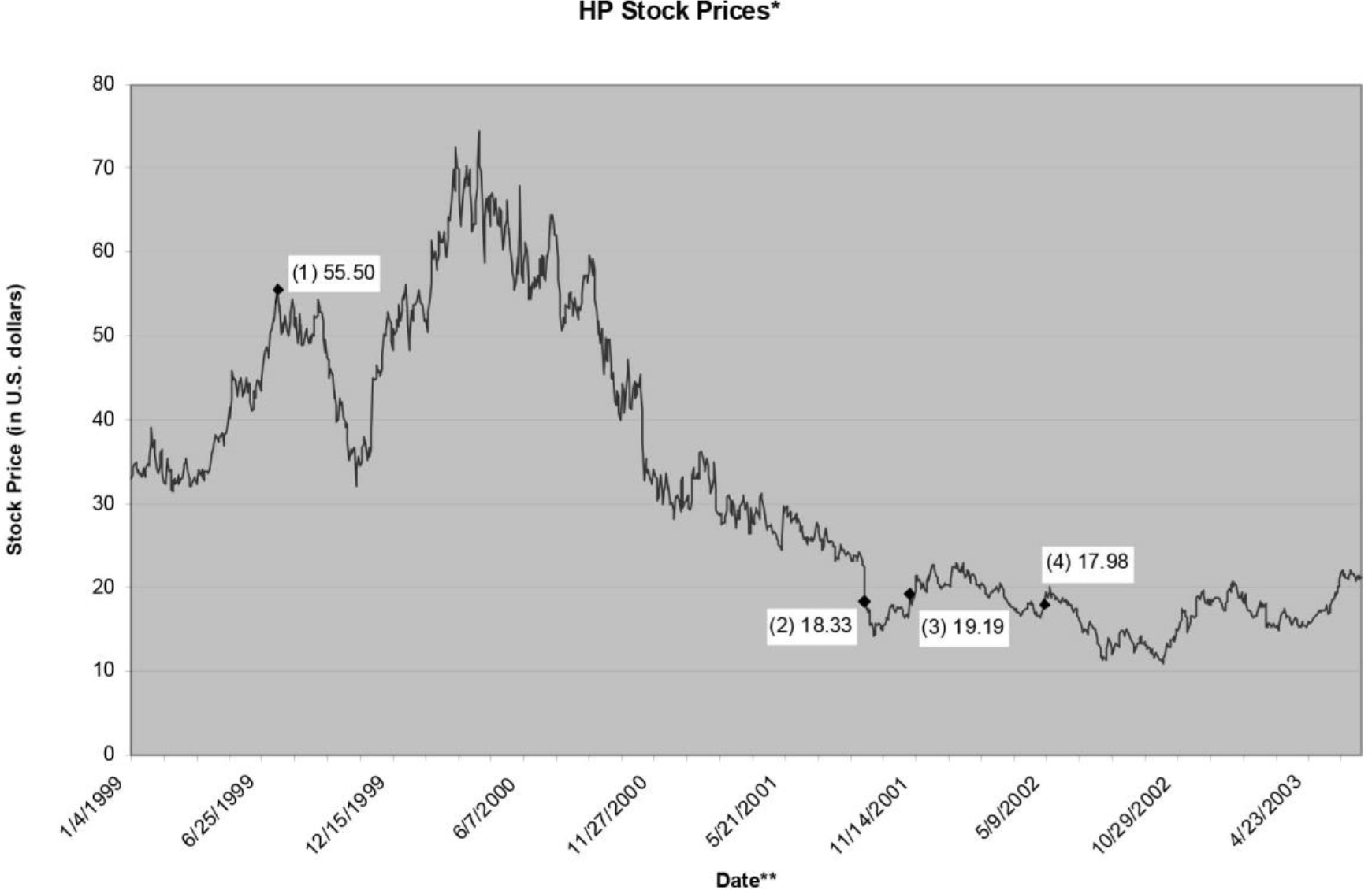
Data source: http://finance.yahoo.com
*Prices shown are prices at time of closing.
**Each tick mark represents 30 days.
Exhibit A-3: Stock Price Table
| Date | Notes about Dates* | Open | Close |
| 07/16/99 | Day before Fiorina is hired | $53.98 | $54.43 |
| 07/19/99 | Monday after Fiorina is hired (1) | 55.26 | 55.50 |
| 01/14/00 | Six months after Fiorina is hired | 54.87 | 53.71 |
| 04/07/00 | High point | 70.75 | 74.48 |
| 07/14/00 | One year after Fiorina is hired | 64.41 | 63.90 |
| 01/16/01 | One and a half years after Fiorina is hired | 29.25 | 29.13 |
| 07/16/01 | Two years after Fiorina is hired | 26.81 | 25.46 |
| 08/31/01 | Before merger is announced | 22.33 | 22.39 |
| 09/04/01 | Day after merger is announced (2) | 20.40 | 18.33 |
| 09/20/01 | Low point after merger is announced | 14.44 | 14.05 |
| 10/03/01 | One month after merger is announced | 14.53 | 15.50 |
| 11/06/01 | Hewlett announces his opposition (3) | 16.37 | 19.19 |
| 01/16/02 | Two and a half years after Fiorina is hired | 22.27 | 21.81 |
| 03/19/02 | HP shareholders vote on merger | 19.33 | 18.36 |
| 05/07/02 | Combination day (4) | 18.41 | 17.98 |
| 09/03/02 | One year after merger is announced | 12.77 | 12.31 |
| 10/04/02 | Low point | 11.87 | 11.30 |
| 11/07/02 | Six months after combination day | 16.92 | 16.50 |
| 05/07/03 | One year after combination day | 17.01 | 17.15 |
| 07/01/03 | Four years after Fiorina is hired | 21.3 | 21.18 |
* Numbers in parentheses correspond with points labeled on the stock price graph (See Exhibit A-2).
Exhibit A-4: Joint Press Release Announcing Merger
HEWLETT-PACKARD AND COMPAQ AGREE TO MERGE, CREATING $87 BILLION GLOBAL TECHNOLOGY LEADER
Will Offer Businesses and Consumers Most Complete Set of Products and Services, With Commitment to Open Systems and Architectures
Will Have #1 Worldwide Positions in Servers, PCs and Hand-helds, and Imaging and Printing; Leading Positions in IT Services, Storage, Management Software
Companies Expect Annual Cost Synergies of Approximately $2.5 Billion; Transaction Expected to Be Substantially Accretive in Year One
PALO ALTO, CA and HOUSTON, TX, September 3, 2001
Source: http://www.hp.com/hpinfo/newsroom/press/2001/index.html, press release issued on September 3, 2001
Exhibit A-5: Projections for the Combined Company
| Key Facts(last 4 qtrs): | HP | Compaq | Pro Forma Combined |
| Total Revenues | $47.0 billion | $40.4 billion | $87.4 billion |
| Assets | $32.4 billion | $23.9 billion | $56.4 billion |
| Operating Earnings | $2.1 billion | $1.9 billion | $3.9 billion |
Source: http://www.hp.com/hpinfo/newsroom/press/2001/index.html, press release issued on September 3, 2001
Exhibit A-6: HP Statement on Hewlett Announcement
PALO ALTO, Calif., Nov. 6, 2001
While we regret very much the Hewlett family’s decision, we are not surprised. The HP Board of Directors and HP and Compaq remain fully committed to the merger and expect shareowner approval. HP’s S-4 registration statement will be filed within the next several days and will serve as the basis for thoughtful shareowner evaluation.
Source: http://www.hp.com/hpinfo/newsroom/press/2001/index.html, press release issued on November 6, 2001
This case was prepared for inclusion in Sage Business Cases primarily as a basis for classroom discussion or self-study, and is not meant to illustrate either effective or ineffective management styles. Nothing herein shall be deemed to be an endorsement of any kind. This case is for scholarly, educational, or personal use only within your university, and cannot be forwarded outside the university or used for other commercial purposes.
2026 Sage Publications, Inc. All Rights Reserved
Get a 30 day FREE TRIAL
-
 Watch videos from a variety of sources bringing classroom topics to life
 -
Read modern, diverse business cases
-
Explore hundreds of books and reference titles

Read next

More like this
Sage Recommends
We found other relevant content for you on other Sage platforms.
Have you created a personal profile? Login or create a profile so that you can save clips, playlists and searches