
Summary
Contents
Subject index
In this volume, Ting-Toomey and Oetzel accomplish two objectives: to explain the culture-based situational conflict model, including the relationship among conflict, ethnicity, and culture; and, second, integrate theory and practice in the discussion of interpersonal conflict in culture, ethnic, and gender contexts. While the book is theoretically directed, it is also a down-to-earth practical book that contains ample examples, conflict dialogues, and critical incidents. Managing Intercultural Conflict Effectively helps to illustrate the complexity of intercultural conflict interactions and readers will gain a broad yet integrative perspective in assessing intercultural conflict situations. The book is a multidisciplinary text that draws from the research work of a variety of disciplines such as cross-cultural psychology, social psychology, sociology, marital and family studies, international management, and communication.
Appendix: Measures of Face Concerns and Facework Behaviors in Four National Cultures
Over the years, there have been numerous studies examining facework and conflict styles across cultures. Many of these studies (e.g., Cocroft & Ting-Toomey, 1994; Oetzel, 1998a, 1998b; Ting-Toomey et al., 1991, 2000; Trubisky et al., 1991) have used the face-negotiation theory (Ting-Toomey, 1988), which provided a strong foundation to the culture-based situational conflict model we presented in Chapter 2. One limitation of prior research using face-negotiation theory is that face concerns were often not measured directly. Rather, they were assumed to be the link between cultural variability and conflict styles (for an updated measure on cross-ethnic conflict styles, see Ting-Toomey et al., 2000). An exception to this limitation is Ting-Toomey et al.'s (1991) study, which did measure self- and other-face. However, the measure used (Baxter, 1984) focused only on a narrow range of face concerns. We felt that measures or survey instruments of face concerns and facework patterns should include a wider range of cross-cultural face concerns and facework styles. Therefore, we sought to create original measures that can be used by researchers interested in face concerns.
In this section, we describe a large, cross-cultural study of face concerns and facework behaviors in four nations: China, Germany, Japan, and the United States. The data from this study were used to confirm the validity of several research measures of face concerns and facework behaviors. These measures also have applications for intercultural trainers and teachers of intercultural communication and conflict. We begin by describing the data collection procedures and then discuss the results of the factor analyses.
Data Collection Procedures
Participants
There were 912 participants who responded to the questionnaire used in the current study. The participants reported about a recent conflict they had with another party. A few of these participants were excluded from analysis because they were not from the national cultures under investigation (n = 20). There were 238 Chinese, 226 Germans, 214 Japanese, and 210 U.S. Americans. The respondents were students recruited from a medium-sized engineering university in China, a small technical university in Germany, a large university in Japan, and a large university in the southwestern United States. The average age of the participants was 21.54 (SD = 3.76).
In the Chinese sample, 63% were female and 37% male. The average age was 19.82 (SD = 1.12). There were 57 who reported a conflict with an equal status and close person, 62 who reported a conflict with an equal status and distant person, 61 who reported a conflict with a higher status and close person, and 58 who reported a conflict with a higher status and distant person. In the German sample, 55% were female and 45% male. The average age was 23.50 (SD = 2.95). There were 61 in the equal/close, 52 in the equal/distant, 65 in the higher/close, and 48 in the higher/distant cells. In the Japanese sample, 62% were female and 38% were male. The average age was 19.96 (SD = 1.97). There were 56 in the equal/close, 53 in the equal/distant, 53 in the higher/close, and 52 in the higher/distant cells. In the U.S. American sample, 63% were female, 35% were male, and 2% were unreported data. The ethnic backgrounds included 46% European Americans, 24% Latin Americans, 10% of mixed ancestry, 9% Asian Americans, 3% Native Americans, 2% African Americans, and 4% unreported data. The average age was 23.55 (SD = 5.58). There were 59 in the equal/close, 47 in the equal/distant, 50 in the higher/close, and 54 in the higher/distant cells.
Instrument
A questionnaire format was used to investigate several objectives (including identifying categories of face concerns and facework behaviors). The respondents were asked to recall a conflict with a person who fit a set of criteria. All respondents were asked to recall someone of same-sex and same ethnic/cultural group. Two variables were manipulated in the questionnaire—status and level of intimacy. For status, participants were asked to recall a conflict with someone who is equal status or higher status. For level of intimacy, the respondents were asked to recall a conflict with someone to whom they were very close or not very close. National culture was measured with a single item (i.e., what is your country of permanent residence).
Self-construal was measured with 20 items from Gudykunst et al.'s (1996) instrument. Ten items measured independent self-construal, and 10 items measured interdependent self-construal. The validity of the self-construal scales is based on findings that the independence items correlate with individualistic values, whereas the interdependence items correlate with collectivistic values. In addition, the scales have been found to be reliable with Cronbach alphas ranging from .73 to .85 across four cultures (Gudykunst et al., 1996). Face concerns were measured with 34 items written specifically for this study. The items were designed to measure self-other-, and mutual-face concerns. Facework behaviors were measured with 87 items written for this study or modified from other instruments (Ting-Toomey et al., 2000). The items were designed to capture more fully the 13 facework categories discovered in a previous study (Oetzel et al., in press). The 13 categories and brief descriptions are
- third party—seeking an outside party to help resolve the conflict;
- apologizing for behavior;
- expressing how one is feeling;
- defending—standing up for one's opinions and persuading others to accept these opinions;
- private discussion—avoiding a public confrontation;
- giving in—accommodating the other's wishes;
- remaining calm during the conflict;
- integrating—behaviors used to join together perspectives of the parties;
- pretending that the conflict does not exist;
- consider the other—listening to the other person to demonstrate respect for him or her;
- direct/passive aggression;
- avoiding the person or the issue;
- compromising points in order to resolve the issue.
All of the items (except national culture) were measured with a five-point Likert-type scale ranging from five (strongly agree) to one (strongly disagree). A team of researchers from different cultures collaborated to create the measures of face concerns and facework behaviors. The team consisted of a Chinese who now lives in the United States, one Japanese who lives in the United States, one Japanese who is studying in the United States, and one European American.
Procedures
The questionnaire asked the participants to recall a conflict in one of the four situations. Conflict was defined for the participants as any intense disagreement between two parties that involves incompatible goals, needs, or viewpoints. The participants were asked to remember a particular conflict and respond to a series of items about the conflict. The questionnaire was laid out in the following format: (a) self-construal items, (b) face concern items, (c) face behavior items, (d) items describing the conflict, (e) power distance items (for another purpose), and (f) demographic information.
The questionnaire was written in English. Then, the English questionnaire was translated and retranslated into Chinese, Japanese, and German to ensure conceptual equivalence. All participants completed the questionnaire in their native language. Participants were recruited through undergraduate courses and many were given extra credit for participating. The questionnaire was self-administered and required approximately 30 minutes to complete. Participants completed the questionnaire on their own time and returned it to the researchers.
Results of Panculture Factor Analyses
The data were submitted to several factor analyses in order to understand the structure and confirm the validity of the measures. We completed separate factor analyses for face concerns and facework behaviors. We used the following procedures for each of the factor analyses. First, all data were standardized within culture. Second, the data for face concerns and facework behaviors were submitted to a principal components factor analysis with equamax rotation because of the expected correlation among factors. Third, the criteria for interpreting factors were (a) the primary loading had to be at least .5, (b) the secondary loading had to be at least .2 less than the primary loading, and (c) a factor needed to have at least three items with sufficient reliability (at least .60 Cronbach's alpha).
The first factor analysis was for face concerns. Three factors accounting for 42.8% of the variance were discovered. The first factor was composed of 11 items, accounted for 17.48% of the variance, and had an eigenvalue of 9.13. The items focus predominately on the concern for the other person's poise, pride, face, and credibility. The factor was labeled other-face concern (α = .87). The second factor consisted of four items, accounted for 13.26% of the variance, and had an eigenvalue of 3.73. The items focus on a concern for the relationship and having peace in the interaction. This factor was labeled mutual-face concern (α = .77). The third factor was composed of seven items, accounted for 12.06% of the variance, and had an eigenvalue of 1.70. The items measure the concern for an individual's own image, dignity, and poise. This factor was labeled self-face concern (α = .80). Table A.1 at the end of this appendix displays the factor loadings for each of the items.
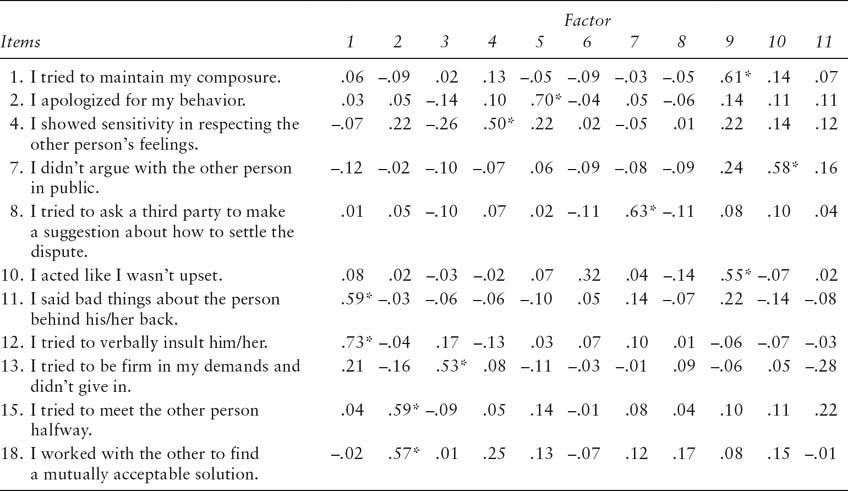
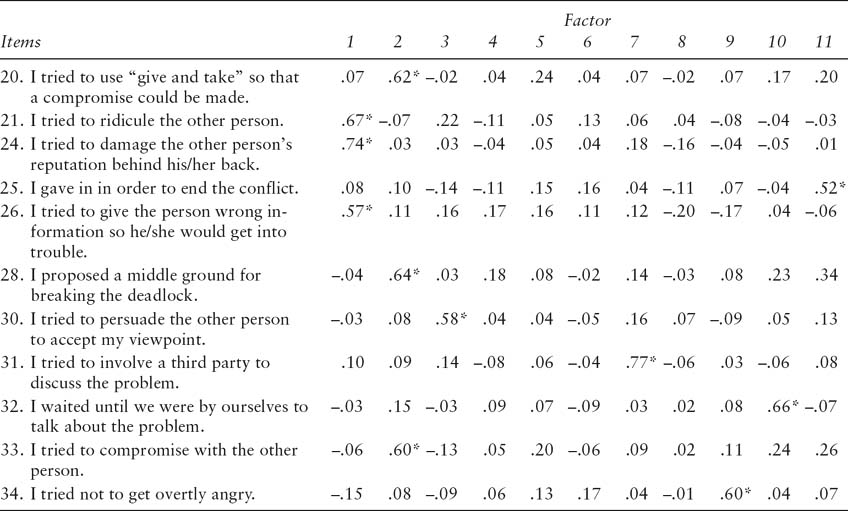
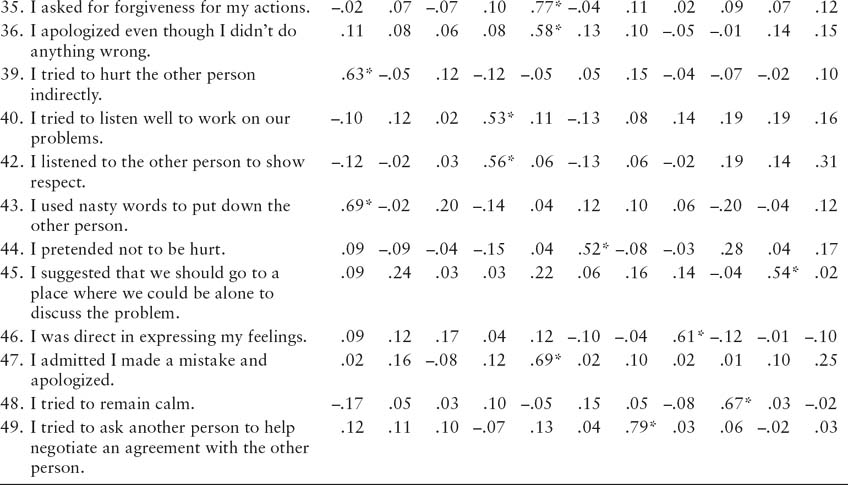
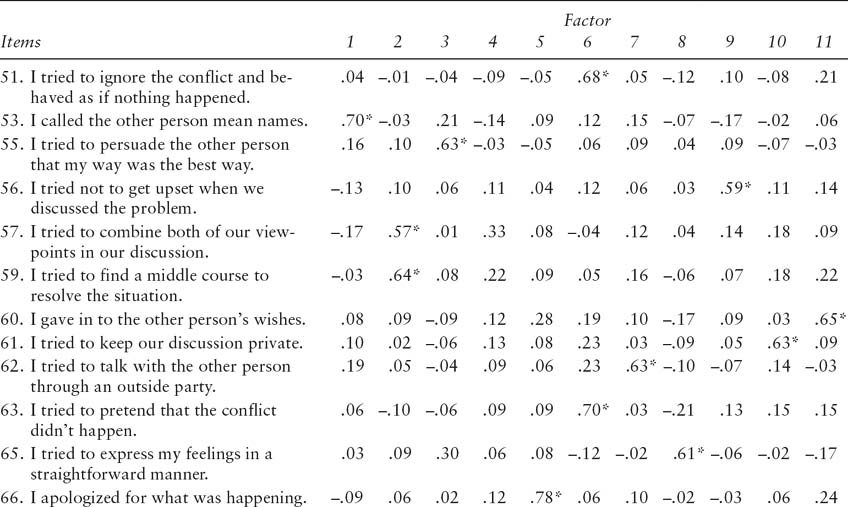
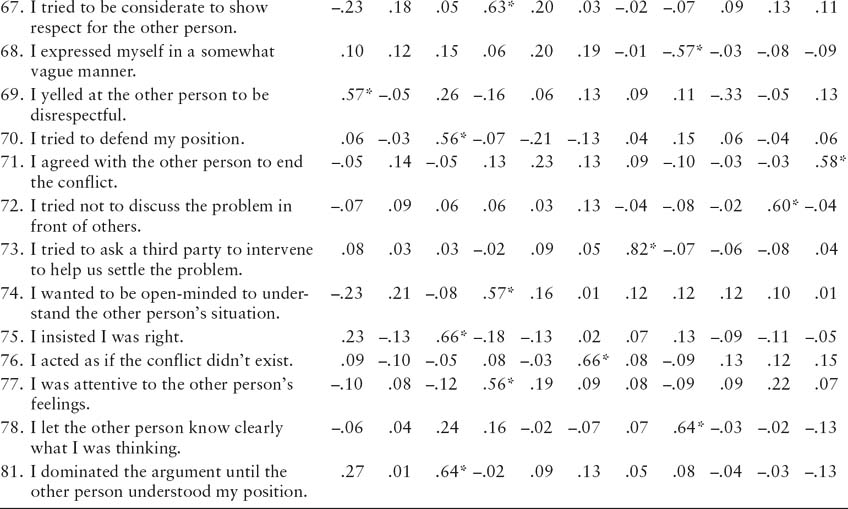
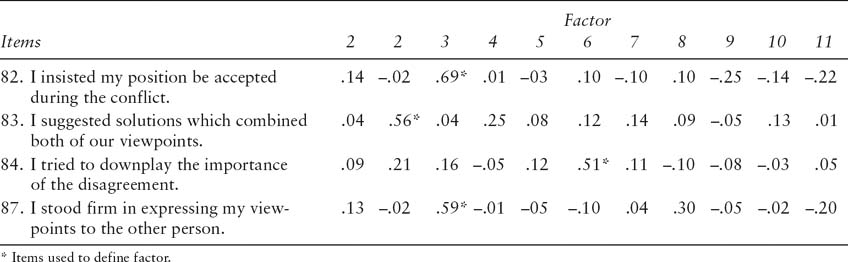
The second factor analysis was for facework behaviors. Eleven factors accounting for 46.38% of the variance were discovered. Table A.2 at the end of this appendix displays the factor loadings for the specific items. The first factor consisted of nine items, accounted for 5.64% of the variance, and had an eigenvalue of 11.67. The items measure the degree to which a person tries to insult, hurt, or ridicule another person. The factor was labeled aggression (α = .89). The second factor consisted of eight items, accounted for 5.38% of the variance, and had an eigenvalue of 8.21. The items focus on behaviors that attempt to resolve a conflict through compromising or integrating viewpoints. The factor was labeled problem-solve (α = .89). The third factor consisted of eight items, accounted for 4.71% of the variance, and had an eigenvalue of 7.37. These items focus on “standing one's ground” and trying to persuade the other person to change his or her mind. Defend was the label for this factor (α = .82).
The fourth factor had six items, accounted for 4.50% of the variance, and had an eigenvalue of 3.35. The items measure the degree of sensitivity, attentiveness, and listening shown toward the other person. We labeled this factor respect (α = .79). The fifth factor was composed of five items, accounted for 4.32% of the variance, and had an eigenvalue of 2.48. The items focus on apologizing for behavior during the conflict, and thus we labeled it apologize (? = .82). The sixth factor consisted of five items, accounted for 3.98% of the variance, and had an eigenvalue of 2.15. The items focus on the downplaying the conflict and acting as if the conflict does not exist. The label for this factor is pretend (α = .75).
The seventh factor had five items, accounted for 3.96% of the variance, and had an eigenvalue of 1.89. The items emphasize the desire to have another person intervene in the conflict. Hence, we labeled it third party (α = .81). The eighth factor consisted of four items, accounted for 3.73% of the variance, and had an eigenvalue of 1.76. The items measure the amount of direct expression of feelings during the conflict. The factor was labeled express (α = .70). The ninth factor consisted of five items, accounted for 3.53% of the variance, and had an eigenvalue of 1.56. The items focus on trying to maintain composure during conflict and not getting angry. We labeled this factor remain calm (α = .68).
The tenth factor had five items, accounted for 3.32% of the variance, and had an eigenvalue of 1.46. The items emphasize the desire to avoid an argument in public. We labeled the factor private discussion (α = .64). The eleventh factor consisted of three items, accounted for 3.29% of the variance, and had an eigenvalue of 1.38. The items measure accommodating or giving in during the conflict. The factor was labeled give in (α = .69).
The results of the panculture factor analysis demonstrate that face concerns and facework behaviors can be measured consistently across the four cultures of study. The items for face concerns measure three distinct factors: self-, other-, and mutual-face. These are consistent with expectations of prior theoretical research (Ting-Toomey & Kurogi, 1998). Each of these measures, furthermore, had good reliabilities for each of the four cultures of study. Thus, this instrument is useful for researchers and facilitators interested in measuring the level of face concerns. The items for facework behaviors measure 11 distinct factors. This discovery is important because it demonstrates a wide variety of behaviors that were used to manage face during conflict. Most prior research has examined a limited range of facework behavior. The majority of the facework dimensions had good reliabilities. However, more collaborative research effort on a global level is needed to test the cross-cultural validity of the facework measurements. Future researchers may want to test these newly developed facework measures in a diverse range of problematic facework situations, and within a diverse range of ethnic communities and cultures.
Table A.1 Pancultural Factor Loadings for Face Concerns
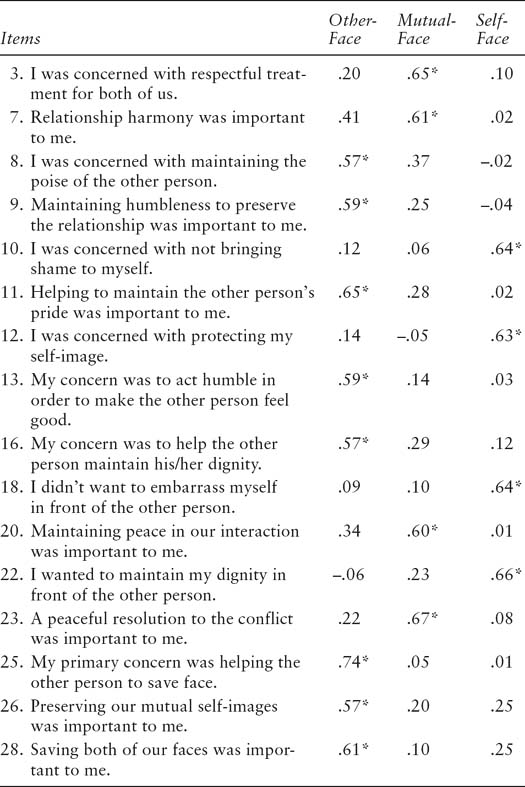
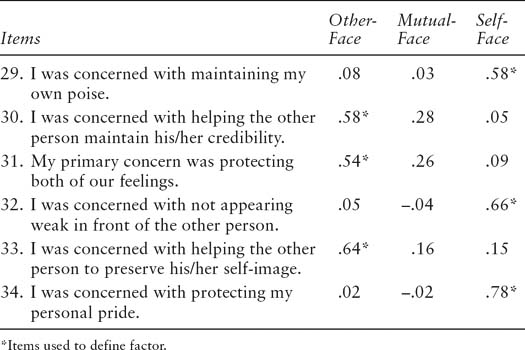
Table A.2 Pancultural Factor Loadings for Facework Behaviors
- Loading...
Get a 30 day FREE TRIAL
-
 Watch videos from a variety of sources bringing classroom topics to life
 -
Read modern, diverse business cases
-
Explore hundreds of books and reference titles
Read next

More like this
Sage Recommends
We found other relevant content for you on other Sage platforms.
Have you created a personal profile? Login or create a profile so that you can save clips, playlists and searches